Quantitative Chemical Profiling of Botanical Parts: Methods, Applications, and Challenges in Drug Discovery
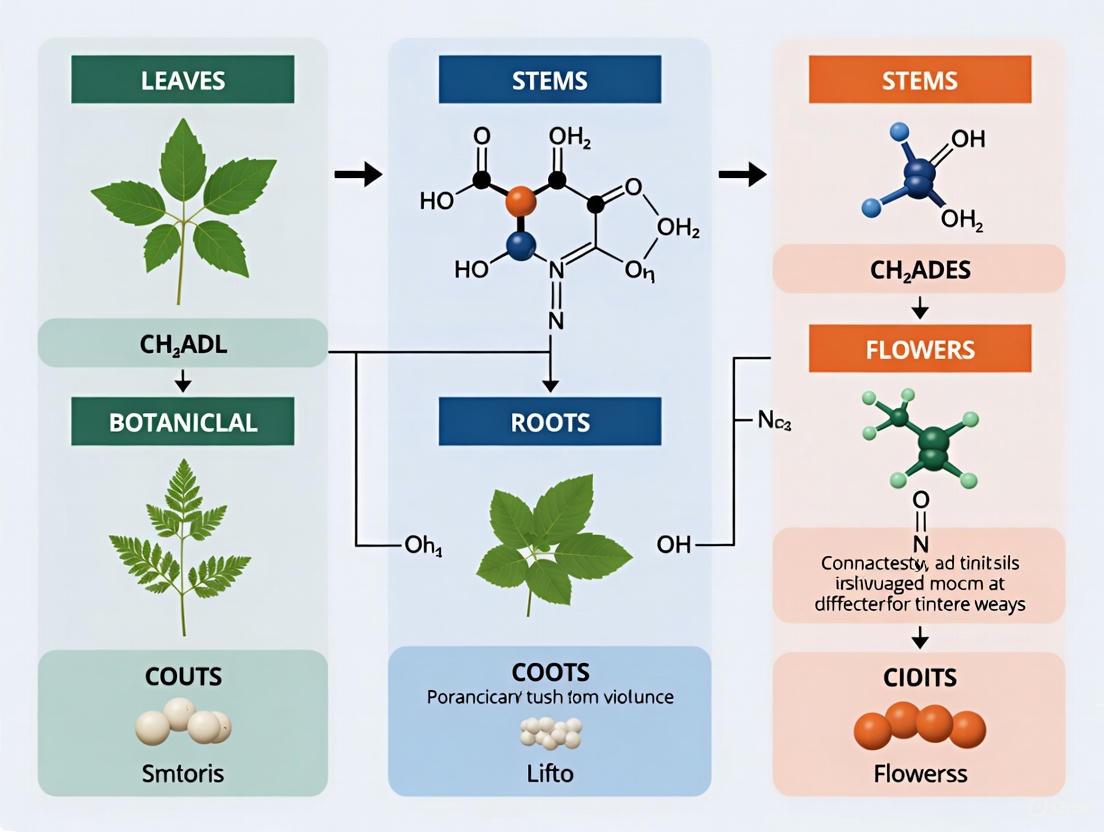
This article provides a comprehensive examination of quantitative chemical profiling techniques for comparing different botanical parts, a critical approach in medicinal plant research and natural product drug discovery.
Quantitative Chemical Profiling of Botanical Parts: Methods, Applications, and Challenges in Drug Discovery
Abstract
This article provides a comprehensive examination of quantitative chemical profiling techniques for comparing different botanical parts, a critical approach in medicinal plant research and natural product drug discovery. It explores the foundational principles explaining why distinct plant organs possess unique chemical signatures and therapeutic potentials. The content details advanced methodological frameworks incorporating metabolomics, LC-MS/MS, GC-MS, and multivariate analysis for precise component analysis. Significant challenges including standardization complexities, source variability, and reproducibility issues are addressed alongside practical optimization strategies. The article further demonstrates validation protocols and comparative analysis case studies that inform evidence-based selection of botanical materials for pharmaceutical development, providing researchers and drug development professionals with a systematic framework for advancing plant-based therapeutics.
Why Botanical Parts Differ: Chemical Diversity and Therapeutic Implications
The quantitative comparison of chemical profiles across different botanical parts—roots, leaves, stems, and flowers—represents a fundamental research domain in phytochemistry and natural product drug discovery. Plants exhibit sophisticated organ-specific chemical partitioning where specialized metabolites are synthesized and accumulated in particular tissues according to their biological roles in defense, reproduction, and physiological regulation [1]. Understanding these spatial distributions is crucial for optimizing the collection, extraction, and utilization of bioactive compounds, ensuring the highest quality and efficacy for pharmaceutical applications. This Application Note provides established protocols and analytical workflows for the comprehensive metabolite profiling of distinct plant organs, framed within the context of rigorous comparative phytochemical research.
Foundational Principles of Plant Chemical Partitioning
The non-uniform distribution of specialized metabolites in plants is a result of evolutionary adaptation. The biosynthetic pathways of these compounds diverge from primary metabolism, leading to diverse structures with specific biological activities essential for plant survival and ecological interactions [1]. Different plant organs often specialize in the production and storage of particular compound classes:
- Leaves are frequently rich in photosynthesis-related compounds like chlorophylls and certain alkaloids, as well as defense compounds against herbivores and pathogens [2].
- Roots often accumulate defensive compounds against soil pathogens and may contain unique secondary metabolites not found in aerial parts [3].
- Stems may serve as transport channels and can contain unique biomarkers; for example, procyanidin dimers have been found exclusively in the stems and roots of Vaccinium angustifolium [3].
- Flowers and Fruits typically produce pigments and volatile compounds to attract pollinators, often rich in specific flavonoids and terpenoids [3].
This compartmentalization means that the medicinal or biological activity of a plant can depend heavily on the organ selected for extraction.
Analytical Techniques for Comparative Profiling
A multi-technique approach is essential for comprehensive coverage of the diverse chemical space present in different plant organs. The techniques below are complementary and together provide a robust framework for quantitative comparison.
Chromatographic Techniques
High-Performance Liquid Chromatography (HPLC) with Mass Spectrometry (MS)
- Protocol Principle: Reversed-phase HPLC separates semi-polar to polar compounds from crude plant extracts, coupled with MS for detection, identification, and quantification.
- Detailed Workflow:
- Sample Preparation: Dry plant material (e.g., leaf, stem, root, fruit) and grind to a fine powder. Extract ~100 mg of each powdered organ with 1 mL of a suitable solvent (e.g., 95% ethanol, aqueous methanol, chloroform) via sonication for 30 minutes. Centrifuge and filter the supernatant (0.22 µm filter) prior to injection [3].
- HPLC-MS Analysis:
- Column: C18 reversed-phase column (e.g., 250 x 4.6 mm, 5 µm).
- Mobile Phase: Gradient of water (with 0.1% formic acid) and acetonitrile/methanol.
- Detection: Photodiode Array (PAD) Detector (e.g., 190-600 nm) and Mass Spectrometer with an Atmospheric Pressure Chemical Ionization (APCI) or Electrospray Ionization (ESI) source [3].
- Data Analysis: Identify compounds by comparing retention times, UV-Vis spectra, and mass spectra with authentic standards. For quantification, use calibration curves of standards (e.g., chlorogenic acid, catechin) analyzed under identical conditions [3].
High-Performance Thin-Layer Chromatography (HPTLC)
- Protocol Principle: A planar chromatography technique ideal for fingerprinting and rapid comparison of multiple samples side-by-side.
- Detailed Workflow:
- Application: Apply alcoholic extracts of different plant organs as bands on an HPTLC silica gel plate.
- Development: Develop the plate in a saturated twin-trough chamber with a suitable mobile phase (e.g., toluene-ethyl acetate-formic acid mixtures for phenolic compounds).
- Derivatization and Imaging: Derivatize with specific reagents (e.g., Natural Product reagent for flavonoids) and document under UV (254 nm and 366 nm) and white light [4]. HPTLC-image analysis allows tracking of chemical markers specific to certain organs.
Gas Chromatography-Mass Spectrometry (GC-MS)
- Protocol Principle: Ideal for profiling volatile and semi-volatile compounds, including essential oils, fatty acids, and terpenoids.
- Detailed Workflow:
- Extraction: Hydrodistillation (e.g., Clevenger apparatus) or steam distillation can be used to obtain volatile oils from each plant organ [5].
- Analysis:
- Column: Non-polar or mid-polar capillary GC column (e.g., TG-5MS, 30 m x 0.25 mm i.d., 0.25 µm film thickness).
- Temperature Program: Ramp from 50°C to 280°C at 3-5°C/min.
- Detection: Electron Impact (EI) mass spectrometer at 70 eV [4].
- Identification: Identify compounds by comparing mass spectra with commercial libraries (NIST, Wiley) and by comparing calculated Kovats retention indices with literature values [4].
Spectroscopic Techniques
Nuclear Magnetic Resonance (NMR) Spectroscopy
- Protocol Principle: A non-destructive technique that provides simultaneous identification and absolute quantification of metabolites without the need for chromatographic separation.
- Detailed Workflow:
- Extraction: Extract ~20-50 mg of lyophilized plant powder from each organ with 1 mL of deuterated solvent (e.g., D₂O, CD₃OD, or D₂O:CD₃OD mixtures). Buffer the solution (e.g., 0.2 M phosphate buffer, pD 7.4) to minimize chemical shift variation. Centrifuge and transfer the supernatant to an NMR tube [1].
- Data Acquisition:
- Acquire ¹H NMR spectra at 25°C on a spectrometer (e.g., 500 MHz or 600 MHz).
- Use standard 1D pulse sequences like the 1D NOESY-presat sequence for water suppression.
- Key parameters: Spectral width of 12-14 ppm, relaxation delay (D1) of 4-5 seconds, and 64-128 transients [1].
- Data Analysis: Identify metabolites using public (HMDB, MMCD) and commercial databases. For quantification, integrate a well-resolved signal from each compound and calculate concentration using an internal standard (e.g., TSP, DSS) of known concentration [1].
Near-Infrared (NIR) Spectroscopy
- Protocol Principle: A rapid, non-destructive technique coupled with multivariate analysis for classification and authentication of plant organ powders.
- Detailed Workflow:
- Sample Presentation: Fill a quartz cup with the powdered plant organ. Ensure consistent packing and surface uniformity.
- Spectral Acquisition: Acquire NIR spectra in reflectance mode over the wavelength range of 800-2500 nm. Average multiple scans (e.g., 32-64) per sample to improve the signal-to-noise ratio [4].
- Chemometric Analysis: Use multivariate analysis (e.g., Principal Component Analysis - PCA) for classification and discrimination. Employ Partial Least Squares (PLS) regression for quantitative prediction of specific compounds or for detecting adulteration [4].
Direct Analysis in Real Time Mass Spectrometry (DART-MS)
- Protocol Principle: An ambient ionization technique that allows rapid, direct profiling of natural products from solid plant samples with minimal preparation.
- Detailed Workflow:
- Sample Presentation: Analyze different forms of plant organs: intact leaf/stem, dewaxed organ (soaked in solvent to remove wax), or organ imprints (pressed onto a solid surface) [2].
- Analysis: Place the sample directly in the gap between the DART ion source and the mass spectrometer inlet. The excited helium gas stream desorbs and ionizes analytes from the sample surface.
- Detection: Use a high-resolution mass spectrometer for accurate mass measurement. Characteristic mass profiles can be obtained within tens of seconds [2].
Quantitative Data and Comparative Analysis
The following tables synthesize representative quantitative data from published studies to illustrate the extent of chemical partitioning across botanical parts.
Table 1: Quantitative Distribution of Key Phenolics in Different Organs of Lowbush Blueberry (Vaccinium angustifolium) [3]
| Plant Organ | Chlorogenic Acid (µg/mg extract) | Total Quercetin Glycosides | (+)-Catechin / (-)-Epicatechin | Procyanidin Dimers |
|---|---|---|---|---|
| Leaf | ~100.0 | High | Present | Absent |
| Stem | Low | Present | Present | Present (Exclusive) |
| Root | Absent | Absent | Present | Present (Exclusive) |
| Fruit | Low | High | Present | Absent |
Table 2: Major Volatile Components (%) in Aerial Parts of Four Artemisia Species [4]
| Artemisia Species | Major Compound 1 | Major Compound 2 | Major Compound 3 | Major Compound 4 |
|---|---|---|---|---|
| A. annua | Camphor (26.45%) | β-Caryophyllene (17.75%) | Germacrene D (9.81%) | trans-β-Farnesene (5.72%) |
| A. herba-alba | Camphene (9.03%) | cis-Pinocarveol (22.6%) | trans-Chrysanthenyl Acetate (13.88%) | cis-Chrysanthenyl Acetate (9.35%) |
| A. monosperma | α-Pinene (9.39%) | β-Pinene (13.95%) | α-Terpinolene (13.61%) | (-)-Spathulenol (11.71%) |
| A. judaica | Camphor (23.19%) | Piperitone | trans-Ethyl Cinnamate | - |
Table 3: Percentage Composition of Selected Bioactive Compounds in Bombax ceiba Organs [6]
| Plant Organ | Saponins (%) | Flavonoids (%) | Alkaloids (%) | Steroids (%) |
|---|---|---|---|---|
| Leaf | 5.04 | 3.10 | Present | 0.18 |
| Stem Bark | - | - | 1.52 | - |
| Root | 1.04 - 1.37 | - | - | - |
Visualizing the Workflow: From Plant to Profile
The following diagram outlines a standardized, multi-technique workflow for the comparative phytochemical analysis of different plant organs.
The Scientist's Toolkit: Essential Reagents and Materials
Table 4: Essential Research Reagent Solutions for Plant Metabolite Profiling
| Item | Function / Application |
|---|---|
| Deuterated Solvents (e.g., CD₃OD, D₂O) | Essential for NMR spectroscopy to provide a locking signal and avoid overwhelming solvent proton signals [1]. |
| HPLC-MS Grade Solvents (e.g., MeOH, ACN, Water) | Ensure high-purity mobile phases to prevent background noise and ion suppression in LC-MS and HPLC analyses [3]. |
| Reference Standards (e.g., Chlorogenic Acid, Catechin, Camphor) | Critical for accurate identification and quantification of metabolites by matching retention time and spectral data [4] [3]. |
| Derivatization Reagents (e.g., MSTFA for GC-MS) | Enhance volatility and thermal stability of non-volatile compounds for GC-MS analysis. |
| HPTLC Plates (e.g., Silica Gel 60 F₂₅₄) | The solid phase for high-performance thin-layer chromatography, enabling parallel analysis of multiple samples [4]. |
| Chemometric Software (e.g., SIMCA, Unscrambler) | For multivariate data analysis of complex datasets from NIR, NMR, or LC-MS to classify samples and identify biomarkers [4] [1]. |
Secondary metabolites are organic compounds not directly involved in the normal growth, development, or reproduction of plants, but are essential for their defense, survival, and ecological interactions. These compounds represent a vast reservoir of chemical diversity and serve as the foundation for numerous pharmaceuticals, nutraceuticals, and agrochemicals. Among the thousands of secondary metabolites, four major classes—alkaloids, flavonoids, terpenoids, and phenolics—have garnered significant research and industrial interest due to their broad spectrum of biological activities and therapeutic potential. The distribution of these compounds varies significantly across different plant organs, influenced by genetic, developmental, and environmental factors. Understanding these tissue-specific accumulation patterns is crucial for rational resource utilization, quality control of herbal medicines, and optimizing extraction processes for industrial applications. This application note provides a comprehensive overview of the distribution profiles, analytical methodologies, and biosynthetic pathways of these key metabolite classes across various plant organs, with emphasis on quantitative comparisons and practical protocols for researchers in phytochemistry and drug development.
Quantitative Distribution Across Plant Organs
Tissue-Specific Accumulation Patterns
Table 1: Distribution of Major Secondary Metabolite Classes in Different Plant Organs
| Plant Organ | Alkaloids | Flavonoids | Terpenoids | Phenolics | Representative Plant Species |
|---|---|---|---|---|---|
| Leaves | High (BIAs: nuciferine, norcoclaurine) | High (flavone C-glycosides, flavonols) | Moderate (mono/sesquiterpenes) | High (hydroxycinnamic acids) | Lotus (Nelumbo nucifera), Moringa (Moringa oleifera), Basil (Ocimum tenuiflorum) |
| Flowers | Low to moderate | Very high (anthocyanins, flavonols) | High (volatile terpenes) | High (various polyphenols) | Daylily (Hemerocallis), Lotus (Nelumbo nucifera) |
| Rhizomes/Roots | Moderate (isoquinoline alkaloids) | Moderate | High (diterpenes, triterpenes) | Moderate | Turmeric (Curcuma longa), Ginseng (Panax ginseng) |
| Seeds | Low to moderate | Low to moderate | Variable | Moderate | Lotus (Nelumbo nucifera), Sea Buckthorn (Hippophae rhamnoides) |
| Fruits | Low | High (flavanones, anthocyanins) | High (carotenoids) | High | Various fruits |
| Bark | High (quinoline alkaloids) | Moderate | High (triterpenoids) | Very high (tannins) | Cinchona (Cinchona officinalis) |
Table 2: Quantitative Distribution of Specific Metabolites in Lotus (Nelumbo nucifera) Tissues [7]
| Lotus Tissue | Total Alkaloids | Total Flavonoids | Key Specific Metabolites | Relative Abundance |
|---|---|---|---|---|
| Mature Leaves (ML) | Very High | High | Nuciferine, Anonaine, Asimilobine | Highest for most BIAs |
| Tender Leaves (TL) | High | Moderate | Norcoclaurine, Nornuciferine | High for early-stage BIAs |
| Leaf Plumules (LP) | High | High | Armepavine, Liensinine | High for bisbenzylisoquinoline alkaloids |
| Flowers (LF) | Low | Very High | Rutin, Flavonoid C-glycosides | Highest for most flavonoids |
Key Findings from Distribution Studies
Systematic tissue-specific metabolite profiling in lotus cultivars revealed distinct accumulation patterns for benzylisoquinoline alkaloids (BIAs) and flavonoids [7]. Alkaloids primarily accumulate in leaves and plumules, with mature leaves showing the highest concentrations of nuciferine and asimilobine, while tender leaves contain higher levels of early-stage BIA precursors like norcoclaurine. Flavonoids demonstrate highest accumulation in flowers and leaves, with flowers particularly rich in flavonoid C-glycosides. In daylily (Hemerocallis), flavonoid distribution varies significantly across floral parts, with petals containing higher anthocyanin content (particularly cyanidin 3,5-glucoside and cyanidin 3-rutinoside) compared to sepals, resulting in flower petal coloration [8]. Comparative analysis of Moringa oleifera and Ocimum tenuiflorum showed higher phenolic and flavonoid content in Moringa leaf and flower, with significant variation between species and tissues [9].
Experimental Protocols for Metabolite Analysis
Sample Preparation and Extraction
Protocol 1: Comprehensive Extraction of Plant Metabolites
Sample Collection and Preparation: Collect plant organs and immediately freeze in liquid nitrogen to prevent metabolite degradation. Lyophilize samples using freeze-drying for optimal preservation of thermolabile compounds. Grind to a fine powder (particle size <0.5mm) using a laboratory mill to increase surface area for extraction [10].
Defatting (for lipid-rich tissues): For seeds or lipid-rich tissues, pre-extract with hexane (solvent-to-sample ratio 10:1 v/w) at room temperature for 24 hours to remove interfering lipids [10].
Primary Extraction:
- Weigh 0.1-0.5g of dried plant powder
- Add extraction solvent (typically methanol/water/formic acid/TFA, 70:27:2:1, v/v/v/v) at a solvent-to-sample ratio of 10:1 to 20:1 (v/w)
- Homogenize using a tissue homogenizer or ultrasonic bath for 15-30 minutes
- Centrifuge at 12,000-15,000 × g for 15-20 minutes at 4°C
- Collect supernatant and repeat extraction twice [8]
Fractionation (for targeted metabolite classes):
- Free Phenolics: Extract directly with 70% ethanol at room temperature, acidify to pH 2-3 with HCl, and partition with ethyl acetate [10]
- Bound Phenolics: After free phenolic extraction, hydrolyze residue with 1M NaOH containing 0.5% NaBH₄ under N₂ gas for 4 hours to liberate esterified phenolics [10]
- Alkaloid-Enriched Fraction: Basify aqueous extract to pH 9-10 with NH₄OH and partition with chloroform or dichloromethane [7]
Analytical Techniques for Identification and Quantification
Protocol 2: UPLC-ESI-Q-TOF-HRMSⁿ for Comprehensive Metabolite Profiling [7]
Instrument Parameters:
- Column: Reverse-phase C18 column (e.g., 2.1 × 100 mm, 1.7 μm)
- Mobile Phase: A) 0.1% formic acid in water; B) 0.1% formic acid in acetonitrile
- Gradient: 5-95% B over 25-40 minutes, depending on metabolite complexity
- Flow Rate: 0.3-0.4 mL/min
- Column Temperature: 35-40°C
- Injection Volume: 2-10 μL
Mass Spectrometry Conditions:
- Ionization: Electrospray ionization (ESI) in positive and negative modes
- Capillary Voltage: 3.0-3.5 kV
- Source Temperature: 120-150°C
- Desolvation Temperature: 350-500°C
- Cone Gas Flow: 50-100 L/h
- Desolvation Gas Flow: 600-800 L/h
- Mass Range: m/z 50-1500
- Collision Energies: 10-40 eV for MSⁿ fragmentation
Data Processing:
- Use untargeted metabolomics software (e.g., Progenesis QI, XCMS, MarkerLynx)
- Perform peak picking, alignment, and normalization
- Identify compounds using accurate mass (<5 ppm error) and MS/MS fragmentation patterns
- Compare against commercial and in-house spectral databases
Protocol 3: HPLC-DAD for Targeted Flavonoid and Anthocyanin Analysis [8]
Chromatographic Conditions:
- Column: C18 column (4.6 × 250 mm, 5 μm)
- Mobile Phase: A) 2% aqueous formic acid; B) acetonitrile
- Gradient: 0 min, 8% B; 3 min, 8% B; 23 min, 20% B; 33 min, 40% B; 43 min, 40% B; 45 min, 8% B
- Flow Rate: 0.8 mL/min
- Temperature: 35°C
- Detection: 350 nm for flavonoids, 520 nm for anthocyanins
- Injection Volume: 10 μL
Quantification:
- Prepare standard curves using authentic reference compounds
- Use external calibration with 5-7 concentration points
- Validate method for linearity (R² > 0.99), precision, and accuracy
Protocol 4: Colorimetric Screening for Alkaloids [11]
- Tablet-Based Screening Method:
- Prepare testing tablets containing mercuric chloride, potassium iodide, picric acid, or iodine
- Add sample extract to tablet in microplate well or test tube
- Observe color development (cream to light yellowish precipitates indicate alkaloids)
- Compare against positive controls (e.g., caffeine, amodiaquine)
Biosynthetic Pathways and Metabolic Networks
Terpenoid Biosynthesis Pathways
Terpenoid biosynthesis occurs via two distinct pathways: the mevalonate (MVA) pathway in the cytosol and endoplasmic reticulum, and the methylerythritol phosphate (MEP) pathway in plastids [12] [13]. The MVA pathway utilizes three acetyl-CoA molecules to produce isopentenyl diphosphate (IPP), with hydroxymethylglutaryl-CoA reductase (HMGR) catalyzing the rate-limiting step. The MEP pathway starts with pyruvate and glyceraldehyde-3-phosphate (GAP) to produce IPP and dimethylallyl diphosphate (DMAPP), with 1-deoxy-D-xylulose-5-phosphate synthase (DXS) as a key regulatory enzyme. IPP and DMAPP serve as universal five-carbon precursors for all terpenoid classes, with various terpene synthases (TPS) and cytochrome P450 oxygenases (CYP450s) generating structural diversity.
Figure 1: Terpenoid Biosynthesis via MVA and MEP Pathways
Flavonoid and Alkaloid Biosynthesis
Flavonoids are synthesized through the phenylpropanoid pathway, beginning with the aromatic amino acids phenylalanine and tyrosine. The key intermediate naringenin chalcone serves as the precursor for all flavonoid subclasses, including flavones, flavonols, anthocyanins, and isoflavonoids, with various glycosyltransferases, methyltransferases, and acyltransferases contributing to structural diversity [10] [14]. Alkaloids originate from diverse biosynthetic pathways depending on their structural class: benzylisoquinoline alkaloids (BIAs) derive from tyrosine, tropane alkaloids from ornithine/arginine, and indole alkaloids from tryptophan. The extensive structural variation arises from complex cyclization, rearrangement, and decoration reactions.
Experimental Workflow for Tissue-Specific Metabolite Analysis
Figure 2: Experimental Workflow for Metabolite Analysis
Research Reagent Solutions
Table 3: Essential Reagents and Materials for Secondary Metabolite Analysis
| Reagent/Material | Application | Function | Examples/Specifications |
|---|---|---|---|
| UPLC-ESI-Q-TOF-HRMSⁿ | Untargeted metabolomics | High-resolution separation and identification of diverse metabolites | Waters, Thermo Fisher systems; C18 columns (1.7-2.1 μm particle size) |
| HPLC-PDA-MS | Targeted analysis of specific metabolite classes | Quantitative analysis with UV-Vis and mass detection | C18 columns (4.6 × 250 mm, 5 μm); compatible with various detection systems |
| Alkaloid Standards | Quantification and identification | Reference compounds for calibration and confirmation | Nuciferine, norcoclaurine, asimilobine, caffeine (purity >95%) |
| Flavonoid Standards | Quantification and identification | Reference compounds for calibration and confirmation | Rutin, quercetin, cyanidin glycosides, apigenin (purity >95%) |
| Extraction Solvents | Metabolite extraction | Selective extraction of different metabolite classes | HPLC-grade methanol, ethanol, acetonitrile, ethyl acetate with 0.1-1% acid modifiers |
| Chemical Derivatization Reagents | Enhanced detection | Improve volatility (GC-MS) or detection sensitivity | MSTFA (for GC-MS), dansyl chloride (for amine-containing compounds) |
| Colorimetric Test Tablets | Rapid alkaloid screening | Preliminary qualitative assessment | Tablets containing mercuric chloride, potassium iodide, picric acid [11] |
| Solid Phase Extraction (SPE) | Sample clean-up | Remove interfering compounds, fractionate samples | C18, ion-exchange, mixed-mode cartridges |
The tissue-specific distribution of secondary metabolites in plants reveals complex biosynthetic regulation and ecological adaptations. As demonstrated across multiple plant species, alkaloids predominantly accumulate in leaves and reproductive tissues, flavonoids show highest concentrations in flowers, terpenoids distribute variably across organs with volatile forms in aerial parts, and phenolics are ubiquitous with highest levels in structural tissues. Understanding these distribution patterns enables rational utilization of plant resources—optimizing harvest times, selecting appropriate plant organs for specific applications, and minimizing agricultural waste. The integrated application of modern analytical techniques, from rapid colorimetric screening to sophisticated UPLC-HRMSⁿ profiling, provides comprehensive tools for qualitative and quantitative assessment of these valuable compounds. Future research directions should focus on elucidating the molecular mechanisms governing tissue-specific accumulation, developing standardized analytical protocols for cross-study comparisons, and applying this knowledge to sustainable bioproduction through metabolic engineering and optimized cultivation practices.
Panax notoginseng (Burk.) F.H. Chen, commonly known as Sanqi or Tianqi, is a highly valuable traditional Chinese medicine with renowned pharmacological effects on the cardiovascular and cerebrovascular systems [15]. The therapeutic efficacy of P. notoginseng is primarily attributed to triterpene saponins, which are classified into two major groups based on the skeleton of their aglycones: protopanaxadiol (PPD)-type and protopanaxatriol (PPT)-type saponins [16]. The distribution of these saponins varies significantly across different botanical parts of the plant, influencing the medicinal properties and appropriate applications of each part [15] [16]. This application note presents a comprehensive quantitative comparison of PPD- and PPT-type saponins in different tissues of P. notoginseng, providing detailed analytical protocols and data interpretation frameworks for researchers and drug development professionals engaged in the chemical profiling of medicinal plants.
Quantitative Distribution of Saponins in Different Botanical Parts
Comparative Saponin Profiles
The differential accumulation of PPD- and PPT-type saponins across various tissues of P. notoginseng has been systematically quantified using advanced chromatographic techniques. The root and rhizome tissues predominantly accumulate PPT-type saponins, while aerial parts, particularly leaves and flowers, show higher abundance of specific PPD-type saponins [16].
Table 1: Quantitative Distribution of Major Saponins in Different Tissues of P. notoginseng (mg/g)
| Saponin | Saponin Type | Root | Rhizome | Leaf | Flower | Stem |
|---|---|---|---|---|---|---|
| Notoginsenoside R1 (R1) | PPT | 4.32 | 6.16 | 0.89 | 1.12 | 0.76 |
| Ginsenoside Rg1 (Rg1) | PPT | 24.67 | 48.42 | 5.43 | 7.85 | 4.12 |
| Ginsenoside Re (Re) | PPT | 1.45 | 2.80 | 0.67 | 0.98 | 0.54 |
| Ginsenoside Rb1 (Rb1) | PPD | 22.85 | 28.13 | 8.76 | 12.45 | 6.32 |
| Ginsenoside Rc (Rc) | PPD | ND | ND | 27.99 | 15.67 | 18.76 |
| Ginsenoside Rb2 (Rb2) | PPD | ND | ND | 18.54 | 29.45 | 12.31 |
| Ginsenoside Rd (Rd) | PPD | 5.87 | 7.73 | 3.21 | 4.56 | 2.67 |
| Total PPT Saponins | PPT | 30.44 | 57.38 | 6.99 | 9.95 | 5.42 |
| Total PPD Saponins | PPD | 28.72 | 35.86 | 58.50 | 62.13 | 40.06 |
| Total Saponins | Mixed | 59.16 | 93.24 | 65.49 | 72.08 | 45.48 |
ND: Not Detected; Data compiled from [16]
Tissue-Specific Saponin Accumulation Patterns
The quantitative analysis reveals distinct tissue-specific patterns in saponin distribution:
- Below-ground tissues (roots and rhizomes): Contain higher levels of PPT-type saponins (R1, Rg1, Re) and specific PPD-type saponins (Rb1, Rd), with the rhizome showing the highest overall saponin content (93.24 mg/g) [16].
- Above-ground tissues (leaves and flowers): Characterized by the presence of specific PPD-type saponins (Rc, Rb2) that are undetectable in below-ground tissues, with flowers showing the highest PPD content (62.13 mg/g) [16].
- Stems: Exhibit an intermediate profile with moderate levels of both PPD and PPT-type saponins [16].
Table 2: Ratio of PPD-type to PPT-type Saponins in Different Tissues
| Plant Tissue | PPD:PPT Ratio | Dominant Saponin Type |
|---|---|---|
| Root | 0.94:1 | Balanced |
| Rhizome | 0.62:1 | PPT-type |
| Leaf | 8.36:1 | PPD-type |
| Flower | 6.24:1 | PPD-type |
| Stem | 7.39:1 | PPD-type |
Experimental Protocols
Sample Preparation Protocol
Materials:
- P. notoginseng tissues (root, rhizome, leaf, flower, stem)
- HPLC-grade methanol and acetonitrile
- Formic acid (analytical grade)
- Deionized water (Milli-Q system)
- 0.22 μm nylon membrane filters
Procedure:
- Drying and Grinding: Dry all plant tissues at 60°C to constant weight. Grind to fine powder using a laboratory mill and pass through a 0.45 mm sieve [15].
- Sample Weighing: Precisely weigh 20.0 mg of each powdered sample into a 20 mL volumetric flask [15].
- Extraction: Add 20 mL of methanol to each sample. Sonicate in an ultrasonic bath for 40 minutes at room temperature [15].
- Centrifugation: Centrifuge the extracts at 4000 × g for 10 minutes to separate particulate matter [15].
- Filtration: Filter the supernatant through 0.22 μm nylon membranes prior to LC-MS analysis [15].
- Storage: Store filtered extracts at 4°C until analysis (within 24 hours) [15].
Quality Control:
- Include procedural blanks (methanol without plant material)
- Prepare triplicate samples for each tissue type
- Use internal standards where quantitative precision is critical
UHPLC-MS/MS Analysis Protocol
Equipment and Reagents:
- UHPLC system (e.g., Agilent 1290) coupled to triple quadrupole mass spectrometer [15]
- UPLC BEH C18 column (2.1 × 100 mm, 1.7 μm) [15]
- HPLC-grade acetonitrile and formic acid
- Saponin standards (purity > 98%) for calibration curves
Chromatographic Conditions:
- Column Temperature: 25°C [15]
- Mobile Phase:
- Solvent A: 0.1% formic acid in water
- Solvent B: acetonitrile [15]
- Gradient Program:
| Time (min) | % Solvent B |
|---|---|
| 0 | 25 |
| 1 | 33 |
| 1-5 | 33 |
| 5-7 | 33-41 |
| 7-9 | 41 |
| 9-10 | 41-59 |
| 10-15 | 59 |
Mass Spectrometry Conditions:
- Ionization Mode: Negative electrospray ionization (ESI-) [15]
- Gas Temperature: 300°C [15]
- Gas Flow: 7 L/min [15]
- Nebulizer Pressure: 35 psi [15]
- Sheath Gas Temperature: 250°C [15]
- Sheath Gas Flow: 12 L/min [15]
- Capillary Voltage: 4000 V [15]
- Data Acquisition: Multiple Reaction Monitoring (MRM) mode [15]
Quantification Method:
- Prepare standard solutions of target saponins at concentrations ranging from 0.1-100 μg/mL
- Establish calibration curves for each saponin (R² > 0.995)
- Use MRM transitions optimized for each saponin
- Calculate saponin concentrations using peak areas relative to standard curves
Biosynthetic Pathway and Regulatory Mechanisms
The differential distribution of PPD and PPT-type saponins across tissues is regulated by tissue-specific expression of key genes in the triterpene saponin biosynthetic pathway. Transcriptomic analyses have identified critical cytochrome P450 (CYP) genes that control this tissue-specific allocation [16].
Figure 1: Biosynthetic Pathway of PPD and PPT-type Saponins in P. notoginseng Showing Key Regulatory Enzymes
Gene Expression Patterns
The tissue-specific distribution of saponins is directly correlated with differential expression of cytochrome P450 genes:
- CYP716A47: Highly expressed in aerial tissues (leaves, flowers), catalyzing the conversion of dammarenediol-II to PPD [16]. Expression levels are 31.5-fold higher in flowers compared to roots [16].
- CYP716A53v2: Predominantly expressed in below-ground tissues (roots, rhizomes), catalyzing the hydroxylation of PPD to PPT [16]. Expression levels are 20.1-fold higher in rhizomes compared to flowers [16].
Experimental Workflow for Comprehensive Saponin Analysis
The complete analytical workflow for quantifying and understanding saponin distribution in P. notoginseng involves multiple integrated steps from sample preparation to data interpretation.
Figure 2: Integrated Workflow for Saponin Distribution Analysis in P. notoginseng
Research Reagent Solutions
Table 3: Essential Research Reagents and Materials for P. notoginseng Saponin Analysis
| Reagent/Material | Specification | Application | Key Considerations |
|---|---|---|---|
| Saponin Standards | Ginsenosides Rg1, Rb1, Rd, Re, Rc, Rb2, R1 (purity >98%) | Quantitative calibration | Critical for accurate quantification; require proper storage at -20°C |
| Chromatography Column | UPLC BEH C18 (2.1 × 100 mm, 1.7 μm) | Chromatographic separation | Provides optimal resolution of structurally similar saponins |
| Mobile Phase Modifiers | 0.1% Formic acid in water | LC-MS analysis | Enhances ionization efficiency in negative ESI mode |
| Extraction Solvent | HPLC-grade methanol | Sample preparation | Efficient extraction of both PPD and PPT-type saponins |
| Filtration Membranes | 0.22 μm nylon filters | Sample cleanup | Removes particulate matter without saponin adsorption |
| Internal Standards | Stable isotope-labeled ginsenosides | Quantitation accuracy | Corrects for matrix effects and recovery variations |
Application in Broader Chemical Profiling Research
The methodologies and findings presented in this case study provide a framework for the quantitative comparison of chemical profiles across different botanical parts of medicinal plants, which aligns with the broader thesis context. The integrated approach combining:
- Comprehensive metabolite profiling using advanced UHPLC-MS/MS techniques
- Transcriptomic analysis to elucidate regulatory mechanisms
- Multivariate statistical methods for pattern recognition and marker identification
This multi-faceted strategy offers a robust template for similar studies on other medicinal plants where different botanical parts possess distinct phytochemical profiles and therapeutic applications. The tissue-specific saponin distribution in P. notoginseng underscores the importance of precise plant part selection and quality control in the development of herbal medicines and nutraceuticals [15] [16].
This application note provides a detailed comparative analysis of the chemical profiles of the overground and underground parts of Asarum heterotropoides (Xixin), a medicinally significant plant. Utilizing advanced chromatographic and mass spectrometric techniques, this study identifies and quantifies distinct variations in both volatile and non-volatile metabolites between different plant organs. The findings offer critical data and methodologies for researchers and drug development professionals engaged in the quality control, safety assessment, and rational medicinal application of botanicals, underscoring the importance of plant part selection in chemical profiling research.
Asarum heterotropoides Fr. Schmidt var. mandshuricum (Maxim.) Kitag. is a perennial herb endemic to China and a key source of the traditional medicine Asari Radix et Rhizoma (Xixin) [17]. Recognized for its anti-inflammatory, antibacterial, and analgesic properties, it is primarily used to treat colds, headaches, and nasal congestion [18]. Since the 2005 edition of the Chinese Pharmacopoeia, the official medicinal part has been restricted to the dried roots and rhizomes (underground parts), a shift from earlier editions that permitted the use of the whole plant [18] [19]. This transition necessitates a clear, scientific understanding of the chemical differences between the overground and underground parts to ensure efficacy and safety, particularly due to the presence of toxic aristolochic acid analogues [20]. This case study systematically investigates these compositional differences, providing a model for the quantitative comparison of chemical profiles across different botanical parts.
Comprehensive Chemical Profiling Data
This section quantifies the distinct chemical compositions found in the overground (aerial) and underground (roots and rhizomes) parts of A. heterotropoides.
Volatile Compound Distribution
Analysis via Solid-Phase Microextraction Gas Chromatography-Mass Spectrometry (SPME-GC-MS) reveals a rich and largely similar volatile profile between the two parts.
Table 1: Key Volatile Oil Components in A. heterotropoides Parts
| Compound Name | Chemical Category | Presence in Overground Part | Presence in Underground Part | Relative Abundance Notes |
|---|---|---|---|---|
| Methyleugenol | Phenylpropane | Yes [20] | Yes [21] [22] | Main component; higher in underground parts [21] |
| 3,5-Dimethoxytoluene | Toluene derivative | Yes [20] | Yes [21] [22] | Higher in A. heterotropoides vs A. sieboldii [21] |
| Safrole | Phenylpropane | Yes [20] | Yes [21] | Major component; higher in underground parts [21] |
| Myristicin | Phenylpropane | Information Missing | Yes [21] | Higher in A. sieboldii vs A. heterotropoides [21] |
| Eucarvone | Monoterpene | Information Missing | Yes [21] | Higher in A. heterotropoides vs A. sieboldii [21] |
| (1R)-(+)-α-Pinene | Monoterpene | Yes [20] | Information Missing | Identified via E-nose [20] |
| Eucalyptol | Monoterpene | Yes [20] | Information Missing | Identified via E-nose [20] |
| Estragole | Phenylpropane | Information Missing | Information Missing | Major component in other species [23] |
A comprehensive study identified 56 volatile compounds in total from A. heterotropoides, with 51 compounds found in the overground part and 55 compounds in the underground part, indicating a high degree of similarity with 89% shared components [18] [19].
Non-Volatile Compound Distribution
Analysis via Liquid Chromatography Orbitrap Mass Spectrometry (LC-Orbitrap-MS) reveals more pronounced differences in non-volatile components, which are critical for pharmacological activity and toxicity.
Table 2: Key Non-Volatile Components in A. heterotropoides Parts
| Compound Name/Class | Chemical Category | Presence in Overground Part | Presence in Underground Part | Notes on Activity / Role |
|---|---|---|---|---|
| Asarinin | Lignan | Yes [18] | Yes [18] [21] | Primary active; quality control marker (≥0.050% in CP) [18] |
| Aristolochic Acid D | Aristolochic Acid | Yes [20] | Information Missing | Toxic component [20] |
| Aristolactam I | Aristolochic Acid | Yes [20] | Information Missing | Toxic component [20] |
| Coumarins | Coumarin | Yes [20] | No [20] | Characteristic of overground part [20] |
| Flavonoids | Flavonoid | Yes [20] | No [20] | Characteristic of overground part [20] |
| Steroidal Compounds | Steroid | No [20] | Yes [20] | Characteristic of underground part [20] |
| Saccharides | Sugar | No [20] | Yes [20] | Characteristic of underground part [20] |
| Lignans | Lignan | Yes [20] | Yes [20] | Shared class; specific isomers may vary [18] |
| Organic Acids | Organic Acid | Yes [20] | Yes [20] | Shared class [20] |
LC-Orbitrap-MS analysis identified 308 non-volatile compounds in total, with 261 in the overground part and 282 in the underground part, sharing 76% commonality [18] [19]. Metabolomics screening pinpointed 14 non-volatile components as stable markers for distinguishing the two parts [19].
Detailed Experimental Protocols
To ensure reproducibility, this section outlines the core methodologies employed in the chemical profiling of A. heterotropoides.
Protocol 1: Volatile Profiling via SPME-GC-MS
Principle: Utilize SPME for non-destructive, headspace extraction of volatile organic compounds, followed by separation and identification using GC-MS [18].
Workflow Diagram: SPME-GC-MS Analysis
Procedure:
- Sample Preparation: Fresh or dried plant material (overground and underground parts separately) is homogenized without generating excessive dust. A representative sample (e.g., 1.0 g) is accurately weighed into a headspace vial [18] [22].
- Equilibration: The vial is sealed and transferred to a heating block. Incubate at a constant temperature (e.g., 60°C) for 10-15 minutes to allow the volatile compounds to equilibrate in the headspace.
- SPME Extraction: A conditioned SPME fiber (e.g., 50/30 μm DVB/CAR/PDMS) is exposed to the vial's headspace for a defined period (e.g., 30-40 minutes) while maintaining the incubation temperature to adsorb volatile compounds [18].
- GC-MS Injection and Analysis:
- The SPME fiber is retracted and immediately injected into the GC injector port, which is configured in splitless mode and set to a high temperature (e.g., 250°C) for thermal desorption [18] [23].
- Gas Chromatography: Separation is achieved using a non-polar or mid-polar capillary column (e.g., Rxi-5MS, 30 m × 0.25 mm i.d., 0.25 μm film thickness). The oven temperature program typically starts at 40°C, held for a few minutes, then ramped to 240°C at a rate of 5-10°C/min [23]. Helium is used as the carrier gas at a constant flow rate of 1 mL/min.
- Mass Spectrometry: The mass spectrometer operates in electron impact (EI) mode at 70 eV. The ion source temperature is set to ~230°C. Data are collected in full scan mode over a mass range of m/z 35-550 [18] [23].
- Data Processing: Acquired chromatograms are processed. Compound identification is performed by comparing the mass spectra of unknown peaks with reference spectra in commercial libraries (e.g., NIST, Wiley). Further confirmation can be achieved by calculating and comparing the Retention Index (RI) of unknowns with literature RI values for standard compounds [18] [23].
Protocol 2: Non-Volatile Profiling via LC-Orbitrap-MS
Principle: Employ high-resolution liquid chromatography coupled to a high-accuracy mass spectrometer for the separation, detection, and tentative identification of a wide range of semi-polar and non-volatile metabolites.
Workflow Diagram: LC-Orbitrap-MS Analysis
Procedure:
- Sample Extraction: Powdered plant material (e.g., 100 mg) is accurately weighed into a centrifuge tube. An appropriate extraction solvent (e.g., 70% ethanol or methanol-water mixture) is added at a defined liquid-to-solid ratio (e.g., 20:1 mL/g) [21]. The mixture is vortexed, then ultrasonicated for a set time (e.g., 30 minutes). The extract is centrifuged, and the supernatant is collected and filtered through a 0.22 μm membrane prior to LC-MS analysis [18].
- Liquid Chromatography:
- Column: A reverse-phase C18 column (e.g., 2.1 × 100 mm, 1.8 μm) is used.
- Mobile Phase: Composed of (A) water with 0.1% formic acid and (B) acetonitrile with 0.1% formic acid.
- Gradient Elution: A typical gradient runs from 5% B to 95% B over 20-30 minutes, followed by a washing and re-equilibration step.
- The column temperature is maintained (e.g., 40°C), and the injection volume is typically 2-5 μL [18].
- High-Resolution Mass Spectrometry:
- The mass spectrometer equipped with an Orbitrap analyzer operates in both positive and negative electrospray ionization (ESI) modes.
- Key parameters include: spray voltage (e.g., 3.5 kV for positive, 3.0 kV for negative), capillary temperature (e.g., 320°C), sheath gas and auxiliary gas flow.
- Full MS data are acquired at a high resolution (e.g., >70,000 FWHM), often with data-dependent MS/MS (dd-MS2) acquisition to fragment the most intense ions for structural elucidation [18] [20].
- Data Analysis:
- Raw data are processed using software (e.g., Compound Discoverer, XCMS) for peak picking, alignment, and component extraction.
- Tentative identification is based on accurate mass (typically within 5 ppm error), MS/MS fragmentation patterns, and comparison with online databases (e.g., GNPS, mzCloud) or in-house libraries of standard compounds [18] [24].
- Multivariate statistical analysis (e.g., PCA, OPLS-DA) is applied to visualize group separation and identify marker compounds that differentiate the overground and underground parts [20].
Biosynthetic Pathways and Regulation
The biosynthesis of key volatile and non-volatile compounds in A. heterotropoides is influenced by both genetics and environmental factors.
Phenylpropane Pathway for Volatile Oil Biosynthesis
The major volatile components like methyleugenol, myristicin, and safrole are phenylpropanoids derived from the shikimic acid pathway.
Pathway Diagram: Phenylpropane Biosynthesis
Phenylalanine is deaminated to form cinnamic acid, which is subsequently hydroxylated and methylated to form ferulic acid. Ferulic acid is then reduced to coniferyl alcohol, a key branch-point intermediate [17]. From coniferyl alcohol, the pathway diverges:
- Methyleugenol and Myristicin: Coniferyl alcohol is converted to coniferyl acetate and then to eugenol by eugenol synthase (EGS). Eugenol is methylated by O-methyltransferases (OMT) to form methyleugenol, which can be further modified to form myristicin [17].
- Safrole: This compound shares coniferyl alcohol as a common precursor and is likely biosynthesized from eugenol through the formation of a methylenedioxy bridge [17].
Regulation by Light: Transcriptome studies show that growing A. heterotropoides under higher light irradiance (full sunlight) upregulates key genes like cinnamyl alcohol dehydrogenase (CAD) and cytochrome p450s, leading to increased accumulation of methyleugenol, safrole, and myristicin [17]. The plant also adjusts its photosynthetic-antenna proteins and hormone signaling pathways in response to light conditions [17].
Biosynthesis and Concern of Toxic Compounds
Asarum species are known to contain aristolochic acids (AAs), which are nitrophenanthrene carboxylic acids with known nephrotoxicity and carcinogenicity [25] [20]. Transcriptome sequencing of A. heterotropoides has identified candidate genes involved in the biosynthesis of these compounds. The tyrosine decarboxylase (TyrDC) enzyme family has been implicated as a key player in the biosynthetic pathway leading to aristolochic acid, likely by providing a tyramine-derived precursor [25]. This highlights a critical area for safety-focused research in drug development.
The Scientist's Toolkit: Essential Research Reagents and Materials
Table 3: Key Reagents and Materials for Chemical Profiling of Botanicals
| Item | Function / Application | Example from Asarum Research |
|---|---|---|
| SPME Fiber Assembly | Adsorbs volatile compounds from sample headspace for introduction to GC-MS. | 50/30 μm DVB/CAR/PDMS fiber for profiling volatiles [18]. |
| GC-MS Grade Solvents | High purity solvents for mobile phase preparation and sample dilution to minimize background interference. | n-Alkane standards (C7-C40) for calculating Retention Indices (RI) [18]. |
| HPLC Grade Solvents | High purity solvents (acetonitrile, methanol, water) for LC-MS mobile phases and sample extraction. | 0.1% Formic acid in water and acetonitrile for LC-Orbitrap-MS analysis [18]. |
| Reference Standards | Authentic chemical compounds for peak identification and method validation via retention time and MS/MS matching. | Asarinin, methyleugenol, safrole, 3,5-dimethoxytoluene for quality control [18] [21] [20]. |
| Chromatography Columns | For separation of complex mixtures. Reverse-phase for LC, non-polar for GC. | Rxi-5MS GC column [23]; C18 UPLC column for LC-MS [18]. |
| Mass Spectrometry Libraries | Digital databases of mass spectra for tentative compound identification. | NIST, Wiley libraries for GC-MS [23]; GNPS for LC-MS/MS [24]. |
Within the broader context of research on the quantitative comparison of chemical profiles from different botanical parts, this case study examines Torreya grandis (T. grandis), a renowned nut tree species from the Taxaceae family [26] [27]. A significant challenge in utilizing botanical resources is the seasonal unavailability of certain plant parts and the potential for resource waste from processing byproducts [28] [26]. The T. grandis fruit aril, which constitutes 50-60% of the fresh fruit mass, is often discarded during nut production, leading to environmental concerns [28] [26]. Meanwhile, the leaves, as an evergreen resource, are not subject to the same seasonal constraints [26]. This study quantitatively assesses the chemical consistency between essential oils (EOs) derived from T. grandis arils (AEO) and leaves (LEO), providing a scientific basis for the potential substitution or supplementary use of LEO for AEO, thereby supporting sustainable and economically viable utilization of T. grandis resources [26] [27].
Quantitative Chemical Profiling
Essential Oil Yield and Gross Composition
The extraction yields and major compositional categories of Essential Oils from arils and leaves were quantitatively compared.
Table 1: Essential Oil Yield and Gross Composition from Different T. grandis Parts
| Parameter | Aril Essential Oil (AEO) | Leaf Essential Oil (LEO) |
|---|---|---|
| Extraction Yield | 2.04 mg/g [26] | 0.49 mg/g [26] |
| Total Identified Compounds | 96.81% [26] | 97.64% [26] |
| Number of Identified Compounds | 42 [26] | 47 [26] |
| Number of Shared Compounds | 39 (78% of total) [26] | |
| Relative Monoterpene Content | Higher [26] | Lower [26] |
| Relative Sesquiterpene & Oxygenated Terpene Content | Lower [26] | Higher [26] |
Quantitative Analysis of Major Volatile Components
The concentrations of the primary terpene constituents in essential oils from different plant parts (fresh arils, dried arils, leaves, and twigs) were determined via GC-MS.
Table 2: Quantitative Composition (mg/mL) of Major Terpenes in T. grandis Essential Oils
| Compound | Fresh Arils | Dried Arils | Leaves/Twigs |
|---|---|---|---|
| Limonene | 281.02 | 328.05 | 210.96 [28] |
| α-Pinene | 177.51 | 237.40 | 131.30 [28] |
| β-Pinene | 21.32 | 27.92 | 16.40 [28] |
| 3-Carene | 29.65 | 34.71 | 20.37 [28] |
| β-Myrcene | 25.69 | 30.07 | 17.65 [28] |
| Terpinolene | 12.60 | 14.75 | 8.66 [28] |
| δ-Cadinene | 26.25 | 30.72 | 18.04 [28] |
Enantiomeric Distribution of Key Chiral Monoterpenes
The enantiomeric excess (ee) of the two dominant monoterpenes was analyzed using chiral GC, revealing critical stereochemical specificity.
Table 3: Enantiomeric Composition of Key Chiral Monoterpenes
| Compound & Enantiomer | Aril Essential Oil (AEO) | Leaf/Twig Essential Oil (LEO) |
|---|---|---|
| (R)-(+)-Limonene | ~98% ee [28] [29] | ~96% ee [28] [29] |
| (-)-α-Pinene | 78% ee [28] [29] | 29% ee [28] [29] |
Detailed Experimental Protocols
Essential Oil Extraction and GC-MS Analysis
Protocol 1: Hydro-Distillation of Essential Oils and GC-MS Profiling
This protocol is adapted from the methods used for the comparative analysis of AEO and LEO [26].
Sample Preparation:
- Arils: Collect fresh T. grandis arils during the harvest season (approximately October). A separate batch should be air-dried in the shade. Both fresh and dried arils should be ground to a coarse powder using a mechanical grinder.
- Leaves: Collect mature T. grandis leaves, rinse with distilled water to remove surface impurities, and air-dry in the shade. The dried leaves should be cut into small pieces (~0.5 cm).
Essential Oil Extraction:
- Weigh 100 g of each prepared sample (fresh aril powder, dried aril powder, leaf pieces) separately.
- Load each sample into a 2 L round-bottom flask of a Clevenger-type apparatus.
- Add 1.5 L of deionized water to the flask, ensuring the sample is fully submerged.
- Conduct hydro-distillation for 4 hours, maintaining a consistent heating rate to achieve a steady boiling and vapor flow.
- Collect the distilled essential oil from the side arm of the apparatus. Dry the oil over anhydrous sodium sulfate (Na₂SO₄) to remove traces of water.
- Filter the dried oil, measure its volume and/or weight, calculate the percentage yield, and store in an airtight amber glass vial at 4°C until analysis.
Gas Chromatography-Mass Spectrometry (GC-MS) Analysis:
- Instrumentation: Use a GC system equipped with a non-polar capillary column (e.g., HP-5MS, 30 m × 0.25 mm i.d., 0.25 µm film thickness) coupled to a Mass Spectrometer Detector.
- GC Parameters:
- Injector Temperature: 250°C
- Carrier Gas: Helium, constant flow rate of 1.0 mL/min
- Injection Mode: Split (split ratio 50:1)
- Oven Program: Initial temperature 50°C (hold 2 min), ramp to 150°C at 3°C/min, then ramp to 250°C at 10°C/min (hold 5 min).
- MS Parameters:
- Ion Source Temperature: 230°C
- Interface Temperature: 280°C
- Ionization Mode: Electron Impact (EI) at 70 eV
- Mass Scan Range: 40-550 m/z
- Compound Identification:
- Identify components by comparing their mass spectra with reference spectra in the NIST library.
- Confirm identifications by calculating and comparing the Retention Indices (RI) of the compounds relative to a homologous series of n-alkanes (C7-C28) with those reported in the literature.
Chiral GC Analysis for Enantiomeric Distribution
Protocol 2: Determination of Enantiomeric Purity via Chiral GC
This protocol is based on the enantiomeric analysis of α-pinene and limonene in T. grandis EOs [28] [29].
- Sample Preparation: Dilute the extracted essential oils in a suitable volatile solvent (e.g., n-hexane) to a concentration of ~1% (v/v).
- Instrumentation: Use a GC system equipped with a chiral stationary phase column specifically designed for terpene separation (e.g., cyclodextrin-based column).
- GC Parameters:
- Injector and Detector Temperature: 250°C.
- Carrier Gas: Hydrogen or Helium.
- Injection Mode: Split (split ratio ~100:1).
- Oven Program: Isothermal or a low-ramp temperature program optimized for baseline separation of the enantiomers of α-pinene and limonene (e.g., 80°C isothermal or a ramp from 70°C to 90°C at 0.5°C/min).
- Quantification and Calculation:
- Inject the diluted samples and record the chromatograms.
- Measure the peak areas for each enantiomer pair [(+)- and (-)-α-pinene; (R)-(+)- and (S)-(-)-limonene].
- Calculate the enantiomeric excess (ee) using the formula:
- ee (%) = [ (Area of Major Enantiomer - Area of Minor Enantiomer) / (Area of Major Enantiomer + Area of Minor Enantiomer) ] × 100
Assessment of Anti-Melanogenesis Activity
Protocol 3: Melanin Content and Tyrosinase Activity Assay in B16/F10 Melanoma Cells
This protocol details the in vitro method for evaluating the skin-lightening potential of AEO and LEO [26] [27].
Cell Culture and Treatment:
- Maintain B16/F10 mouse melanoma cells in Dulbecco's Modified Eagle Medium (DMEM) supplemented with 10% fetal bovine serum (FBS) and 1% penicillin-streptomycin at 37°C in a 5% CO₂ incubator.
- Seed cells in 24-well plates at a density of 1 × 10⁴ cells per well and allow to adhere for 24 hours.
- Pre-treat the cells with non-cytotoxic concentrations of AEO or LEO (dissolved in DMSO, final DMSO concentration < 0.1%) for 1 hour.
- Subsequently, stimulate melanogenesis by adding α-Melanocyte-Stimulating Hormone (α-MSH) to each well (final concentration 100 nM) and incubate for a further 72 hours.
- Include control groups (untreated cells) and a positive control group (e.g., cells treated with α-MSH only and/or a known tyrosinase inhibitor like kojic acid).
Melanin Content Measurement:
- After incubation, wash the cells twice with phosphate-buffered saline (PBS).
- Lyse the cells with 200 µL of 1 N NaOH and incubate at 60°C for 1 hour to solubilize the melanin.
- Transfer the lysates to a 96-well plate and measure the absorbance at 405 nm using a microplate reader.
- Normalize the melanin content to the total cellular protein concentration, which is determined using a standard protein assay kit (e.g., BCA assay).
Cellular Tyrosinase Activity:
- After the same treatment, wash the cells with PBS and lyse with 200 µL of PBS containing 1% Triton X-100.
- Freeze-thaw the lysates once to ensure complete lysis.
- Clarify the lysates by centrifugation at 10,000 × g for 10 minutes.
- Pipette 100 µL of the supernatant into a 96-well plate and mix with 100 µL of L-DOPA solution (2 mg/mL in PBS).
- Incubate the plate at 37°C for 1-2 hours and measure the absorbance at 475 nm, which corresponds to the formation of dopachrome, the product of tyrosinase activity.
- Normalize the tyrosinase activity to the total protein concentration.
Signaling Pathways and Workflows
The following diagrams, generated using Graphviz DOT language, illustrate the experimental workflow and the hypothesized mechanism of action for the essential oils' anti-melanogenic effect, which involves anti-inflammatory pathways.
Diagram 1: Experimental workflow for chemical and bioactivity profiling.
Diagram 2: Proposed mechanism of AEO and LEO action on inflammation and melanogenesis.
The Scientist's Toolkit: Research Reagent Solutions
Table 4: Essential Research Reagents and Materials
| Reagent/Material | Function/Application | Key Notes |
|---|---|---|
| Clevenger Apparatus | Standard hydro-distillation for essential oil extraction from plant material. | Ensures quantitative recovery of volatile oils [26]. |
| Chiral GC Column | Enantiomeric separation of chiral compounds like α-pinene and limonene. | Cyclodextrin-based columns are commonly used for terpene separation [28] [29]. |
| Non-Polar GC Column (e.g., HP-5MS) | General-purpose separation of complex volatile mixtures for GC-MS analysis. | Provides robust performance and matches with standard mass spectral libraries (NIST) [28] [26]. |
| n-Alkane Standard Mix (C7-C28) | Calculation of Retention Indices (RI) for compound identification. | Serves as a critical reference for confirming compound identity by comparing experimental RI with literature values [28]. |
| B16/F10 Melanoma Cell Line | In vitro model for studying melanogenesis and screening tyrosinase inhibitors. | Responds to α-MSH stimulation, making it ideal for testing the anti-melanogenic effects of AEO/LEO [26] [27]. |
| RAW 264.7 Macrophage Cell Line | In vitro model for evaluating anti-inflammatory activity. | LPS-stimulated cells release NO and proinflammatory cytokines (TNF-α, IL-6), which can be inhibited by AEO/LEO [26] [27]. |
| α-MSH (α-Melanocyte-Stimulating Hormone) | Stimulant to induce melanogenesis in B16/F10 cells. | Essential for creating a cellular model of hyperpigmentation to test efficacy [26] [27]. |
| LPS (Lipopolysaccharide) | Stimulant to induce inflammatory response in RAW 264.7 macrophages. | Used to trigger the release of inflammatory mediators for anti-inflammatory assays [26] [27]. |
The therapeutic application of botanicals is deeply rooted in traditional medicine, yet modern science systematically validates these uses by elucidating the precise chemical components responsible for biological activity. Contemporary research has evolved from simply identifying active constituents to understanding how quantitative variations in chemical profiles, particularly across different botanical parts, directly influence pharmacological effects [15]. This paradigm forms the core of modern botanical quality control and drug discovery.
The established correlation between specific chemical fingerprints and biological outcomes now enables more predictive approaches in natural product research. Advanced analytical technologies like NMR and LC-MS metabolomics provide the resolution necessary to detect these nuanced chemical differences, creating opportunities for quality verification, supplier authentication, and bioactivity prediction [30] [31]. This application note details standardized methodologies for quantifying chemical profiles across botanical parts and demonstrates how these chemical maps can predict biological activity through integrated computational and experimental approaches.
Experimental Protocols
Chemical Profiling of Different Botanical Parts
Sample Preparation and Extraction
Protocol Objective: Standardized preparation of plant samples for comprehensive metabolite profiling from different botanical parts (roots, stems, leaves, etc.).
Materials:
- Freeze-dried plant material from different botanical parts
- Liquid nitrogen for cryogenic grinding
- Analytical balance (±0.1 mg sensitivity)
- Methanol, HPLC grade
- Deuterated methanol (CD₃OD) for NMR
- Deuterium oxide (D₂O)
- Ultrasonic water bath
- Centrifuge with temperature control
- 0.22 μm nylon membrane filters
Procedure:
- Sample Preparation: Separate fresh plant material into different botanical parts (root, stem, leaf, etc.). Rapidly freeze in liquid nitrogen and lyophilize. Homogenize using a cryogenic mill to obtain fine powder.
- Precision Weighing: Accurately weigh 20 mg of powdered sample for LC-MS analysis or 300 mg for combined NMR/LC-MS analysis into sterile glass vials.
- Solvent Extraction: Add 1-2 mL of appropriate extraction solvent based on analytical method:
- Extraction Process: Sonicate in ultrasonic water bath for 40 minutes at 25°C. Centrifuge at 12,000 × g for 15 minutes at 4°C.
- Sample Filtration: Filter supernatant through 0.22 μm nylon membrane into HPLC vials. Store at 4°C until analysis (within 24 hours recommended).
Note: For volatile compound analysis, alternative extraction with n-hexane and GC-MS profiling is recommended [32].
Instrumental Analysis Parameters
Ultra-High Performance Liquid Chromatography-Mass Spectrometry (UHPLC-MS/MS)
- Column: ACQUITY UPLC BEH C₁₈ (2.1 × 100 mm, 1.7 μm)
- Mobile Phase: A) 0.1% formic acid in water; B) acetonitrile
- Gradient: 0-1 min (25-33% B), 1-5 min (33% B), 5-7 min (33-41% B), 7-9 min (41% B), 9-10 min (41-59% B), 10-15 min (59% B)
- Flow Rate: 0.3 mL/min
- Injection Volume: 5 μL
- Mass Spectrometer: Triple quadrupole with ESI source
- Ionization Mode: Negative mode for saponins, phenolic compounds
- Data Acquisition: Multiple Reaction Monitoring (MRM) for quantification [15]
Nuclear Magnetic Resonance (NMR) Spectroscopy
- Instrument: 400 MHz Bruker Avance III spectrometer
- Extraction Solvent: Methanol-deuterium oxide (1:1) or 10% deuterated methanol
- Spectral Width: 0-10 ppm
- Bin Size: 0.01 ppm for metabolite fingerprinting
- Temperature: Controlled at 25°C
- Lock Solvent: Deuterated solvent for field frequency stabilization [31]
Gas Chromatography-Mass Spectrometry (GC-MS) for Volatiles
- Sample Preparation: 1 g powder sonicated in 50 mL n-hexane for 40 minutes
- Filtration: 0.22 μm nylon membrane prior to injection [15]
Bioactivity Prediction Using Chemical and Phenotypic Profiles
Protocol Objective: Computational prediction of compound bioactivity using chemical structures and phenotypic profiling data.
Materials and Data Sources:
- Chemical structures in SMILES format
- Phenotypic profiles (Cell Painting morphological features, L1000 gene expression)
- Chemical language models (CLMs) for bioactivity prediction [33]
- QSAR Toolbox software (free download from qsartoolbox.org) [34]
Procedure:
- Data Compilation:
Model Training:
- For chemical language models, fine-tune with both active and inactive molecules incorporating activity labels [33]
- For multimodal prediction, train separate predictors for each data modality (chemical structure, gene expression, morphology)
Bioactivity Prediction:
- Use late fusion approach: combine output probabilities from individual modality predictors using max-pooling [36]
- Apply trained models to predict activity for novel compounds or botanical extracts
Validation:
- Use scaffold-based splits to ensure structural dissimilarity between training and test sets
- Evaluate using area under receiver operating characteristic curve (AUROC)
- Consider predictors with AUROC > 0.9 as high-accuracy [36]
Results and Data Analysis
Quantitative Comparison of Chemical Profiles Across Botanical Parts
Table 1: Comparative Metabolite Content in Different Botanical Parts of Pogostemon cablin and Panax notoginseng
| Botanical Species | Plant Part | Total Non-volatile Compounds | Total Volatile Compounds | Key Marker Compounds | Notable Quantitative Findings |
|---|---|---|---|---|---|
| Pogostemon cablin [32] | Aerial parts | 72 | 72 | Pogostone, Patchouli alcohol | Pogostone highest in aerial parts; Patchouli alcohol highest in leaves |
| Pogostemon cablin [32] | Leaves | 72 | 72 | Pogostone, Patchouli alcohol | Patchouli alcohol content highest (relative to other parts) |
| Panax notoginseng [15] | Roots | 18 saponins quantified | 26 volatile markers | Ginsenosides Rg1, Rb1, Rg2 | Protopanaxatriol-type saponins dominant (Rg1, Re, Rg2) |
| Panax notoginseng [15] | Stems | 18 saponins quantified | 26 volatile markers | Ginsenosides Rc, Rb2, Rb3 | Similar profile to roots but different ratios |
| Panax notoginseng [15] | Leaves | 18 saponins quantified | 26 volatile markers | Ginsenosides Rb3, Rc, Rb2 | Protopanaxadiol-type saponins dominant |
Table 2: Extraction Efficiency Across Multiple Botanical Species Using Optimized NMR Protocols
| Botanical Species | Common Name | Optimal Extraction Solvent | NMR Spectral Variables Detected | Key Metabolites Assigned |
|---|---|---|---|---|
| Camellia sinensis [30] [31] | Tea | Methanol-D₂O (1:1) | 155 | Caffeine, catechins, theanine |
| Cannabis sativa [30] [31] | Cannabis | 90% CH₃OH + 10% CD₃OD | 198 | Cannabinoids, terpenes |
| Myrciaria dubia [30] [31] | Camu Camu | 90% CH₃OH + 10% CD₃OD | 167 | Vitamin C, flavonoids, ellagic acid |
| Panax notoginseng [15] | Notoginseng | Methanol | 18 saponins quantified | Ginsenosides, notoginsenosides |
Bioactivity Prediction Performance Across Data Modalities
Table 3: Assay Prediction Performance by Data Modality (16,170 Compounds, 270 Assays)
| Data Modality | Assays Accurately Predicted (AUROC > 0.9) | Assays Predictably (AUROC > 0.7) | Unique Strengths |
|---|---|---|---|
| Chemical Structure (CS) Alone | 16 (6%) | ~100 (37%) | Broad applicability, no wet lab work required |
| Morphological Profiles (MO) Alone | 28 (10%) | ~100 (37%) | Best individual predictor, captures cellular phenotypes |
| Gene Expression (GE) Alone | 19 (7%) | ~70 (26%) | Mechanistic insights into pathways |
| Combined CS+MO (Late Fusion) | 31 (11%) | ~173 (64%) | Complementary strengths, 3x improvement over CS alone |
Table 4: Key Research Reagent Solutions for Chemical Profile-Bioactivity Studies
| Reagent/Resource | Function/Application | Specific Examples/Notes |
|---|---|---|
| Methanol with 10% CD₃OD | Optimal extraction solvent for comprehensive NMR and LC-MS metabolite fingerprinting | Provides broadest metabolite coverage; deuterated portion aids NMR lock without compromising LC-MS compatibility [30] |
| Supercritical CO₂ | Green extraction for lipophilic compounds | Ideal for essential oils, waxes, cannabinoids; solvent-free, tunable solvating power [37] |
| Enzyme Cocktails (cellulases, pectinases) | Cell wall disruption for enhanced metabolite release | Used in Enzyme-Assisted Extraction (EAE); particularly effective for lignocellulosic materials [37] |
| QSAR Toolbox | Chemical hazard assessment, read-across, data gap filling | Free software with 63 databases covering 155k+ chemicals; enables reproducible chemical assessment [34] |
| UHPLC-Q-TOF-MS/MS | Non-targeted metabolomics for marker discovery | Enables identification of novel chemical markers across botanical parts; high-resolution capability [15] |
| Cell Painting Assay Reagents | Morphological profiling for phenotypic screening | Uses 6 fluorescent dyes to label 8 cellular components; generates rich morphological data for bioactivity prediction [36] |
| L1000 Assay Platform | Gene expression profiling at reduced cost | Measures ~1000 landmark transcripts; scalable transcriptional profiling for compound characterization [36] |
| Chemical Language Models (CLMs) | Bioactivity prediction from chemical structures | Uses SMILES strings and activity labels for self-supervised learning; identifies novel modulators for drug targets [33] |
Workflow and Pathway Visualizations
Integrated Workflow for Chemical Profile and Bioactivity Analysis
Multi-Modal Bioactivity Prediction Pathway
Applications and Implications
The integrated approach of quantitative chemical profiling and bioactivity prediction has significant implications for multiple sectors. For natural health product manufacturers, these protocols enable verification of authentic botanical ingredients and qualification of suppliers through metabolite fingerprinting [30] [31]. The ability to differentiate botanical parts ensures appropriate use of plant materials with distinct phytochemical profiles, as demonstrated in Panax notoginseng where roots contain protopanaxatriol-type saponins while leaves are rich in protopanaxadiol-type saponins with different pharmacological activities [15].
In drug discovery, combining chemical profiles with phenotypic data dramatically expands the universe of predictable assays from 6-10% using single modalities to 21% when integrated, representing a 2-3 times improvement in predictive capability [36]. This multi-modal approach accelerates compound prioritization while maintaining structural diversity, particularly valuable for natural product libraries where chemical complexity presents challenges for traditional screening methods.
The methodologies outlined also support sustainability initiatives in the botanical industry through technologies that reduce solvent consumption and energy usage while enabling valorization of different plant parts that might otherwise be discarded as waste [37]. This aligns with circular economy principles while providing scientific validation for traditional uses of botanical preparations.
Analytical Approaches for Comprehensive Chemical Profiling and Standardization
The quantitative comparison of chemical profiles across different botanical parts is a critical endeavor in phytochemical research and drug development. The complex nature of plant matrices—comprising roots, stems, leaves, and flowers—each with unique biochemical compositions, demands sophisticated analytical separation technologies [38]. Among these, High-Performance Liquid Chromatography (HPLC), Ultra-High-Performance Liquid Chromatography (UHPLC/UPLC), and Gas Chromatography (GC) have emerged as cornerstone methodologies. These techniques enable researchers to separate, identify, and quantify bioactive compounds, providing essential data for authenticating botanical materials, ensuring quality control, and understanding structure-activity relationships [39] [40]. The evolution from HPLC to UHPLC has particularly revolutionized phytochemical analysis by offering enhanced resolution, speed, and sensitivity, while GC remains indispensable for profiling volatile compounds [41]. This article details the application notes and experimental protocols for these techniques within the context of a thesis focused on the quantitative comparison of chemical profiles from different botanical parts.
Technical Principles and Comparative Analysis
Fundamental Separation Mechanisms
Gas Chromatography (GC) employs an inert gaseous mobile phase (e.g., helium, hydrogen, or nitrogen) to carry a vaporized sample through a column coated with a liquid or solid stationary phase. Separation occurs based on the differential partitioning of analytes between the mobile gas phase and the stationary phase, making it ideal for volatile and thermally stable compounds [39]. Common detectors include the Flame Ionization Detector (FID) and Mass Spectrometer (MS), which provide high sensitivity for trace analysis [39].
In contrast, High-Performance Liquid Chromatography (HPLC) utilizes a liquid mobile phase (e.g., water, acetonitrile, methanol) that is pumped at high pressure (typically up to 400 bar) through a column packed with a solid stationary phase (often silica-based with particle sizes of 3-5 µm) [39] [41]. Separation is based on differential affinity between the mobile and stationary phases, allowing for the analysis of a wide range of non-volatile, polar, and high-molecular-weight compounds, such as proteins, peptides, and saponins [39].
Ultra-High-Performance Liquid Chromatography (UHPLC) represents a significant advancement over HPLC. It employs stationary phases with smaller particle sizes (<2 µm) and systems capable of withstanding significantly higher pressures (up to 1,500 bar) [42] [41]. This results in superior resolution, faster analysis times, and enhanced sensitivity compared to conventional HPLC [41].
Comparative Performance and Application Fit
Table 1: Comparative Analysis of GC, HPLC, and UHPLC Techniques
| Parameter | GC | HPLC | UHPLC |
|---|---|---|---|
| Mobile Phase | Gas (e.g., He, H₂, N₂) [39] | Liquid (e.g., ACN, MeOH, H₂O) [39] | Liquid (e.g., ACN, MeOH, H₂O) [41] |
| Ideal Compound Types | Volatile, thermally stable compounds [39] | Non-volatile, polar, and large molecules (e.g., saponins, flavonoids) [39] [43] | Non-volatile, polar, and large molecules [41] |
| Typical Pressure Range | Low pressure | Up to 400 bar [41] | Up to 1,500 bar [41] |
| Stationary Phase Particle Size | N/A | 3-5 µm [41] | <2 µm [42] [41] |
| Analysis Speed | Fast | Moderate | Ultra-fast (2-3x faster than HPLC) [41] |
| Resolution & Sensitivity | High for volatiles | High | Superior to HPLC [42] [41] |
| Operational Cost | Lower initial investment [39] | Moderate | Higher initial investment [41] |
| Primary Botanical Applications | Essential oils, volatile organic compounds (VOCs), flavor compounds [39] | Saponins, phenolic acids, flavonoids, quality control of extracts [39] [40] [44] | High-throughput metabolomics, complex biomarker profiling [45] [46] |
Application in Botanical Profiling: A Case Study onPanax notoginseng
A representative study demonstrates the integrated use of UHPLC-MS/MS and GC-MS for the quantitative comparison of saponins and volatile compounds in different parts (root, stem, leaf) of Panax notoginseng [45]. This research established chemical profiles and identified 52 constituents as potential markers for discriminating between plant parts, showcasing a practical workflow for botanical chemical comparison [45].
Experimental Workflow for Comprehensive Botanical Analysis
The following diagram illustrates the integrated experimental workflow for the quantitative comparison of chemical profiles in different botanical parts:
Diagram Title: Workflow for Botanical Chemical Profiling
Detailed Experimental Protocols
Protocol 1: UHPLC-MS/MS for Saponin Quantification in Plant Tissues
This protocol is adapted from a study quantifying 18 saponins in Panax notoginseng [45].
4.1.1 Sample Preparation
- Milling and Sieving: Freeze-dry plant material (root, stem, leaf) and grind into a fine powder. Pass the powder through a sieve with a hole diameter of 0.45 mm.
- Extraction: Precisely weigh 20 mg of powdered sample into a centrifuge tube. Add 20 mL of methanol.
- Sonication and Centrifugation: Sonicate the mixture for 40 minutes. After cooling, centrifuge the resulting mixture.
- Filtration: Filter the supernatant through a 0.22 µm nylon membrane. Store the filtrate at 4°C until UHPLC-MS/MS analysis [45].
4.1.2 UHPLC-MS/MS Analysis Conditions
- Instrumentation: Agilent 1290 UHPLC system coupled to an Agilent 6470 triple quadrupole tandem mass spectrometer.
- Chromatographic Conditions:
- Column: ACQUITY UPLC BEH C18 (2.1 × 100 mm, 1.7 µm).
- Column Temperature: 25°C.
- Mobile Phase: A: 0.1% formic acid in water; B: Acetonitrile.
- Gradient Elution:
- 0–1 min: 25–33% B
- 1–5 min: 33–33% B
- 5–7 min: 33–41% B
- 7–9 min: 41–41% B
- 9–10 min: 41–59% B
- 10–15 min: 59–59% B
- Flow Rate: 0.3 mL/min.
- Injection Volume: 5 µL [45].
- Mass Spectrometric Conditions:
- Ionization Mode: Electrospray Ionization (ESI), negative mode.
- Gas Temperature: 300°C.
- Gas Flow: 7 L/min.
- Nebulizer Pressure: 35 psi.
- Sheath Gas Temperature: 250°C.
- Sheath Gas Flow: 12 L/min.
- Capillary Voltage: 4,000 V.
- Data Acquisition: Multiple Reaction Monitoring (MRM) [45].
Protocol 2: GC-MS for Volatile Compound Profiling
This protocol outlines the analysis of volatile constituents from botanical samples [45].
4.2.1 Sample Preparation for GC-MS
- Extraction: Weigh 1 g of powdered plant material into a vial. Add 50 mL of n-hexane.
- Sonication: Sonicate the mixture for 40 minutes.
- Filtration: Filter the extract through a 0.22 µm nylon membrane to obtain the sample solution for GC-MS analysis. Store at 4°C prior to analysis [45].
4.2.2 GC-MS Analysis Conditions (General Guidelines)
- Instrumentation: GC system equipped with a mass spectrometric detector.
- Injector: Split/splitless injector, typically at 250°C.
- Carrier Gas: Helium, at a constant flow rate.
- Column: Fused silica capillary column (e.g., 30 m length, 0.25 mm i.d., coated with 0.25 µm stationary phase such as 5% phenyl polysiloxane).
- Oven Temperature Program: A typical program might be: 50°C (hold 2 min), ramp to 300°C at 5-10°C/min, final hold for 5-10 min.
- Mass Spectrometer: Operated in electron impact (EI) mode at 70 eV. Scan range: m/z 40-600.
The following diagram details the specific UHPLC-MS/MS protocol for saponin analysis:
Diagram Title: UHPLC-MS/MS Saponin Analysis Protocol
The Scientist's Toolkit: Essential Research Reagent Solutions
Table 2: Key Reagents and Materials for Chromatographic Analysis of Botanicals
| Reagent/Material | Function/Application | Example from Protocols |
|---|---|---|
| Methanol, Acetonitrile (HPLC Grade) | Mobile phase components and extraction solvents; ensure high purity to minimize background noise. | Used for sample extraction and as the organic mobile phase (B) in UHPLC [45]. |
| Formic Acid/Acetic Acid (LC-MS Grade) | Mobile phase additive to improve chromatographic peak shape and enhance ionization in MS. | 0.1% formic acid in water used as aqueous mobile phase (A) [45]. |
| n-Hexane | Organic solvent for extraction of non-polar compounds, particularly for GC-MS analysis. | Used for sonication-based extraction of volatile compounds [45]. |
| Ultrapure Water (e.g., Milli-Q) | Aqueous component of mobile phases and dilution solvent; essential for avoiding contaminants. | Used in mobile phase preparation [45] [46]. |
| C18 UHPLC Column (1.7 µm) | Stationary phase for reverse-phase separation of non-polar to mid-polar compounds. | ACQUITY UPLC BEH C18 column for saponin separation [45]. |
| Reference Standards | Pure chemical compounds used for method calibration, peak identification, and quantification. | Ginsenoside standards (Rg1, Rb1, etc.) for quantitative UHPLC-MS/MS [45] [44]. |
| 0.22 µm Nylon Membrane Filters | Filtration of sample extracts to remove particulate matter and protect chromatographic columns. | Used for filtering both methanolic (HPLC) and hexane (GC) extracts [45]. |
Data Analysis and Interpretation in Botanical Research
Quantitative Analysis and Metabolite Identification
Following data acquisition, quantitative analysis is performed using calibration curves constructed from reference standards. For untargeted profiling, advanced software is used for peak picking, alignment, and normalization. Metabolite identification is achieved by comparing MS/MS spectra and retention times with authentic standards, or tentatively by matching fragmentation patterns and accurate mass against databases [45] [43].
Multivariate Statistical Analysis for Pattern Recognition
Chemometric approaches are vital for interpreting complex datasets from botanical comparisons.
- Principal Component Analysis (PCA): An unsupervised method used to visualize inherent clustering of samples (e.g., roots vs. leaves) and identify outliers.
- Orthogonal Projections to Latent Structures-Discriminant Analysis (OPLS-DA): A supervised method that maximizes the separation between predefined classes and identifies biomarker ions (Variable Importance in Projection, VIP) that are most responsible for the differences [45] [38].
In the case study of Panax notoginseng, multivariate analysis revealed that the quality of stems and leaves was significantly affected by geographical origin, and 52 constituents were identified as potential markers for discriminating between different parts of the plant [45]. This highlights the power of integrating advanced chromatography with statistical modeling for comprehensive botanical analysis.
Mass spectrometry (MS) has become a cornerstone analytical technique in modern botanical research, particularly for the quantitative comparison of chemical profiles across different plant parts. The ability to precisely identify and measure a wide spectrum of metabolites—from volatile terpenes to non-volatile saponins and phytohormones—is crucial for understanding plant physiology, ensuring medicinal quality, and validating traditional uses of botanicals. The selection of an appropriate MS platform, whether LC-MS/MS, GC-MS, Q-TOF, or Orbitrap technology, is dictated by the specific chemical properties of the target analytes and the required depth of analysis. This article provides a detailed technical overview of these platforms, supported by application notes and standardized protocols derived from current research, to guide scientists in designing robust experiments for comparative phytochemical profiling.
The choice of mass spectrometry platform significantly impacts the scope, depth, and quantitative rigor of botanical comparative studies. Each technology offers distinct advantages in mass accuracy, resolution, sensitivity, and dynamic range, making them suited for different analytical scenarios.
Table 1: Technical Comparison of Major Mass Spectrometry Platforms
| Platform | Mass Analyzer Type | Mass Accuracy | Resolving Power | Ideal Application in Botanical Research |
|---|---|---|---|---|
| LC-MS/MS (Triple Quad) | Quadrupole-Quadrupole-Quadrupole (QQQ) | Unit mass (1 Da) | Unit resolution | Targeted, high-sensitivity quantification of known compounds (e.g., saponins, phytohormones) [47] [15]. |
| GC-MS | Quadrupole or Time-of-Flight (ToF) | < 5 ppm (for ToF) | Unit to High (≥ 20,000) | Analysis of volatile and semi-volatile compounds (essential oils, fatty acids) without the need for chromatography [48] [49]. |
| Q-TOF | Quadrupole-Time-of-Flight | < 5 ppm | High (≥ 20,000) | Untargeted profiling, metabolite identification, and structural elucidation of unknown compounds [19] [50]. |
| Orbitrap | Orbitrap | < 3 ppm | Very High (≥ 60,000) | Comprehensive untargeted and targeted analysis with high confidence in metabolite annotation [19] [18] [51]. |
The quantitative data generated by these platforms form the basis for robust comparative analyses. For instance, a study on Panax notoginseng used UHPLC-MS/MS to quantify 18 saponins, revealing that roots and stems were rich in protopanaxatriol-type saponins, while leaves contained predominantly protopanaxadiol-type saponins [15]. Conversely, GC-MS analysis of Portulaca oleracea identified hexahydrofarnesyl acetone (58.89%) and dillapiole (16.80%) as major volatile components [49]. Such precise, part-specific quantification is essential for rationalizing the use of specific botanical parts in medicine and industry.
Application Notes in Botanical Research
Comparative Profiling of Different Plant Parts
A pivotal application of these MS platforms is the systematic comparison of metabolic profiles in different botanical parts, providing a scientific basis for quality standards. A seminal study on Asarum heterotropoides employed a synergistic approach using SPME-GC-QTOF-MS and LC-Orbitrap-MS to compare its overground and underground parts [19] [18]. SPME-GC-MS identified 51 volatile constituents in the overground part and 55 in the underground part, with 89% being shared components, indicating close similarity in volatile profiles. In contrast, LC-Orbitrap-MS identified 308 non-volatile constituents, with only 76% commonality, revealing a more pronounced disparity [19]. Plant metabolomics screening pinpointed 8 volatile and 14 non-volatile components as markers for distinguishing the two parts. The non-volatile markers were found to be more stable, providing a scientific rationale for the Chinese Pharmacopoeia's decision to restrict the official medicinal part to the roots and rhizomes since 2005 [19] [18].
Untargeted Metabolomics for Species Differentiation
Orbitrap and Q-TOF technologies are powerful for untargeted metabolomics, enabling species classification and biomarker discovery without prior knowledge of composition. Research on three Pelargonium species (P. graveolens, P. denticulatum, and P. fragrans) using UPLC-Orbitrap-MS annotated 154 metabolites [51]. Multivariate data analysis (PCA, PLS-DA) of the data revealed clear species clustering. The study found P. graveolens and P. denticulatum were rich in flavonols and cinnamic acid derivatives, while P. fragrans was abundant in tannins and flavone C-glycosides [51]. This detailed chemical differentiation aids in the authentication of these commercially valuable species and guides the selection of appropriate species for specific therapeutic applications.
Targeted Phytohormone Profiling
The highly selective and sensitive nature of LC-MS/MS makes it the platform of choice for targeted quantification of low-abundance signaling molecules like phytohormones. A unified LC-MS/MS platform was developed for profiling abscisic acid (ABA), salicylic acid (SA), gibberellic acid (GA), and indole-3-acetic acid (IAA) across five diverse plant matrices [47]. The method employed tailored matrix-specific extraction procedures and multiple reaction monitoring (MRM) for precise quantification. It revealed distinct phytohormonal profiles, such as high levels of SA and ABA in cardamom associated with stress responses in arid climates [47]. This highlights the platform's utility in understanding plant physiology and stress adaptation.
Table 2: Representative Quantitative Findings from Botanical Studies
| Botanical Species | Analytical Platform | Key Quantitative Finding | Biological/Regulatory Implication |
|---|---|---|---|
| Asarum heterotropoides [19] | LC-Orbitrap-MS & SPME-GC-QTOF-MS | 76% commonality in 308 non-volatile compounds between overground and underground parts. 14 non-volatile markers identified. | Supports regulatory restriction to roots/rhizomes due to distinct, stable chemical profile. |
| Panax notoginseng [15] | UHPLC-MS/MS (QQQ) | Roots & stems: rich in PPT-type saponins (e.g., G-Rg1). Leaves: rich in PPD-type saponins (e.g., G-Rb1). | Rationalizes differential use of plant parts; leaves as a sustainable source of PPD saponins. |
| Portulaca oleracea [49] | GC-MS & LC-MS/MS | Major volatile: Hexahydrofarnesyl acetone (58.89%). Major phenolic: p-Coumaric acid (1228.10 mg/kg). | Correlates specific compounds (e.g., p-Coumaric acid) with anti-diabetic activity via in-silico docking. |
| Pelargonium spp. [51] | UPLC-Orbitrap-MS | Species-specific flavonoid and tannin profiles (e.g., flavonols high in P. graveolens and P. denticulatum). | Enables chemical authentication and guides use for specific health benefits. |
Detailed Experimental Protocols
Protocol 1: Untargeted Metabolomic Profiling of Plant Parts Using UPLC-Orbitrap-MS
This protocol is adapted from studies on Asarum heterotropoides [19] and Pelargonium species [51], providing a framework for comprehensive metabolite fingerprinting.
I. Sample Preparation and Extraction
- Plant Material: Collect fresh plant parts (root, stem, leaf, etc.). Wash, separate, and freeze-dry. Homogenize the dried material into a fine powder using a commercial grinder.
- Extraction: Weigh 20.0 ± 0.1 mg of powdered sample into a centrifuge tube. Add 1.0 mL of extraction solvent (e.g., 80% methanol/water or pure methanol, optimized for metabolite coverage [31] [51]).
- Extraction Procedure: Sonicate the mixture for 30 minutes in an ice-water bath. Centrifuge at 13,000 × g for 10 minutes at 4°C. Collect the supernatant and filter through a 0.22 µm nylon membrane. Store the filtrate at 4°C until LC-MS analysis.
II. UPLC-Orbitrap-MS Analysis
- Chromatography:
- System: UPLC system (e.g., Thermo Scientific Vanquish or Waters Acquity).
- Column: C18 column (e.g., Waters UPLC BEH C18, 1.7 µm, 2.1 × 100 mm).
- Mobile Phase: A) 0.1% Formic acid in water; B) 0.1% Formic acid in acetonitrile.
- Gradient: Use a linear gradient from 1% B to 99% B over 15-20 minutes.
- Flow Rate: 0.3 mL/min.
- Column Temperature: 40°C.
- Injection Volume: 2 µL.
- Mass Spectrometry:
- System: Orbitrap mass analyzer (e.g., Q-Exactive series).
- Ionization: Heated Electrospray Ionization (HESI) in both positive and negative modes.
- MS Parameters:
- Spray Voltage: ±3.5 kV.
- Sheath Gas: 40 psi.
- Auxiliary Gas: 15 psi.
- Capillary Temperature: 300°C.
- MS1 Resolution: 70,000.
- MS2 Resolution: 17,500.
- Data Acquisition: Data-Dependent Acquisition (DDA) mode. Perform a full MS scan (e.g., 50-1500 m/z) followed by MS/MS fragmentation on the top 5 most intense ions.
III. Data Processing and Analysis
- Molecular Networking: Convert raw data files (.raw) to .mzML format. Process using the Global Natural Product Social Molecular Networking (GNPS) platform to create molecular families and annotate metabolites [51].
- Multivariate Data Analysis: Export feature intensity tables and import into software like MetaboAnalyst 5.0. Apply Pareto scaling and log transformation. Perform unsupervised (PCA, HCA) and supervised (PLS-DA) analyses to identify discriminatory markers between plant parts [15] [51].
Protocol 2: Targeted Saponin Quantification in Botanicals using UHPLC-MS/MS
This protocol, based on the work for Panax notoginseng [15], is exemplary for precise, multi-component quantification.
I. Standard and Sample Preparation
- Standard Solutions: Dissolve reference standards (e.g., ginsenosides Rg1, Rb1, notoginsenoside R1) in methanol to create stock solutions. Prepare a series of calibration working solutions by serial dilution.
- Sample Solutions: Precisely weigh 20.0 mg of powdered botanical sample. Add 20.0 mL of methanol, sonicate for 40 minutes, and cool. Centrifuge the mixture, and filter the supernatant through a 0.22 µm membrane before UHPLC-MS/MS analysis.
II. UHPLC-MS/MS Analysis (Multiple Reaction Monitoring - MRM)
- Chromatography:
- System: UHPLC system (e.g., Agilent 1290).
- Column: C18 column (e.g., ACQUITY UPLC BEH C18, 1.7 µm, 2.1 × 100 mm).
- Mobile Phase: A) 0.1% Formic acid in water; B) Acetonitrile.
- Gradient: Optimized multi-step gradient (e.g., 25-59% B over 15 minutes).
- Flow Rate: 0.3 mL/min.
- Injection Volume: 5 µL.
- Mass Spectrometry:
- System: Triple quadrupole mass spectrometer (e.g., Agilent 6470).
- Ionization: Electrospray Ionization (ESI), typically in negative mode for saponins.
- MS Parameters:
- Gas Temperature: 300°C.
- Gas Flow: 7 L/min.
- Nebulizer: 35 psi.
- Capillary Voltage: 4000 V.
- MRM Transitions: For each analyte, define the precursor ion → product ion transition pairs, optimized cone voltages, and collision energies. An example MRM diagram for 18 saponins is detailed in the supporting information of the source study [15].
Protocol 3: Volatile Profiling Using Headspace SPME-GC-MS
This protocol is ideal for analyzing volatile organic compounds (VOCs) in plant materials, as applied to Asarum [19] and Moltkiopsis ciliata [48].
I. Sample Preparation and SPME Extraction
- Weigh 1.0 g of finely powdered plant material into a headspace vial.
- Condition the SPME fiber (e.g., 50/30 µm DVB/CAR/PDMS) in the GC injector port as per manufacturer instructions.
- Expose the conditioned fiber to the headspace of the sample vial. Heat and incubate the vial at a constant temperature (e.g., 60°C) for a defined extraction time (e.g., 30 minutes) with constant agitation.
II. GC-MS Analysis
- Gas Chromatography:
- System: GC system coupled with a single quadrupole MS.
- Column: Non-polar or mid-polar capillary column (e.g., HP-5MS, 30 m × 0.25 mm, 0.25 µm).
- Carrier Gas: Helium at a constant flow rate (e.g., 1.0 mL/min).
- Oven Program: Use a temperature ramp (e.g., 50°C for 2 min, then to 250°C at 5°C/min, hold for 5 min).
- Injector: Operate in splitless mode at 250°C.
- Mass Spectrometry:
- Ionization: Electron Impact (EI) at 70 eV.
- Ion Source Temperature: 230°C.
- Quadrupole Temperature: 150°C.
- Scan Range: 50-600 m/z.
III. Data Analysis
- Identify compounds by comparing their mass spectra and calculated retention indices against commercial libraries (e.g., NIST).
- Perform relative quantification based on peak area percentages or by using an internal standard for absolute quantification.
Workflow Visualization
The following diagram illustrates a standard workflow for the quantitative comparison of botanical parts using integrated mass spectrometry platforms.
The Scientist's Toolkit: Essential Research Reagents and Materials
Table 3: Key Reagents and Materials for Botanical Metabolomics
| Item Name | Specification / Example | Critical Function in Protocol |
|---|---|---|
| LC-MS Grade Solvents | Methanol, Acetonitrile, Water (e.g., Fisher Scientific) | High-purity mobile phase components to minimize background noise and ion suppression. |
| SPME Fiber Assembly | 50/30 µm DVB/CAR/PDMS (Supelco) | Adsorbs volatile organic compounds from sample headspace for GC-MS analysis [19]. |
| UHPLC Column | C18, 1.7-1.8 µm, 2.1 x 100 mm (e.g., Waters BEH, Agilent HSS T3) | Provides high-resolution separation of complex botanical extracts prior to MS detection [47] [15]. |
| Reference Standards | Certified phytochemicals (e.g., Ginsenosides, Asarinin, p-Coumaric acid) | Enables definitive identification and absolute quantification of target metabolites [18] [49] [15]. |
| Isotope-Labeled Internal Standard | e.g., Salicylic acid D4 [47] | Corrects for matrix effects and losses during sample preparation, ensuring quantification accuracy. |
| n-Alkane Standard Mix | C7-C40 (e.g., Sigma-Aldrich) | Used in GC-MS to calculate retention indices for reliable compound identification [48] [18]. |
Metabolomics and Non-Targeted Screening Strategies for Novel Compound Discovery
Within botanical research, the comprehensive comparison of chemical profiles across different plant parts is fundamental for validating traditional uses, ensuring safety, and discovering new bioactive compounds. Metabolomics, defined as the comprehensive characterization of metabolites and metabolism in biological systems, has emerged as a powerful tool for this purpose [52]. This field has grown rapidly over the past 25 years, driven by advances in analytical technologies [53]. A key component of modern metabolomics is non-targeted analysis (NTA), a discovery-based approach that uses high-resolution mass spectrometry (HRMS) to detect and identify chemicals without a priori knowledge of the species present in a sample [54]. When integrated with quantitative methods, this strategy provides a robust framework for comparing the chemical composition of different botanical parts, such as roots, stems, and leaves, thereby generating a scientific basis for their rational application [45].
Key Analytical Techniques and Workflows
The core of modern metabolomics lies in two complementary strategies: targeted and non-targeted analysis.
Targeted analysis focuses on the accurate identification and precise quantification of a predefined set of metabolites. This hypothesis-driven approach is typically used for validation and absolute quantitation. In contrast, non-targeted analysis (NTA) adopts a holistic, hypothesis-generating approach aimed at globally profiling as many metabolites as possible in a biological sample without bias [55] [53]. Also known as discovery metabolomics, this strategy is ideal for uncovering novel compounds and generating new hypotheses about the metabolic differences between plant parts.
The workhorse techniques for NTA are high-resolution mass spectrometry (HRMS), often coupled with separation techniques like liquid chromatography (LC) or gas chromatography (GC) [56] [54]. HRMS instruments provide the high resolution, mass accuracy, and sensitivity needed to isolate and identify chemicals based on their observed accurate masses, isotopic fingerprints, and MS/MS fragmentation patterns [56]. A typical metabolomics workflow consists of two main phases: data acquisition and data analysis, each with specific considerations for targeted and non-targeted approaches [53].
The following diagram illustrates the general workflow for a metabolomics study that integrates both targeted and non-targeted strategies, from sample preparation to data interpretation.
Application Note: Quantitative Profiling ofPanax notoginseng
Background and Objective
The root of Panax notoginseng is a highly valued traditional medicine and functional food. While the underground parts are primarily used, the stems and leaves also possess pharmacological properties [45]. The objective of this application note is to detail a methodology for the quantitative comparison and non-targeted discovery of saponins in different botanical parts (root, stem, leaf) of P. notoginseng to provide a chemical basis for their distinct uses and to investigate the impact of geographical origin on quality [45].
Experimental Protocol
Sample Preparation
- Plant Material: Twenty-five batches of the whole P. notoginseng plant were harvested in Yunnan Province, China. Each batch was dried and separated into root, stem, and leaf [45].
- Extraction for LC-MS: Powdered samples (20 mg) were ultrasonically extracted in 20 mL of methanol for 40 min. The supernatant was centrifuged, filtered through 0.22 μm nylon membranes, and stored at 4°C for analysis [45].
- Extraction for GC-MS: Powdered samples (1 g) were sonicated in 50 mL of n-hexane for 40 min and filtered through a 0.22 μm membrane [45].
Quantitative Analysis of Saponins via UHPLC-MS/MS
- Instrumentation: Agilent 1290 UHPLC system coupled with an Agilent 6470 triple quadrupole mass spectrometer [45].
- Chromatography: ACQUITY UPLC BEH C18 column (2.1 ×100 mm, 1.7 μm). Mobile phase: 0.1% formic acid (A) and acetonitrile (B) with a gradient elution. Flow rate: 0.3 mL/min; injection volume: 5 μL [45].
- Mass Spectrometry: Electrospray ionization (ESI) in negative mode. Data acquired in Multiple Reaction Monitoring (MRM) mode for 18 specific saponin standards (e.g., ginsenosides Rg1, Rb1, Re, notoginsenoside R1, etc.) [45].
Non-Targeted Profiling via UHPLC-Q-TOF-MS/MS and GC-MS
- Instrumentation: Agilent 1290 UHPLC system coupled with an Agilent 6520 Q-TOF mass spectrometer [45].
- Chromatography: Waters UPLC BEH C18 column (2.1 ×100 mm, 1.7 μm). Mobile phase and gradient were optimized for broader metabolite separation [45].
- Mass Spectrometry: Full-scan data acquired in high-resolution mode. MS/MS fragmentation data were collected for structural elucidation.
- GC-MS Analysis: The hexane extracts were analyzed using GC-MS to profile volatile constituents [45].
Data Processing and Multivariate Analysis
- Targeted Data: Quantification was performed using calibration curves of the authentic standards [45].
- Non-Targeted Data: Raw data from UHPLC-Q-TOF-MS and GC-MS were processed using software (e.g., Compound Discoverer, XCMS) for peak picking, alignment, and deconvolution. Molecular features were annotated using accurate mass, isotopic patterns, and MS/MS spectral matching against databases [45] [54].
- Statistical Analysis: Both unsupervised (e.g., Principal Component Analysis - PCA) and supervised (e.g., Orthogonal Projections to Latent Structures - OPLS-DA) multivariate analyses were applied to identify significant markers differentiating plant parts and geographical origins [45].
The integrated approach successfully characterized the chemical profile of P. notoginseng.
Table 1: Key Quantitative Findings for Saponins in P. notoginseng (Representative Data)
| Saponin Type | Example Compounds | Predominant Plant Part | Key Quantitative Finding |
|---|---|---|---|
| Protopanaxatriol-type | Ginsenoside Rg1, Re, Notoginsenoside R1 | Roots & Stems | Roots and stems showed similar chemical characteristics, consisting mainly of PPT-type saponins [45]. |
| Protopanaxadiol-type | Ginsenoside Rb1, Rb2, Rb3, Rc | Leaves | PPD-type saponins were principally present in the leaves [45]. |
| Notoginsenosides | N-R1, N-Fe, N-Fc | Varies by specific compound | Multivariate analysis suggested that the quality of stems and leaves was significantly affected by geographical origin [45]. |
Table 2: Markers Identified by Non-Targeted Analysis
| Analysis Type | Total Markers Identified | Key Discriminating Markers | Function |
|---|---|---|---|
| Non-volatile (LC-MS) | 26 | 14 specific saponins and other polar compounds | Differentiated roots from aerial parts; stable markers for quality control [45] [19]. |
| Volatile (GC-MS) | 26 | 8 specific volatile organic compounds | Provided complementary discrimination power, especially for aromatic qualities [45] [19]. |
The non-targeted workflow enabled the discovery of 52 constituents that served as potential markers for discriminating between the different plant parts. A comparable study on Asarum heterotropoides using SPME-GC-MS and LC-Orbitrap-MS identified 308 constituents, sharing 76% commonality between parts, reinforcing the power of this approach for botanical profiling [19].
The Scientist's Toolkit: Essential Reagents and Materials
Table 3: Key Research Reagent Solutions for Metabolomics Studies of Botanical Samples
| Item | Function/Benefit | Example from Application Note |
|---|---|---|
| UHPLC-MS/MS System (QqQ) | Provides highly sensitive and specific quantitative data for known metabolites. Ideal for validating targeted compounds like specific saponins [45] [55]. | Used for absolute quantification of 18 saponins in P. notoginseng [45]. |
| UPLC-Q-TOF-MS/MS System | Enables high-resolution, accurate mass measurement for non-targeted discovery and identification of unknown compounds [45] [53]. | Used for non-targeted metabolomics and structural elucidation of novel markers [45]. |
| GC-MS System | Complements LC-MS by extending coverage to volatile and semi-volatile metabolites, providing a more comprehensive chemical profile [45] [54]. | Used to analyze hexane extracts for volatile constituents [45]. |
| Authentic Chemical Standards | Essential for constructing calibration curves for absolute quantification in targeted analysis and for confirming identities in non-targeted workflows [45]. | 18 saponin standards (purity >98%) were used for targeted quantification [45]. |
| Solid Phase Extraction (SPE) | A sample cleanup and fractionation step used to reduce matrix complexity and ion suppression, improving data quality [57]. | Mentioned as a key cleanup strategy in veterinary drug NTA, applicable to complex plant extracts [57]. |
| C18 Chromatography Column | The most common reversed-phase column for separating a wide range of medium-to-non-polar metabolites in complex mixtures [45] [57]. | ACQUITY UPLC BEH C18 column used for both targeted and non-targeted LC-MS [45]. |
| Data Processing Software | Platforms for automated peak picking, alignment, metabolite identification, and statistical analysis (e.g., Compound Discoverer, XCMS, MS-DIAL) [58] [54]. | Critical for handling large, complex HRMS datasets in NTA [58] [54]. |
The combination of quantitative targeted metabolomics and discovery-based non-targeted screening provides a powerful, comprehensive strategy for comparing the chemical profiles of different botanical parts. The quantitative data ensures accuracy and reproducibility for known bioactive compounds, while NTA opens the door to the discovery of novel markers and a deeper understanding of global metabolic differences. As demonstrated in the Panax notoginseng study, this integrated approach can provide the chemical evidence needed to rationalize the use of specific plant parts, monitor the impact of geographical origin, and ultimately, support the sustainable and effective development of botanical resources for medicine and functional foods.
In the field of botanical research, particularly in the quantitative comparison of chemical profiles from different plant parts, multivariate analysis provides indispensable tools for extracting meaningful information from complex chemical datasets. Multivariate analysis comprises a suite of statistical techniques that allow for the simultaneous analysis of multiple variables to discern patterns, clusters, and relationships within chemical data [59]. The application of these methods has become fundamental in authenticating botanical materials, ensuring quality control, and understanding the chemotaxonomic relationships between different plant organs [59] [15].
The chemical profiling of different botanical parts—such as roots, stems, leaves, and flowers—reveals significant compositional differences that underlie their distinct medicinal and nutritional values [15]. For instance, studies on Panax notoginseng have demonstrated that roots and stems contain predominantly protopanaxatriol-type saponins, while leaves are richer in protopanaxadiol-type saponins, explaining their different pharmacological applications [15]. Similarly, research on Pogostemon cablin has identified substantial differences in volatile constituents between aerial parts, stems, leaves, and essential oils, with leaves containing significantly higher levels of patchouli alcohol (12.47 mg/g) compared to stems (2.05 mg/g) [60]. These chemical distinctions necessitate analytical approaches that can handle multidimensional data while preserving the intrinsic relationships between samples and variables.
This article establishes the critical role of Principal Component Analysis (PCA), Partial Least Squares-Discriminant Analysis (PLS-DA), and Cluster Analysis within the broader context of botanical chemical profiling research. We present detailed application notes and standardized protocols to guide researchers in implementing these powerful statistical tools for their investigations into the chemical variation between different botanical parts.
Key Multivariate Analysis Techniques: Principles and Applications
The interpretation of chemical data from botanical parts relies primarily on three multivariate techniques: PCA for unsupervised exploration, PLS-DA for supervised classification, and Cluster Analysis for natural grouping identification. Each method offers distinct advantages and is suitable for specific research objectives in botanical chemical profiling.
Table 1: Key Multivariate Analysis Techniques for Botanical Chemical Data Interpretation
| Technique | Type | Primary Purpose | Key Outputs | Best Applications in Botanical Research |
|---|---|---|---|---|
| PCA | Unsupervised | Data exploration and dimensionality reduction | Principal components, score plots, loading plots | Initial data exploration, outlier detection, visualizing natural clustering patterns in chemical data [61] |
| PLS-DA | Supervised | Classification and group separation | Latent variables, VIP scores, classification accuracy | Identifying biomarker compounds discriminating plant parts, classifying samples based on botanical origin [62] [61] |
| Cluster Analysis | Unsupervised | Identifying natural groupings in data | Dendrograms, cluster membership | Discovering inherent similarity between samples, grouping plant parts with similar chemical profiles [63] |
Detailed Technical Protocols
Protocol for Principal Component Analysis (PCA)
Principle: PCA is an unsupervised statistical method that reduces high-dimensional data by identifying new axes (principal components) that capture the greatest variance within the dataset without using prior class labels [61].
Procedure:
- Data Preparation: Standardize the chemical data (e.g., compound concentrations, spectral intensities) to mean-centered and unit-variance format to prevent variables with larger scales from dominating the model.
- Covariance Matrix Computation: Calculate the covariance matrix to understand how variables vary from the mean relative to each other.
- Eigenvalue Decomposition: Compute eigenvalues and eigenvectors of the covariance matrix to identify principal components (PCs).
- Component Selection: Retain components explaining the most significant variance (typically >70% cumulative variance).
- Result Interpretation: Analyze score plots to visualize sample patterns and loading plots to identify influential variables (chemical compounds) driving the separation.
Application Note: In botanical research, PCA effectively reveals natural clustering of different plant parts based on their chemical composition. For example, PCA applied to honey samples successfully differentiated botanical origins based on physicochemical parameters and bioactive compounds [64]. The method is particularly valuable for quality control, identifying chemical outliers, and visualizing overall data structure at the initial stages of investigation.
Protocol for Partial Least Squares-Discriminant Analysis (PLS-DA)
Principle: PLS-DA is a supervised method that incorporates known class labels (e.g., root, stem, leaf) to maximize separation between predefined groups by identifying latent variables capturing covariance between predictors and response variables [61].
Procedure:
- Data Preprocessing: Arrange chemical data into predictor matrix (X) and create a dummy matrix (Y) containing class membership information.
- Model Training: Extract latent components that maximize covariance between X and Y matrices using the NIPALS algorithm.
- Model Validation: Perform cross-validation to determine optimal number of components and prevent overfitting. Use permutation tests (typically 200-1000 permutations) to assess statistical significance.
- Variable Selection: Calculate Variable Importance in Projection (VIP) scores to identify compounds most responsible for class separation (VIP >1.0 considered significant).
- Performance Evaluation: Assess model using metrics such as R2Y (goodness-of-fit) and Q2 (predictive ability), with Q2 >0.5 indicating a valid model.
Application Note: PLS-DA has proven highly effective in discriminating different botanical parts based on their chemical profiles. For instance, PLS-DA successfully classified different types of honey by botanical origin when combined with data fusion approaches, achieving up to 99% accuracy [62] [65]. The VIP scores generated by PLS-DA are invaluable for identifying biomarker compounds that differentiate plant parts, guiding subsequent targeted analyses.
Protocol for Cluster Analysis
Principle: Cluster Analysis encompasses several unsupervised techniques that identify natural groupings in datasets based on similarity measures, without using prior class information [63].
Procedure:
- Similarity Measurement: Calculate similarity/distance matrix between all samples using measures such as Euclidean distance for continuous chemical data.
- Clustering Algorithm: Apply hierarchical clustering algorithms (e.g., Ward's method) that sequentially merge most similar samples into nested clusters.
- Cluster Validation: Determine optimal number of clusters using statistical measures such as cophenetic correlation coefficient.
- Result Visualization: Generate dendrograms to display hierarchical relationships and cluster membership.
- Interpretation: Relate identified clusters to experimental factors (e.g., plant part, geographical origin).
Application Note: In botanical studies, Cluster Analysis has been instrumental in identifying groups of samples with similar chemical characteristics. Research on summer herbaceous vegetation successfully used Two-Way Cluster Analysis (TWCA) to classify 216 species from 40 sites into six major plant groups based on their chemical and environmental characteristics [63]. This approach helps establish chemotaxonomic relationships between different plant parts and identifies samples with similar chemical properties for further investigation.
Experimental Workflow and Data Analysis Pathways
The following diagram illustrates the comprehensive workflow for multivariate analysis of chemical data from different botanical parts, from sample preparation through final interpretation:
Diagram 1: Comprehensive Workflow for Multivariate Analysis of Botanical Chemical Data. This workflow outlines the sequential process from sample preparation through biological interpretation, highlighting the complementary roles of different multivariate techniques.
Research Reagent Solutions for Botanical Chemical Profiling
Successful implementation of multivariate analysis in botanical research requires specific reagents, standards, and analytical materials to ensure reproducible and high-quality chemical data.
Table 2: Essential Research Reagents and Materials for Botanical Chemical Profiling Studies
| Reagent/Material | Function | Application Example | Technical Notes |
|---|---|---|---|
| Reference Standard Compounds | Quantitative calibration and compound identification | Ginsenoside standards for Panax notoginseng saponin quantification [15] | Purity >98% recommended; prepare serial dilutions in appropriate solvents |
| LC-MS Grade Solvents | Mobile phase preparation and sample extraction | Methanol, acetonitrile with 0.1% formic acid for UHPLC-MS/MS analysis [15] | Low UV absorbance, high purity to minimize background noise and ion suppression |
| Derivatization Reagents | Enhancing detection of non-volatile compounds | Silylation reagents for GC-MS analysis of volatile components [60] | Handle in anhydrous conditions; optimize reaction time and temperature |
| Solid Phase Extraction (SPE) Cartridges | Sample clean-up and fractionation | C18 cartridges for phenolic compound purification from honey [64] | Select appropriate stationary phase based on target compound polarity |
| Internal Standards | Correction for analytical variability | Stable isotope-labeled compounds for LC-MS quantification | Use compounds not naturally present in samples but with similar chemical properties |
| Quality Control Materials | Monitoring analytical system performance | Pooled quality control (QC) samples from all study samples | Inject repeatedly throughout analytical sequence to assess system stability |
Case Studies and Data Interpretation in Botanical Research
Quantitative Comparison of Chemical Profiles
The application of multivariate analysis to chemical data from different botanical parts has revealed significant quantitative differences that inform their appropriate use in medicine and functional foods.
Table 3: Quantitative Comparison of Saponins in Different Parts of Panax notoginseng (Adapted from Frontiers in Nutrition) [15]
| Plant Part | Total Saponin Content (mg/g) | Dominant Saponin Type | Key Quantitative Findings |
|---|---|---|---|
| Root | 45.2-68.7 | Protopanaxatriol (Rg1, Re) | Ginsenoside Rg1: 12.4-18.2 mg/g; Notoginsenoside R1: 8.3-12.1 mg/g |
| Stem | 28.5-42.3 | Protopanaxatriol (Rg1, Re) | Similar profile to root but 30-40% lower concentrations overall |
| Leaf | 52.8-75.6 | Protopanaxadiol (Rb1, Rb2, Rb3) | Ginsenoside Rb3: 15.7-22.4 mg/g; Significant protopanaxadiol predominance |
The chemical profiling of different Panax notoginseng parts demonstrated that multivariate analysis could effectively discriminate between plant organs based on their saponin composition. Specifically, PLS-DA models clearly separated roots, stems, and leaves, with VIP scores identifying ginsenosides Rg1, Rb3, and notoginsenoside R1 as the most significant biomarkers responsible for the differentiation [15]. This chemical evidence provides a rational basis for the distinct traditional uses of different plant parts and ensures appropriate application in pharmaceutical and functional product development.
Data Fusion Strategies for Enhanced Classification
Advanced applications of multivariate analysis in botanical authentication increasingly employ data fusion strategies, which combine multiple analytical sources to improve classification accuracy. Research on honey botanical origin identification demonstrated that combining spectroscopic techniques (NIR, Raman) with mass spectrometry (PTR-MS) through high-level data fusion achieved superior classification (99% accuracy) compared to single-method approaches [62] [65].
The data fusion workflow operates at three distinct levels:
- Low-level fusion: Direct concatenation of raw data from multiple instruments
- Mid-level fusion: Extraction of features from each analytical block followed by concatenation
- High-level fusion: Separate models for each technique with subsequent combination of predictions
This approach is particularly valuable for botanical part differentiation when chemical differences are subtle, as it provides a more comprehensive chemical profile of each sample, enhancing the discriminatory power of multivariate models.
Multivariate analysis techniques, particularly PCA, PLS-DA, and Cluster Analysis, provide powerful frameworks for interpreting complex chemical data in botanical research. Through the protocols and applications presented in this article, researchers can effectively leverage these methods to quantify chemical differences between plant parts, identify discriminatory biomarkers, and establish quality control protocols. The integration of these statistical approaches with modern analytical technologies and data fusion strategies represents the forefront of botanical chemical profiling, enabling more precise authentication and rational utilization of plant materials in pharmaceutical and functional food applications. As research in this field advances, multivariate analysis will continue to play a pivotal role in deciphering the complex chemical relationships between different botanical parts and their associated bioactivities.
Quality Control and Standardization Protocols for Botanical Materials
The therapeutic efficacy and safety of botanical materials are directly contingent upon rigorous quality control (QC) and standardization protocols. For researchers focused on the quantitative comparison of chemical profiles from different botanical parts, establishing reproducible and scientifically sound methodologies is paramount [66]. The inherent complexity of botanical preparations, which consist of hundreds or thousands of chemical constituents, presents significant challenges for standardization [67]. Variations in plant species, geographical origin, harvesting practices, and plant part utilized can profoundly influence the chemical profile and, consequently, the biological activity of the final product [32] [68] [15]. This document outlines detailed application notes and experimental protocols to guide researchers and drug development professionals in ensuring the identity, purity, potency, and consistency of botanical materials within a research framework centered on chemical profiling.
Foundational Principles of Botanical Quality Control
A comprehensive quality control strategy for botanical materials must be multilayered, integrating both classical and modern analytical techniques. The primary objectives are to ensure identity (correct plant species and part), purity (freedom from contaminants), and potency (consistent chemical profile) [67] [69] [70].
The Standardization Workflow
A robust quality control process follows a logical sequence from raw material assessment to final analytical profiling. The workflow below outlines the critical stages for standardizing botanical materials based on chemical profile comparison.
Key Quality Control Parameters
The following parameters form the foundation of any quality control protocol for botanical materials [71] [70].
- Identity and Authenticity: Verification of the correct plant species, genus, and specific plant part (e.g., root, leaf, stem) used. This is the first and most critical step to prevent misidentification and adulteration [67].
- Purity and Safety: Assessment of the material for the presence of foreign matter, contaminants, and adulterants. This includes testing for heavy metals, pesticide residues, microbial load, and mycotoxins [69] [70].
- Chemical Profile Consistency: Quantitative and qualitative documentation of the chemical constituents. This ensures batch-to-batch reproducibility and forms the basis for correlating chemical profiles with biological activity [66] [68].
Pre-Analytical Processing and Authentication Protocols
Proper handling and authentication of plant material prior to chemical analysis are crucial for obtaining reliable and reproducible data.
Sample Collection and Preparation
Protocol 3.1.1: Collection and Voucher Specimen Preparation
- Purpose: To ensure traceability and correct botanical identification.
- Procedure:
- Collect plant samples from defined geographical locations, noting GPS coordinates, collection date, and environmental conditions [68] [15].
- Separate the plant into different botanical parts (e.g., roots, stems, leaves, flowers) immediately after collection, as their chemical profiles can be drastically different [32] [15].
- Prepare a voucher specimen for each batch. This involves pressing and drying representative plant samples.
- The voucher specimen must be taxonomically identified by a qualified botanist and deposited in a recognized herbarium with a unique voucher number [68] [72].
- Materials: GPS device, sterile containers, plant press, herbarium sheets.
Protocol 3.1.2: Drying and Comminution
- Purpose: To preserve chemical integrity and ensure a homogeneous sample for analysis.
- Procedure:
- Air-dry plant materials in the shade or use controlled-temperature ovens (typically 40°C or lower) to prevent thermal degradation of compounds [72].
- Grind the dried material to a homogeneous powder using a mechanical grinder.
- Pass the powder through a standardized sieve (e.g., sieve No. 20 with 0.85 mm aperture) to achieve uniform particle size [15] [72].
- Store the powdered material in airtight, light-resistant containers at controlled temperature and humidity until analysis.
Macroscopic and Microscopic Authentication
Protocol 3.2.1: Organoleptic and Macroscopic Evaluation
- Purpose: Preliminary assessment of identity and quality based on sensory characteristics.
- Procedure:
- Note: This method requires a trained analyst and is most effective for whole or crudely chopped plant materials.
Protocol 3.2.2: Powdered Plant Material Microscopy
- Purpose: To identify characteristic cellular structures (trichomes, stomata, starch grains, calcium oxalate crystals) that confirm plant identity, especially when material is powdered [67] [71].
- Procedure:
- Mount a small amount of powdered plant material on a microscope slide with a clearing agent (e.g., chloral hydrate solution) [72].
- Gently heat the slide to clear the sample and then observe under a biological microscope at different magnifications (e.g., 10x, 40x).
- Identify and document diagnostic cellular features by comparing with reference images or authenticated samples [71].
Advanced Chemical Profiling for Quantitative Comparison
Modern analytical techniques are indispensable for the comprehensive chemical characterization and quantitative comparison of different botanical parts.
The Analytical Instrumentation Toolkit
A combination of separation sciences and spectroscopy is typically employed for in-depth phytochemical analysis. The workflow for advanced chemical profiling integrates multiple techniques to achieve comprehensive characterization.
Research Reagent and Instrumentation Solutions
Table 1: Essential Research Reagents and Instruments for Phytochemical Profiling
| Item | Function/Application | Example in Research |
|---|---|---|
| Chromatographic Solvents (HPLC-grade methanol, acetonitrile, water) | Mobile phase for HPLC/UPLC; extraction solvent. | Gradient elution for separation of saponins in Panax notoginseng [15]. |
| Chemical Reference Standards | To identify and quantify specific target compounds (e.g., quercetin, patchouli alcohol). | Quantification of pogostone in Pogostemon cablin [32] or gallic acid for total phenolic content [72]. |
| Derivatization Reagents | To visualize compounds on TLC plates that are not otherwise visible. | Used in TLC analysis of Limeum obovatum to detect various phytochemicals [72]. |
| Mass Spectrometry Reference Kits | For instrument calibration in high-resolution mass spectrometry (e.g., Q-TOF). | Ensures mass accuracy during metabolite identification in Paeonia lactiflora [68]. |
| Solid Phase Extraction (SPE) Cartridges | Clean-up and pre-concentration of samples prior to analysis to reduce matrix effects. | Purification of plant extracts before HPLC-MS/MS analysis. |
Detailed Chromatographic and Spectrometric Protocols
Protocol 4.3.1: Thin-Layer Chromatography (TLC) / High-Performance TLC (HPTLC) Fingerprinting
- Purpose: To create a unique chemical "fingerprint" for rapid identity confirmation and quality assessment [67] [71].
- Procedure:
- Sample Application: Apply test and reference standard solutions as bands on an HPTLC plate (e.g., silica gel 60 F254).
- Chromatographic Development: Develop the plate in a saturated twin-trough chamber with a suitable mobile phase (e.g., toluene:ethyl acetate:formic acid in varying ratios).
- Derivatization and Visualization: Dry the plate and derivatize with an appropriate reagent (e.g., anisaldehyde-sulfuric acid reagent for terpenoids). Heat if necessary.
- Documentation and Analysis: Capture images under white light, UV 254 nm, and UV 365 nm. Calculate Rf values for all major bands and compare the fingerprint with that of a reference material [72].
- Data Interpretation: Similarity in banding pattern, Rf values, and color between the test sample and the reference standard confirms identity.
Protocol 4.3.2: Ultra-High-Performance Liquid Chromatography-Mass Spectrometry (UPLC-MS/MS) for Quantitative Analysis
- Purpose: To simultaneously separate, identify, and quantitatively measure multiple target compounds in a complex plant extract with high sensitivity and specificity [32] [68] [15].
- Procedure:
- Sample Extraction: Accurately weigh powdered plant material. Ultrasonicate with a defined volume of solvent (e.g., methanol) for a set time (e.g., 40 minutes). Centrifuge and filter the supernatant through a 0.22 µm membrane [15].
- Instrumental Parameters:
- Column: ACQUITY UPLC BEH C18 (2.1 x 100 mm, 1.7 µm).
- Mobile Phase: (A) 0.1% Formic acid in water; (B) Acetonitrile.
- Gradient: Optimized for the compound class (e.g., 25-59% B over 15 min for saponins [15]).
- Mass Spectrometer: Triple Quadrupole (QQQ) with Electrospray Ionization (ESI).
- Mode: Multiple Reaction Monitoring (MRM) for quantification.
- Quantification: Generate a calibration curve using a series of diluted reference standards. Use this curve to calculate the concentration of each compound in the sample extracts [15].
Protocol 4.3.3: Gas Chromatography-Mass Spectrometry (GC-MS) for Volatile Profiling
- Purpose: To separate, identify, and quantify volatile and semi-volatile compounds in botanical materials [32].
- Procedure:
- Sample Preparation: Extract powdered plant material with an organic solvent like n-hexane via sonication. Filter the extract before analysis [15].
- Instrumental Parameters:
- Column: HP-5MS capillary column (30 m × 0.25 mm, 0.25 µm).
- Oven Program: Ramp temperature from initial (e.g., 60°C) to final (e.g., 300°C) at a defined rate.
- Ionization: Electron Impact (EI) at 70 eV.
- Data Analysis: Identify compounds by comparing their mass spectra and retention indices with those in commercial libraries (e.g., NIST). Use internal standards for quantification [32].
Data Analysis and Chemometrics for Comparative Studies
For research comparing different botanical parts or geographical origins, multivariate data analysis is essential to interpret complex chemical datasets.
Multivariate Data Analysis Workflow
Protocol 5.1.1: Chemometric Analysis of Chemical Profiling Data
- Purpose: To identify patterns, classify samples, and discover chemical markers that discriminate between different botanical parts or growing regions [68] [15].
- Procedure:
- Data Matrix Construction: Compile a data matrix where rows represent samples (e.g., root, leaf, stem from different regions) and columns represent the relative peak areas or absolute concentrations of identified compounds.
- Data Pre-treatment: Apply pre-processing methods such as mean-centering and Pareto scaling to reduce unwanted variance.
- Pattern Recognition:
- Unsupervised Learning: Use Principal Component Analysis (PCA) to observe natural clustering of samples and identify outliers.
- Supervised Learning: Use Partial Least Squares-Discriminant Analysis (PLS-DA) or Orthogonal PLS-DA (OPLS-DA) to maximize the separation between pre-defined groups (e.g., roots vs. leaves) and identify marker compounds responsible for the discrimination [68].
- Marker Identification: Examine the variable importance in projection (VIP) scores from PLS-DA models. Compounds with VIP scores >1.0 are considered potential markers [15].
Case Study: Quantitative Comparisons in Research
The following table summarizes key findings from recent studies that exemplify the application of these protocols in the quantitative comparison of different botanical parts.
Table 2: Quantitative Comparison of Chemical Profiles in Different Botanical Parts: Research Examples
| Botanical Species | Key Analytical Techniques | Major Finding (Quantitative Comparison) | Identified Chemical Markers |
|---|---|---|---|
| Pogostemon cablin (Patchouli) [32] | UPLC-MS/MS, GC-MS | Pogostone content was highest in the aerial part, while patchouli alcohol was most abundant in the leaves. | 15 nonvolatile and 14 volatile components were identified as markers for discriminating plant parts. |
| Panax notoginseng [15] | UHPLC-MS/MS (MRM), GC-MS, Metabolomics | Roots and stems were rich in protopanaxatriol-type saponins (e.g., Rg1), while leaves were rich in protopanaxadiol-type saponins (e.g., Rb3). | 52 constituents (26 non-volatile, 26 volatile) were potential markers for part differentiation. |
| Paeonia lactiflora [68] | UPLC-Q-Orbitrap-MS, UPLC-QQQ-MS/MS, Chemometrics | Monopetalous cultivars from Dao-di regions (e.g., Zhejiang, Anhui) showed higher total tannin content. Polypetalous cultivars had distinct metabolite profiles. | 52 compounds quantitatively identified; 115 putatively characterized. Monopetalous and polypetalous cultivars were clearly clustered. |
The quantitative comparison of chemical profiles across different botanical parts requires a systematic and multi-analytical approach. By integrating classical pharmacognostic methods with advanced chromatographic and spectrometric techniques, followed by robust chemometric analysis, researchers can obtain a comprehensive understanding of phytochemical variation. The protocols outlined herein provide a framework for generating reliable, reproducible, and meaningful data that is critical for the quality control, standardization, and rational development of botanicals based on their specific chemical composition and intended biological activity. This scientific rigor is fundamental to validating traditional uses and fully integrating botanical materials into modern evidence-based therapeutic applications.
Integrating Chemical Profiling with Biological Activity Assessment
The therapeutic application of botanicals in drug discovery necessitates a rigorous approach that links their complex chemical composition with observable biological effects. For a thesis investigating the quantitative comparison of chemical profiles across different botanical parts, this integration is paramount. Such an approach moves beyond simple ingredient listing to establish causative relationships between specific phytochemicals and pharmacological outcomes, ensuring that quality control assessments are biologically relevant [38]. This protocol provides a detailed framework for systematically profiling chemical constituents from distinct plant parts and evaluating their multi-target biological activities, with structured workflows for data correlation.
Experimental Design and Workflow
A successful integration of chemical and biological data requires a coordinated, sequential approach. The overarching workflow, from sample preparation to data correlation, is designed to ensure that biological activity can be definitively linked to chemical composition.
The diagram below outlines the key stages of the integrated profiling and activity assessment process.
Rationale for Botanical Part Selection
Different plant organs exhibit distinct chemical characteristics due to specialized metabolic functions. Roots often serve as storage organs for specific secondary metabolites, stems may contain transport-related compounds, and leaves, as primary photosynthetic organs, can be rich in certain phenolic compounds and pigments [45]. This chemical partitioning means that comparative profiling of different botanical parts is not merely an analytical exercise but a fundamental requirement for understanding the plant's complete phytochemical landscape and selecting the most appropriate material for a intended biological activity.
Chemical Profiling Protocols
Sample Preparation and Extraction
Principle: Comprehensive extraction of both polar and non-polar metabolites from different botanical parts (roots, stems, leaves) is critical for representative chemical profiling. The choice of solvent significantly impacts the compound profile and subsequent biological activity results [49].
Protocol:
- Plant Material Separation: Carefully separate the botanical material into roots, stems, and leaves. Wash thoroughly to remove soil and debris.
- Drying and Comminution: Dry the separated parts in a forced-air oven at 40°C until a constant weight is achieved. Grind the dried material to a fine, homogeneous powder using a laboratory mill, and pass it through a sieve (e.g., 0.45 mm mesh) [45].
- Sequential Extraction:
- Weigh 1.0 g of each powdered sample accurately.
- Perform sequential extraction using solvents of increasing polarity: start with n-hexane (for non-polar lipids and waxes), followed by ethyl acetate (for medium-polarity compounds), and finally methanol or ethanol-water mixtures (for polar compounds like phenolics and glycosides) [49] [73].
- For each solvent, sonicate the mixture for 40 minutes at room temperature or use a Soxhlet apparatus. Centrifuge the resulting mixture at ~16,000 × g for 5 minutes [74].
- Filter the supernatant through a 0.22 μm membrane filter. Concentrate the filtrates under reduced pressure using a rotary evaporator.
- Redissolve the dried extracts in DMSO or the appropriate solvent for subsequent analysis and bioassays. Store at 4°C until use [74].
Instrumental Analysis for Quantitative Profiling
Principle: Liquid and gas chromatography coupled to mass spectrometry are the cornerstone techniques for separating, identifying, and quantifying the complex mixture of metabolites in botanical extracts.
Protocol A: UHPLC/Q-Orbitrap-MS for Non-Volatile Metabolites
- Application: Ideal for comprehensive, untargeted profiling and identification of a wide range of semi-polar and polar compounds like saponins, phenolic acids, and flavonoids [45] [75].
- Chromatography:
- Mass Spectrometry:
- Ionization: Electrospray Ionization (ESI), positive/negative switching mode
- Mass Analyzer: Orbitrap
- Resolution: >60,000
- Scan Range: m/z 100-1500 [75]
- Data Analysis: Use high-resolution mass data (mass error < 5 ppm) and MS/MS fragmentation patterns to tentatively identify compounds by matching against databases (e.g., GNPS, MassBank). Use authentic standards for definitive confirmation [75].
Protocol B: UPLC-TQ-MS/MS for Targeted Quantification
- Application: Highly sensitive and specific simultaneous quantification of pre-defined marker compounds across many samples [75].
- Chromatography: Similar to Protocol A, optimized for shorter run times.
- Mass Spectrometry:
- Quantification: Generate a calibration curve for each standard compound. Quantify analytes in the sample extracts based on their peak areas and the calibration curves. Express results as μg/g of dry plant weight [75].
Protocol C: GC-MS for Volatile and Non-Polar Compounds
- Application: Analysis of volatile organic compounds, essential oils, fatty acids, and steroids [49].
- Sample Preparation: Derivatize non-volatile extracts (e.g., via silylation) if necessary. For volatile analysis, use direct solvent extraction or headspace sampling [45].
- Chromatography:
- Mass Spectrometry:
- Ionization: Electron Impact (EI) at 70 eV
- Scan Range: m/z 40-600
- Data Analysis: Identify compounds by comparing their mass spectra and retention indices with those in commercial libraries (e.g., NIST, Wiley). Perform semi-quantification based on peak area percentages [49].
Biological Activity Assessment Protocols
Enzyme Inhibition Assays
Principle: Many therapeutic effects of botanicals are mediated through enzyme inhibition. Assaying key enzymes related to chronic diseases (e.g., diabetes, inflammation) provides mechanistic insights into potential bioactivity.
Protocol A: α-Glucosidase Inhibition Assay (Anti-diabetic)
- Reagents: α-Glucosidase enzyme (from Saccharomyces cerevisiae), substrate (p-Nitrophenyl-α-D-glucopyranoside, pNPG), phosphate buffer (100 mM, pH 6.8), test extracts, acarbose (positive control) [76] [77].
- Procedure:
- Mix 50 μL of plant extract (various concentrations) with 100 μL of α-glucosidase solution (0.5 U/mL) in buffer.
- Incubate at 37°C for 10 minutes.
- Start the reaction by adding 50 μL of pNPG (5 mM).
- Incubate at 37°C for 20 minutes.
- Stop the reaction by adding 500 μL of sodium carbonate (1 M).
- Measure the absorbance of the released p-nitrophenol at 405 nm [76].
- Calculation: Calculate % Inhibition = [(Acontrol - Asample) / A_control] × 100. Determine the IC₅₀ value (concentration causing 50% inhibition) using non-linear regression.
Protocol B: Cyclooxygenase-2 (COX-2) Inhibition Assay (Anti-inflammatory)
- Reagents: Human recombinant COX-2 enzyme, arachidonic acid substrate, hematin, Tris-HCl buffer, test extracts, specific COX-2 inhibitor (e.g., Celecoxib, as positive control) [76].
- Procedure: (Utilizes a commercial COX-2 Inhibitor Screening Assay Kit)
- Reconstitute all reagents according to the kit instructions.
- In a 96-well plate, add COX-2 enzyme, cofactors, and the test extract.
- Pre-incubate for 10-15 minutes at 25°C.
- Initiate the reaction by adding arachidonic acid.
- Incubate for 10 minutes at 37°C.
- Measure the generated prostaglandin product using the provided detection reagents (e.g., via ELISA or colorimetric method) [76].
- Calculation: As above, calculate % inhibition and the IC₅₀ value.
Antioxidant Capacity Assays
Principle: Oxidative stress is implicated in numerous pathologies. Antioxidant assays evaluate the ability of plant extracts to scavenge free radicals or reduce oxidants, providing a measure of their potential to mitigate oxidative damage.
Protocol: ABTS Radical Cation Scavenging Assay
- Reagents: ABTS (2,2'-azino-bis(3-ethylbenzothiazoline-6-sulfonic acid)), potassium persulfate, phosphate buffered saline (PBS, pH 7.4), Trolox (standard antioxidant), test extracts [76].
- Procedure:
- ABTS•+ Stock Solution: React 7 mM ABTS and 2.45 mM potassium persulfate in water. Allow the mixture to stand in the dark at room temperature for 12-16 hours before use.
- Working Solution: Dilute the ABTS•+ stock with PBS to an absorbance of 0.70 (±0.02) at 734 nm.
- Mix 10 μL of the test sample with 190 μL of the ABTS•+ working solution.
- Incubate for 6 minutes in the dark.
- Measure the absorbance at 734 nm [76].
- Calculation: Express results as Trolox Equivalents (μM TE/mg extract) using a Trolox standard curve.
Cytotoxicity and Cell-Based Assays
Principle: Cell-based models provide a more physiologically relevant context for assessing bioactivity, including cytotoxicity, anti-proliferative effects, and induction of cell death pathways.
Protocol: MTT Cell Viability Assay
- Reagents: Mammalian cell line (e.g., HepG2, HEK293), cell culture medium, MTT reagent (3-[4,5-dimethylthiazol-2-yl]-2,5 diphenyl tetrazolium bromide), DMSO, test extracts [77].
- Procedure:
- Seed cells in a 96-well plate at a density of 1 × 10⁴ cells/well and culture for 24 hours.
- Treat cells with a range of concentrations of the plant extracts.
- Incubate for 24-72 hours.
- Add MTT solution (0.5 mg/mL final concentration) to each well.
- Incubate for 2-4 hours at 37°C to allow formazan crystal formation.
- Carefully remove the medium and dissolve the formed formazan crystals in DMSO.
- Measure the absorbance at 570 nm, with a reference wavelength of 630 nm [77].
- Calculation: Calculate cell viability as a percentage of the untreated control. Determine the IC₅₀ value for cytotoxic extracts.
Data Integration and Analysis
The final and most critical step is to correlate the comprehensive chemical profiles with the biological activity data to identify the compounds responsible for the observed effects.
Data Correlation Workflow
The process of linking chemical data to biological activity involves statistical analysis and validation, as illustrated below.
Quantitative Bioactivity Data from Profiled Botanicals
Table 1: Experimentally Determined Biological Activities of Different Plant Extracts and Fractions.
| Botanical Species / Sample | Assay Type | Target / Mechanism | Key Quantitative Result (IC₅₀ or Equivalent) | Most Active Fraction | Citation |
|---|---|---|---|---|---|
| Commicarpus grandiflorus | Enzyme Inhibition | COX-2 (Anti-inflammatory) | 0.69 ± 0.01 μg/mL | Remaining Water (RW) Fraction | [76] |
| Commicarpus plumbagineus | Enzyme Inhibition | α-Glucosidase (Anti-diabetic) | 86.85 ± 6.66 μg/mL | Remaining Water (RW) Fraction | [76] |
| Portulaca oleracea (Giresun) | Enzyme Inhibition | α-Glucosidase (Anti-diabetic) | 146.85 - 339.20 mg/mL | Ethanol Extract | [49] |
| Portulaca oleracea (Giresun) | Antioxidant | ABTS Radical Scavenging | Reported as Trolox Equivalents | Ethanol Extract | [49] |
| Panax notoginseng | Chemical Profiling | Saponin Content (PPD-type vs PPT-type) | Higher PPD-type in leaves; higher PPT-type in roots/stems | Varies by Plant Part | [45] |
Key Research Reagent Solutions
Table 2: Essential Materials and Reagents for Integrated Profiling and Bioactivity Workflows.
| Reagent / Material | Function / Application | Specific Example / Note |
|---|---|---|
| UHPLC-Q-Orbitrap-MS System | Untargeted chemical profiling and compound identification. Provides high-resolution mass data for accurate structural elucidation. | Thermo Scientific Orbitrap series; used for initial comprehensive profiling [75]. |
| UPLC-TQ-MS/MS System | Targeted, highly sensitive quantification of known marker compounds across many samples using MRM mode. | Agilent 6470 series; optimal for validation and quantification of compounds identified in untargeted profiling [45] [75]. |
| GC-MS System | Separation and identification of volatile and semi-volatile organic compounds, fatty acids, and essential oils. | Equipped with HP-5MS column; used for analysis of hexane extracts [45] [49] [73]. |
| α-Glucosidase Enzyme | Key enzyme target for in vitro assessment of potential anti-diabetic activity. | Sourced from Saccharomyces cerevisiae; used with pNPG substrate [76] [49]. |
| COX-2 Inhibitor Screening Kit | Standardized assay system for evaluating cyclooxygenase-2 inhibitory activity (anti-inflammatory potential). | Commercial kits (e.g., Cayman Chemical) ensure reproducibility for measuring prostaglandin production [76]. |
| ABTS (≥98% purity) | Free radical cation used to determine the hydrogen-donating or radical-scavenging capacity of extracts. | Requires pre-incubation with potassium persulfate to generate the blue-green ABTS•+ chromophore [76]. |
| MTT Reagent | Tetrazolium salt used in colorimetric assays to measure cell viability, proliferation, and cytotoxicity. | Yellow MTT is reduced to purple formazan by metabolically active cells [77]. |
Concluding Remarks
The integrated framework outlined in this application note provides a robust, multi-faceted pipeline for advancing botanical research. By systematically linking quantitative chemical data from different plant parts with relevant biological activities, researchers can transition from simply observing effects to understanding their chemical basis. This approach is fundamental for validating traditional uses, ensuring the quality and consistency of botanical preparations, and identifying novel lead compounds for pharmaceutical development. The incorporation of advanced chemometrics and in-silico validation further strengthens the conclusions drawn from the experimental data, creating a solid foundation for a thesis focused on the rational exploitation of plant chemical diversity.
Addressing Challenges: Variability, Reproducibility, and Standardization
For researchers and drug development professionals, the chemical profile of a medicinal plant is not a static entity. It is a dynamic characteristic significantly influenced by a triad of factors: the plant's geographical origin, the climate it is grown in, and the timing of its harvest. For a thesis focused on the quantitative comparison of chemical profiles across different botanical parts, understanding and controlling for this variability is not merely beneficial—it is fundamental to ensuring reproducible, efficacious, and safe phytopharmaceutical products. This application note provides a structured overview of these influences, supported by quantitative data and detailed protocols, to guide experimental design and data interpretation in phytochemical research.
Quantitative Evidence of Variability
The following tables consolidate key findings from recent studies, demonstrating the measurable impact of environmental and temporal factors on plant chemistry.
Table 1: Impact of Geographical Origin on Phytochemical Profiles
| Plant Species | Locations Compared | Key Quantitative Findings | Reference |
|---|---|---|---|
| Glycyrrhiza glabra (Licorice) | Rayen, Eghlid, Kalat, Zanjan (Iran) | Kalat: Highest glabridin (2.92 mg/g DW). Rayen: Highest glycyrrhizic acid (17.92 mg/g DW) and liquiritigenin (1.22 mg/g DW). Eghlid: Highest total phenol content & antioxidant activity. | [78] |
| Allophylus edulis | Bonito vs. Dourados (Brazil) | Bonito: α-zingiberene dominant (46.90% in summer). Dourados: Caryophyllene oxide dominant (20.1-29.81%). Shared four sesquiterpenes but in different proportions. | [79] |
| Panax notoginseng | Various in Yunnan (China) | The quality of stems and leaves was significantly affected by geographical origin, influencing saponin content and profile. | [45] |
Table 2: Impact of Harvest Timing on Phytochemical Composition in Lamiaceae Species
| Plant Species | Key Compounds Monitored | Trend (Over 80 Days Post-Transplant) | Reference |
|---|---|---|---|
| Korean Mint (AR) & Opal Basil (OBP) | Rosmarinic Acid (RA) & Total Phenolics | Rapid increase during transition from vegetative to reproductive stage (flowering). Highest content/activity during flowering. | [80] |
| Lemon Balm (MO) & Sage (SO) | Rosmarinic Acid (RA) & Total Phenolics | Steady increase in content and antioxidant activities; non-flowering during cycle. | [80] |
| All Four Species | Total Volatile Organic Compounds (VOCs) | Peak content at 60 days after transplanting, regardless of species. | [80] |
Table 3: Climate Stressors and Their Documented Effects on Bioactive Compounds
| Stressor | Documented Effect on Plant Chemistry | Example |
|---|---|---|
| Drought & Salinity | Alters biosynthesis pathways, often increasing specific defense compounds. | Drought stress upregulates bornyl-PP synthase in Salvia officinalis, leading to higher camphor. Soil salinity raised aloin in Aloe vera but reduced total phenolics in some plants. [81] [82] |
| Increased Temperature & CO₂ | Can change the concentration and profile of secondary metabolites. | Affects synthesis of flavonoids, phenolic acids, and essential oils; may reduce efficacy. [81] |
| Ultraviolet Radiation | Can stimulate production of specific phytochemicals as a defense mechanism. | May lead to increased bioactivity in certain medicinal plants. [81] |
Experimental Protocols for Investigating Variability
Protocol for Multi-Location Cultivation and Phytochemical Analysis
This protocol is adapted from studies on Glycyrrhiza glabra [78] and Panax notoginseng [45].
Objective: To systematically evaluate the effect of geographical and environmental parameters on the growth and phytochemical profile of a target medicinal plant.
Methodology:
- Site Selection & Characterization: Select multiple cultivation regions (e.g., ≥3) with varying climatic conditions (temperature, rainfall) and soil properties. Record and monitor all environmental data [78].
- Experimental Design: Establish plots in a Randomized Complete Block Design (RCBD) with multiple replications (e.g., n=3) at each location.
- Sample Preparation:
- Harvesting: Harvest plant material at a predetermined maturity stage. Separate into different botanical parts (root, stem, leaf, etc.) if required [45].
- Drying: Dry samples in the shade at room temperature to constant weight.
- Extraction: For saponins and phenolics, sonicate powdered sample (e.g., 20 mg) in methanol (e.g., 20 mL) for 40 min. Centrifuge and filter the supernatant (0.22 µm) for analysis [45]. For root extracts, use 80% methanol with sonication [78].
- Chemical Analysis:
- UHPLC-MS/MS for Quantification: Use a C18 column with a gradient elution (water with 0.1% formic acid and acetonitrile). Operate mass spectrometer in Negative Ion Mode with Multiple Reaction Monitoring (MRM) for precise quantification of target compounds (e.g., saponins, phenolics) [45].
- Chromatographic Fingerprinting: Use UHPLC-Q-TOF-MS/MS for non-targeted metabolomics to identify potential chemical markers [45] [83].
- Data Analysis: Employ multivariate statistical analysis (e.g., Principal Component Analysis - PCA, cluster analysis) to elucidate patterns and correlations between environmental factors and phytochemical traits [78].
Protocol for Harvest Time Series Analysis
This protocol is adapted from a controlled study on Lamiaceae plants [80].
Objective: To determine the optimal harvest time for maximizing the yield of target bioactive compounds.
Methodology:
- Controlled Cultivation: Grow plants in an environment-controlled system (greenhouse or growth chamber) to minimize confounding environmental variables.
- Sequential Harvesting: Harvest plant material at multiple, pre-defined time points (e.g., 30, 60, 70, 80 days after transplanting). For flowering species, ensure time points bracket the flowering stage.
- Sample Preparation: Freeze samples immediately in liquid nitrogen, lyophilize, and grind to a fine powder. Extract using 70% ethanol with sonication at 60°C for 2 hours. Concentrate extracts under nitrogen gas and re-dissolve for analysis [80].
- Chemical & Bioactivity Analysis:
- Total Phenolic Content (TPC): Use the Folin-Ciocalteu method with gallic acid as a standard, measuring absorbance at 750 nm [80].
- Antioxidant Activity: Assess using the DPPH (2,2-diphenyl-1-picrylhydrazyl) radical scavenging assay [78] [80].
- Specific Compound Quantification: Use UPLC-TQ-MS/MS for precise quantification of key metabolites like rosmarinic acid [80].
- Volatile Organic Compounds (VOCs): Analyze using GC-MS to profile fragrance compounds and essential oils at different stages [80].
- Data Analysis: Plot the content of key compounds and bioactivity against time to identify peaks and trends. Use statistical analysis (e.g., ANOVA) to confirm significant differences between time points.
Visualizing the Workflow and Impact Pathways
The following diagrams, generated using Graphviz, illustrate the core experimental workflow and the biological pathways affected by environmental stressors.
Experimental Workflow for Phytochemical Variability Studies
Pathways of Environmental Impact on Plant Chemistry
The Scientist's Toolkit: Essential Research Reagents & Materials
Table 4: Key Reagents and Materials for Phytochemical Variability Research
| Category | Item | Function / Application | Example |
|---|---|---|---|
| Analytical Standards | Ginsenoside & Notoginsenoside Standards (e.g., Rb1, Rg1, R1) | Quantitative calibration for UHPLC-MS/MS analysis of saponins in Panax species. | [45] |
| Rosmarinic Acid, Glabridin, Glycyrrhizic Acid | Standards for quantifying key bioactive compounds in Lamiaceae and Licorice studies. | [78] [80] | |
| Chromatography & Separation | UPLC BEH C18 Column (e.g., 2.1 x 100 mm, 1.7 µm) | High-resolution chromatographic separation of complex plant extracts. | [45] [83] |
| GC-MS Capillary Column | Separation and identification of volatile organic compounds (VOCs) and essential oils. | [45] [80] | |
| Solvents & Reagents | LC-MS Grade Methanol, Acetonitrile, Formic Acid | Mobile phase components for high-sensitivity MS detection, minimizing background noise. | [45] |
| Folin-Ciocalteu Reagent | Measurement of total phenolic content (TPC) in plant extracts. | [78] [80] | |
| DPPH (2,2-Diphenyl-1-picrylhydrazyl) | Free radical for assessing the antioxidant activity of plant extracts. | [78] [80] | |
| Software & Databases | GNPS (Global Natural Product Social Molecular Networking) | Platform for MS/MS data processing, molecular networking, and metabolite annotation. | [83] |
| Multivariate Analysis Software (e.g., R, SIMCA) | For pattern recognition (PCA, cluster analysis) to link chemical profiles to environmental variables. | [45] [78] |
Application in Drug Development
For the pharmaceutical industry, navigating natural variability is a critical component of quality by design. The quantitative data and protocols outlined here are essential for:
- Quality Control (QC) and Standardization: Establishing rigorous QC protocols that account for geographical and seasonal variation is mandatory for ensuring batch-to-batch consistency of herbal drugs, as emphasized by WHO guidelines [70].
- Sourcing Strategy: Identifying and validating specific geographical regions (e.g., Kalat for glabridin-rich licorice [78]) that consistently produce plant material with the desired chemical profile.
- Optimizing Harvest Schedules: Defining the precise developmental stage for harvest to maximize the yield of active pharmaceutical ingredients (APIs) and ensure therapeutic efficacy [80].
- Mitigating Climate Risk: Developing cultivation strategies and selecting plant varieties that are resilient to climate-related stressors to secure the long-term supply chain of medicinal plant resources [81] [82].
By systematically integrating the study of geography, climate, and harvest time into the R&D pipeline, scientists can transform natural variability from a source of uncertainty into a tool for optimization, ultimately leading to more reliable and effective plant-based medicines.
Botanical research faces a significant reproducibility crisis, with studies suggesting that approximately 50% of scientific literature is not reproducible, leading to wasteful spending of nearly $28 billion annually in the United States alone [84]. This irreproducibility problem stems from multiple factors, including variability in biological reagents, improper study design, biased data analysis, and inadequate documentation of protocols [84]. For natural products research, these challenges are particularly acute due to the inherent complexity of botanical materials, where composition varies significantly based on plant part, geographical origin, extraction methods, and processing techniques [85] [32] [15].
The National Center for Complementary and Integrative Health (NCCIH) established its Natural Product Integrity Policy in 2005 specifically to address these challenges by providing a comprehensive framework for characterizing natural products used in research [85] [86]. This policy aims to ensure that NCCIH-funded research yields definitive and reproducible results by requiring rigorous characterization of all natural products, from complex botanical extracts to refined compounds [85]. The policy's core principle is to hold the Center and its funded researchers to the highest standards of research integrity, resulting in higher quality data and increased confidence in research findings [86].
The NCCIH Natural Product Integrity Policy: Framework and Requirements
Policy Scope and Applicability
The NCCIH Policy establishes comprehensive guidance on the information required for different types of natural products used in both mechanistic and clinical research [85]. The policy defines "natural product" broadly as any substance of natural origin or its synthetic alternative, and "product integrity" as the entirety and completeness of information about a product that ensures it meets NCCIH requirements [85]. This framework applies to virtually all NCCIH research mechanisms, including Research Grants (R01, R15, R21), Center Grants (P01, P50), Cooperative Agreements, Contracts, Fellowships, and Career Awards, though it excludes Institutional Training Grants (T32, T35) [85].
Key Information Requirements for Botanical Products
For complex botanical products, the policy requires detailed information across multiple domains to ensure complete characterization [85]. The following workflow illustrates the key components and their relationships within the policy framework:
Quantitative Comparison of Botanical Parts: Core Principles and Methods
Chemical Variation Across Botanical Parts
Recent research has demonstrated significant chemical differences between various parts of the same plant species, highlighting the importance of precise botanical part specification in research. The table below summarizes key findings from quantitative comparisons of different botanical parts:
Table 1: Quantitative Comparison of Bioactive Compounds in Different Botanical Parts
| Plant Species | Botanical Part | Key Compounds Identified | Quantitative Findings | Analytical Methods | Citation |
|---|---|---|---|---|---|
| Panax notoginseng | Root | Protopanaxatriol-type saponins (Rg1, Re, R1) | Roots and stems dominated by protopanaxatriol-type saponins | UHPLC-MS/MS, GC-MS | [15] |
| Stem | Protopanaxatriol-type saponins | Similar chemical profile to roots | UHPLC-MS/MS, GC-MS | [15] | |
| Leaf | Protopanaxadiol-type saponins (Rb1, Rb2, Rb3, Rc) | Leaves rich in protopanaxadiol-type saponins | UHPLC-MS/MS, GC-MS | [15] | |
| Pogostemon cablin | Aerial parts | Pogostone | Highest content of pogostone in aerial parts | UPLC-Q-TOF-MS, GC-MS | [32] |
| Leaves | Patchouli alcohol | Highest content of patchouli alcohol in leaves | UPLC-Q-TOF-MS, GC-MS | [32] |
Impact of Geographical Origin on Chemical Composition
Geographical origin significantly affects the chemical composition of botanical materials, adding another layer of complexity to natural product reproducibility. For Panax notoginseng, multivariate analysis revealed that the quality of stems and leaves was significantly affected by geographical origin, with 52 constituents (26 non-volatile and 26 volatile) identified as potential markers for discriminating between different parts of the plant [15]. Similarly, for Pogostemon cablin, researchers characterized 72 nonvolatile and 72 volatile chemical components and identified 29 potential markers for discriminating between different botanical parts [32].
Experimental Protocols for Natural Product Characterization
Comprehensive Chemical Profiling Workflow
The following workflow illustrates the integrated approach required for comprehensive chemical characterization of botanical products under the NCCIH policy:
Detailed Methodologies for Chemical Analysis
UHPLC-MS/MS Quantitative Analysis
For quantitative analysis of saponins in Panax notoginseng, researchers have developed validated UHPLC-MS/MS methods with the following parameters [15]:
- Column: ACQUITY UPLC BEH C18 (2.1 × 100 mm, 1.7 μm)
- Mobile Phase: 0.1% formic acid (A) and acetonitrile (B)
- Gradient Elution: 0-1 min (25-33% B), 1-5 min (33% B), 5-7 min (33-41% B), 7-9 min (41% B), 9-10 min (41-59% B), 10-15 min (59% B)
- Flow Rate: 0.3 mL/min
- Injection Volume: 5 μL
- Mass Spectrometer: Triple quadrupole with ESI source in negative mode
- Ionization Parameters: Gas temperature 300°C, gas flow 7 L/min, nebulizer 35 psi, sheath gas temperature 250°C, sheath gas flow 12 L/min, capillary voltage 4000 V
Non-Targeted Metabolomics Using UHPLC-Q-TOF-MS/MS
For comprehensive metabolite profiling, the following methodology has been employed [15]:
- Column: Waters UPLC BEH C18 (2.1 × 100 mm, 1.7 μm)
- Column Temperature: 40°C
- Mobile Phase: 0.1% formic acid in water (A) and acetonitrile (B)
- Gradient: 0-5 min (5-15% B), 5-11 min (15-30% B), 11-25 min (30-38% B), 25-30 min (38-90% B), 30-38 min (90% B)
- Flow Rate: 0.3 mL/min
- Mass Spectrometer: Q-TOF instrument with accurate mass measurement capabilities
Volatile Compound Analysis by GC-MS
For characterization of volatile components [15]:
- Sample Preparation: 1 g powdered samples sonicated in 50 mL n-hexane for 40 minutes
- Filtration: Through 0.22 μm nylon membranes
- Analysis: GC-MS with appropriate column and temperature programming
Data Processing and Multivariate Analysis
Effective data visualization and multivariate analysis are crucial for interpreting complex metabolomics data. As highlighted in recent reviews, "Data visualization is a crucial step at every stage of the metabolomics workflow, where it provides core components of data inspection, evaluation, and sharing capabilities" [87]. The following approaches are recommended:
- Multiple Pattern Recognition Models: Utilize Principal Component Analysis (PCA), Partial Least Squares-Discriminant Analysis (PLS-DA), and Orthogonal Partial Least Squares-Discriminant Analysis (OPLS-DA) to identify chemical markers distinguishing different botanical parts and geographical origins [15].
- Visual Validation: Employ scatter plots, cluster heatmaps, and network visualizations to validate data quality and identify patterns [88] [87].
- Statistical Integration: Combine statistical measures with visualizations to assess applicability and identify potential distortions in data interpretation [87].
Research Reagent Solutions for Natural Product Research
Table 2: Essential Research Reagents and Resources for Natural Product Integrity
| Reagent/Resource | Function/Purpose | Examples/Specifications | Validation Requirements |
|---|---|---|---|
| Reference Standards | Quantitative analysis and compound identification | Ginsenosides, notoginsenosides, patchouli alcohol; purity >98% | Source documentation, purity verification, stability data |
| Chromatography Columns | Compound separation | C18 columns (2.1 × 100 mm, 1.7 μm) | Performance testing, retention time stability |
| Mass Spectrometry Instruments | Compound identification and quantification | UHPLC-MS/MS, UPLC-Q-TOF-MS, GC-MS | Regular calibration, sensitivity testing, mass accuracy verification |
| Voucher Specimens | Taxonomic verification | Herbarium-deposited specimens | Proper identification by trained taxonomist, deposition in accessible herbarium |
| Certified Reference Materials | Method validation and quality control | NIST standards, in-house characterized extracts | Documentation of characterization methods, stability information |
| Sample Preparation Materials | Extraction and purification | Solvents (HPLC grade), filters (0.22 μm) | Purity testing, blank analysis, compatibility verification |
Implementation Case Study: Centella asiatica Research
A sample response to the NCCIH Policy for Centella asiatica (gotu kola) research demonstrates practical implementation [89]:
- Product Identification: Centella asiatica (L.) Urban, Family Apiaceae, using dried whole herb aerial parts (leaves and stems with ≤5% roots) [89]
- Supplier: AAA Herb Company, with purchase of 10kg bulk material to ensure consistency [89]
- Extraction Methods: Water extract (CAW) prepared by reflux extraction with double distilled water, plus comparative extracts with ethanol and other solvents [89]
- Characterization Methods: TLC and LC-UV-MS to verify characteristic triterpenes (asiatic acid, madecassic acid, asiaticoside, madecassoside) and caffeoylquinic acids [89]
- Independent Verification: In-house TLC methods and LC-UV-MS at collaborating institutions to confirm supplier data [89]
- Stability Monitoring: Plant material stored in dark at room temperature, extracts freeze-dried and stored at -20°C with chemical fingerprint monitoring [89]
The NCCIH Natural Product Integrity Policy provides an essential framework for addressing the reproducibility crisis in botanical research. By requiring rigorous characterization of plant materials, independent verification of supplier data, comprehensive chemical profiling, and stability monitoring, the policy enables researchers to generate reliable, reproducible data. The quantitative comparison of different botanical parts reveals significant chemical differences that must be documented and controlled for in natural product research. Through implementation of these detailed protocols and methodologies, researchers can advance the field of botanical science with increased confidence in their findings, ultimately supporting the development of evidence-based natural products for health applications.
For researchers and scientists in drug development, the standardization of botanical materials is a critical step in ensuring the consistency, safety, and efficacy of herbal medicines and botanical dietary supplements. Standardization addresses the inherent challenges posed by the natural variation in phytochemical profiles, which can be influenced by factors such as plant part used, geographical origin, seasonal variations, and post-harvest processing [45] [90]. This document outlines application notes and protocols for the standardization of botanicals, with a specific focus on the quantitative comparison of chemical profiles across different botanical parts, framing the discussion within the context of advanced analytical techniques and classification schemes for chemical markers.
The United States Pharmacopeia (USP) emphasizes a three-pronged approach to standardization: from the plant material, to the plant extract, and finally to the botanical dosage form [91]. A key strategy in this process is the use of chemical markers, which the European Medicines Agency (EMEA) defines as "chemically defined constituents or groups of constituents of a herbal medicinal product which are of interest for quality control purposes" [92]. These markers are categorized based on their relationship to the product's therapeutic activity and safety profile.
Classification and Roles of Chemical Markers
The selection of appropriate chemical markers is fundamental to quality control. Markers can be classified into several categories, as detailed in the table below.
Table 1: Categories of Chemical Markers for Botanical Standardization
| Marker Category | Definition | Role in Standardization | Example |
|---|---|---|---|
| Therapeutic Components/Active Principles | Constituents with known and direct therapeutic effects [92]. | Serve as definitive markers for qualitative and quantitative assessment of efficacy [92]. | Artemisinin in Artemisia annua (antimalarial) [92]. |
| Bioactive Components | Structurally diverse chemicals whose combined bioactivities contribute to the therapeutic effect [92]. | Used for qualitative and quantitative assessment when active principles are not fully known [92]. | Isoflavonoids and saponins in Radix Astragali [92]. |
| Synergistic Components | Constituents that reinforce the bioactivity of other components without direct therapeutic effects [92]. | Ensure the presence of components critical for full therapeutic activity [92]. | Rutin in St. John's wort for antidepressant activity [92]. |
| Characteristic Components | Specific and/or unique ingredients of a herbal medicine [92]. | Aid in authentication and identity confirmation [92]. | Terpene lactones (e.g., ginkgolides) in Ginkgo biloba [92]. |
| Analytical Markers | Constituents with no known clinical activity, used solely for analytical purposes [92] [91]. | Used for positive identification and batch-to-batch consistency when active markers are unknown [91]. | Echinacoside in Echinacea species [93]. |
| Negative Markers | Constituents with allergenic or toxic properties [92] [91]. | Monitored and controlled to ensure product safety [93] [91]. | Ginkgolic acids in Ginkgo biloba extracts [91]. |
The following diagram illustrates the decision-making workflow for selecting an appropriate chemical marker strategy based on the available knowledge of the botanical's pharmacology and chemistry.
Case Study: Quantitative Profiling of DifferentPanax notoginsengParts
Application Note
A 2022 study provides a model protocol for the quantitative comparison of chemical profiles in different botanical parts, using Panax notoginseng (Sanqi) as a case study [45]. The root is the primary medicinal part, but stems and leaves are also used, necessitating a clear chemical basis for their different applications [45]. The study established that the roots and stems were chemically similar, dominated by protopanaxatriol-type saponins, while the leaves consisted mainly of protopanaxadiol-type saponins [45]. This chemical divergence underscores the importance of selecting the correct plant part and corresponding markers for standardization. Furthermore, multivariate analysis revealed that the quality of the stems and leaves was significantly affected by geographical origin, a critical factor for raw material qualification [45].
Experimental Protocol: UHPLC-MS/MS for Saponin Quantification
Objective: To quantitatively compare 18 saponins in the root, stem, and leaf of Panax notoginseng for chemical profiling and standardization.
Materials and Reagents:
- Samples: 25 batches of whole Panax notoginseng plants, harvested in Yunnan Province, China. Each batch was divided into root, stem, and leaf, dried, and powdered [45].
- Standard Compounds: 18 saponin standards (e.g., ginsenosides Rg1, Rb1, Re, Rd, notoginsenoside R1, etc.) with purity >98% [45].
- Solvents: Methanol, acetonitrile (chromatographic grade), formic acid.
- Equipment: Ultrasonic bath, centrifuge, 0.22 μm nylon membrane filters.
Sample Preparation:
- Precisely weigh 20 mg of powdered sample into a suitable container.
- Add 20 mL of methanol and ultrasonicate for 40 minutes.
- Cool the mixture to room temperature, then centrifuge to separate particulates.
- Filter the supernatant through a 0.22 μm nylon membrane before UHPLC-MS/MS analysis [45].
Instrumentation and Analytical Conditions:
- System: UHPLC (e.g., Agilent 1290) coupled with a triple quadrupole mass spectrometer (e.g., Agilent 6470) [45].
- Column: ACQUITY UPLC BEH C18 (2.1 × 100 mm, 1.7 μm) [45].
- Column Temperature: 25 °C [45].
- Mobile Phase: A) 0.1% Formic acid in water; B) Acetonitrile [45].
- Gradient Program:
- 0 – 1 min: 25% → 33% B
- 1 – 5 min: 33% B (hold)
- 5 – 7 min: 33% → 41% B
- 7 – 9 min: 41% B (hold)
- 9 – 10 min: 41% → 59% B
- 10 – 15 min: 59% B (hold) [45].
- Flow Rate: 0.3 mL/min [45].
- Injection Volume: 5 μL [45].
- Mass Spectrometry:
Data Analysis:
- Construct calibration curves for each of the 18 saponins using serial dilutions of the standard solutions.
- Quantify the saponins in the samples based on their respective calibration curves.
- Use multivariate statistical analysis (e.g., Principal Component Analysis - PCA) to discriminate between the chemical profiles of roots, stems, and leaves and to identify potential marker saponins for each part [45].
Results and Data Presentation
The quantitative data from the UHPLC-MS/MS analysis can be summarized to highlight the differential distribution of key saponins, providing a basis for part-specific standardization.
Table 2: Quantitative Profile of Select Saponins in Different Parts of Panax notoginseng (% of Dry Weight, Representative Data) [45]
| Saponin Compound | Aglycone Type | Root | Stem | Leaf |
|---|---|---|---|---|
| Notoginsenoside R1 | Protopanaxatriol | 0.50 - 1.20 | 0.10 - 0.40 | < 0.05 |
| Ginsenoside Rg1 | Protopanaxatriol | 2.00 - 4.50 | 0.80 - 2.00 | 0.05 - 0.20 |
| Ginsenoside Re | Protopanaxatriol | 0.10 - 0.30 | 0.30 - 0.80 | 0.01 - 0.08 |
| Ginsenoside Rb1 | Protopanaxadiol | 1.50 - 3.00 | 0.50 - 1.50 | 0.80 - 2.50 |
| Ginsenoside Rd | Protopanaxadiol | 0.20 - 0.60 | 0.10 - 0.40 | 0.50 - 1.50 |
The Scientist's Toolkit: Essential Reagents and Materials
Successful standardization relies on a suite of high-quality reagents and materials. The following table lists key items for the experiments described.
Table 3: Essential Research Reagent Solutions for Botanical Standardization
| Item | Function / Application | Justification |
|---|---|---|
| Authenticated Reference Plant Material (ARPM) | Taxonomic and chemical identification via TLC/HPLC comparison [91]. | Ensures species identity and validates chemical identity, preventing misidentification [94] [91]. |
| Chemical Reference Standards (e.g., ginsenosides, artemisinin) | Calibration and quantification in chromatographic assays (UHPLC-MS/MS) [45] [92]. | Essential for accurate and reproducible quantitative analysis of markers. |
| Chromatographic Solvents (HPLC/MS grade methanol, acetonitrile, water) | Mobile phase preparation for UHPLC-MS/MS and UHPLC-Q-TOF-MS/MS [45]. | High-purity solvents are critical for sensitive mass spectrometric detection and preventing column damage. |
| Volatile Analysis Supplies (e.g., n-Hexane) | Solvent for extraction of volatile compounds for GC-MS profiling [45]. | Suitable for extracting non-polar constituents for complementary chemical profiling. |
| Certified Reference Materials (CRMs) for Contaminants (Heavy metals, pesticides) | Calibration for safety testing via AAS/ICP-MS and GC-MS/MS [94] [91]. | Required to verify compliance with safety limits for heavy metals and pesticide residues. |
Integrated Workflow for Comprehensive Standardization
The following diagram integrates the key stages of botanical standardization, from raw material assessment to extract characterization, incorporating both chemical and safety controls.
The standardization of botanicals is a multifaceted process that requires a strategic selection of chemical markers tailored to the available scientific knowledge. As demonstrated in the Panax notoginseng case study, a rigorous analytical approach combining targeted quantification with non-targeted profiling is powerful for differentiating botanical parts and establishing meaningful quality controls [45]. Adherence to detailed protocols for sample preparation, instrumental analysis, and data interpretation, supported by the use of high-quality reagents, is paramount for generating reliable and reproducible data. This ensures the development of botanical products with consistent chemical profiles, predictable therapeutic potential, and assured safety for end-users.
Optimizing Extraction Protocols for Different Plant Matrices and Compound Classes
The quantitative comparison of chemical profiles across different botanical parts is a cornerstone of modern plant research, with critical applications in drug discovery, phytochemistry, and quality control. The accuracy and reliability of such comparisons are fundamentally dependent on the initial extraction protocol, which must be meticulously optimized for the specific plant matrix and target compound classes [95]. Plant metabolomics, lipidomics, ionomics, and peptidomics each present unique challenges due to the vast chemical diversity, concentration ranges, and physical properties of plant metabolites [95]. A well-designed experimental hypothesis and power analysis are prerequisites for a successful study, guiding the choice of analytical tools and ensuring the statistical validity of subsequent comparisons [95]. This application note provides detailed methodologies and quantitative comparisons to guide researchers in selecting and optimizing extraction protocols for diverse plant matrices.
Experimental Design and Power Analysis
A clear research hypothesis is the foundation of any experiment aimed at comparing botanical profiles. This hypothesis should directly link to the metabolic pathways and metabolites of interest [95]. When designing such experiments, it is crucial to consider biological levels, as metabolite concentrations can vary significantly between leaves on the same branch, different branches, or even individual plants [95].
- True Replication vs. Pseudo-replication: Employing true replication—using independent experimental units like different plants—is essential to capture genuine biological variation. Sampling different parts of the same plant constitutes pseudo-replication and fails to provide independent data points [95].
- Randomization: Randomizing the order of sample collection or treatment application helps control potential biases by evenly distributing systematic effects [95].
- Statistical Power and Sample Size: Determining the appropriate sample size is challenging due to the high dimensionality of metabolomics data. Power analysis helps identify the minimum sample size needed to detect the desired effect while minimizing false positives (Type I errors) and false negatives (Type II errors). Tools like MetaboAnalyst and MetSizeR can assist in these calculations [95].
For lipidomics, tools such as LipidQC and MS-DIAL aid in normalization and power analysis, while in fluxomics, tools like 13CFlux and INCA help calculate statistical power for detecting changes in metabolic fluxes [95].
Optimized Extraction Protocols for Different Plant Matrices
The following section details specific, optimized protocols for various plant matrices, emphasizing the critical parameters that influence extraction efficiency and reproducibility.
Protocol for Aerial Parts vs. Root tissues
The chemical profile of Pogostemon cablin (Patchouli) demonstrates significant variation between aerial parts and leaves, necessitating tailored extraction protocols [32].
- Harvesting and Quenching: Rapidly freeze the harvested botanical parts (aerial parts and leaves, separated) in liquid nitrogen to quench metabolic activity. Store at -80°C until extraction [95].
- Homogenization: Grind the frozen tissue to a fine powder under liquid nitrogen using a pre-chilled mortar and pestle or a ball mill.
- Extraction Solvent Optimization: Based on the comprehensive study of Pogostemon cablin, a sequential extraction protocol is recommended for broad metabolite coverage [32]:
- Non-volatile Compounds: Use a methanol-water mixture (e.g., 80:20 v/v) for compounds like pogostone. A solid-to-solvent ratio of 1:10 (w/v) is effective. Homogenize using a vortex mixer followed by sonication in an ice-water bath for 15-30 minutes. Centrifuge at 14,000 × g for 15 minutes at 4°C, and collect the supernatant [32].
- Volatile Compounds: For compounds like patchouli alcohol, employ hexane or ethyl acetate. The procedure involves vortexing, sonication, and centrifugation as above [32].
- Analysis: Analyze the non-volatile extracts using UPLC-Q-TOF-MS and UPLC-MS/MS for identification and quantification. Analyze volatile extracts using GC-MS [32].
Protocol for Seed and Fruit Tissues
Seeds and fruits often contain high levels of oils, lipids, and sugars, requiring solvents that can efficiently penetrate waxy cuticles and extract a broad polarity range.
- Harvesting and Drying: Lyophilize (freeze-dry) seeds or fruits to preserve labile compounds and facilitate grinding.
- Homogenization: Grind the lyophilized material into a fine powder. For oily seeds, using anhydrous sodium sulfate can help absorb moisture and oils.
- Extraction: A modified Bligh and Dyer method is effective for simultaneous extraction of polar and non-polar metabolites. Use a chloroform:methanol:water mixture (2:2:1.8 v/v/v). Add the solvents sequentially, vortexing after each addition. After sonication and centrifugation, the mixture will separate into two phases: a lower organic (chloroform) phase containing lipids and a lower-polarity metabolites, and an upper aqueous (methanol/water) phase containing polar metabolites. Collect both phases for comprehensive analysis [95].
- Analysis: The lipid-rich fraction can be analyzed by LC-MS for lipidomics, while the aqueous fraction is suitable for GC-MS or LC-MS for polar metabolites like sugars and amino acids [95].
Protocol for Bark and Woody Tissues
Bark and woody tissues are rich in complex polymers like lignin, tannins, and cellulose, requiring more aggressive extraction techniques.
- Preparation: The tough, fibrous nature of these tissues necessitates cryogenic grinding as described above to achieve a fine, homogeneous powder.
- Extraction: Pre-extract with hexane or petroleum ether to remove surface waxes and pigments. Subsequently, for phenolic compounds, flavonoids, and lignans, use a mixture of acetone:water:acetic acid (e.g., 70:29.5:0.5 v/v/v). Extended sonication (up to 60 minutes) or agitation on a rotary shaker for several hours may be required for efficient extraction [96].
- Analysis: LC-MS and GC-MS (after derivatization) are suitable platforms. The study of soybean response to fungal pathogens, which involved the activation of phenylpropanoid pathways, effectively utilized these platforms to identify coumarins and flavonoids [96].
Quantitative Comparison of Chemical Profiles Across Botanical Parts
The following table summarizes quantitative data from a study on Pogostemon cablin, illustrating the stark differences in compound abundance between botanical parts. This underscores the necessity of matrix-specific protocols [32].
Table 1: Quantitative Comparison of Major Compounds in Different Botanical Parts of Pogostemon cablin
| Compound Class | Specific Compound | Aerial Part Content (Relative Abundance or µg/g) | Leaf Content (Relative Abundance or µg/g) | Key Finding |
|---|---|---|---|---|
| Volatile | Patchouli Alcohol | Low | Highest | Most abundant compound in leaves [32] |
| Non-Volatile | Pogostone | Highest | Low | Most abundant in the aerial part [32] |
| Non-Volatile | Other Components | Low | Relatively High | Higher content generally found in leaves [32] |
The Scientist's Toolkit: Essential Research Reagents and Materials
Table 2: Key Research Reagent Solutions for Plant Metabolite Extraction
| Item | Function/Benefit |
|---|---|
| Liquid Nitrogen | Rapid quenching of metabolic activity to preserve the in-vivo metabolite profile [95]. |
| Methanol-Water Mixtures | Versatile solvents for extracting a wide range of mid-to-high polarity metabolites (e.g., sugars, amino acids, organic acids) [32]. |
| Chloroform | Key component of biphasic extraction systems for comprehensive metabolomics and lipidomics; efficiently extracts lipids and non-polar metabolites [95]. |
| Acetonitrile | Common solvent for LC-MS, often providing good chromatographic separation and ionization efficiency. |
| Methyl-tert-butyl ether (MTBE) | An alternative to chloroform in lipid extraction protocols; forms a reverse-phase system with methanol/water [95]. |
| Derivatization Reagents (e.g., MSTFA) | For GC-MS analysis; increases volatility and thermal stability of non-volatile metabolites like organic acids and sugars [96]. |
| Protease/Phosphatase Inhibitors | Essential for peptidomics and phosphoproteomics to prevent degradation of peptides and loss of phosphate groups during extraction [95]. |
| Internal Standards (e.g., Stable Isotope-Labeled Compounds) | Critical for correcting for analyte loss during sample preparation and matrix effects during analysis; enables accurate quantification [95]. |
Visualizing the Experimental Workflow
The following diagram outlines the comprehensive workflow for the quantitative comparison of chemical profiles from different botanical parts, integrating steps from experimental design through data acquisition.
Figure 1: A generic yet comprehensive workflow for the quantitative comparison of chemical profiles from different botanical parts.
Detailed Methodologies for Key Experiments
UPLC-Q-TOF-MS and GC-MS Analysis ofPogostemon cablin
This methodology is derived from the comprehensive profiling study that identified 72 non-volatile and 72 volatile components [32].
- Sample Preparation: As described in Section 3.1, prepare extracts for non-volatile (methanol-water) and volatile (hexane) analysis.
- UPLC-Q-TOF-MS Conditions (for non-volatiles):
- Column: C18 reversed-phase column (e.g., 2.1 x 100 mm, 1.7 µm).
- Mobile Phase: (A) Water with 0.1% formic acid; (B) Acetonitrile with 0.1% formic acid.
- Gradient: Linear gradient from 5% B to 95% B over 20-30 minutes.
- Ionization: Electrospray ionization (ESI) in both positive and negative modes.
- Mass Detection: Time-of-Flight (TOF) mass analyzer with mass accuracy < 5 ppm.
- GC-MS Conditions (for volatiles):
- Column: Non-polar or mid-polar capillary column (e.g., DB-5MS, 30 m x 0.25 mm, 0.25 µm).
- Injector: Operated in split or splitless mode at 250°C.
- Oven Program: Initial temperature 50-60°C, then ramp to 280-300°C at 5-10°C/min.
- Ionization: Electron Impact (EI) at 70 eV.
- Identification: Compounds are identified by comparing mass spectra with commercial libraries (e.g., NIST) and by comparing calculated retention indices with literature values.
Monitoring Plant Defense Responses via Metabolomics
This protocol is adapted from the strategy used to dissect soybean's defense against Rhizoctonia solani [96].
- Experimental Design: A time-course experiment is critical. Include infected and control plants, with true biological replicates (different plants), harvested at multiple time points post-inoculation (e.g., 24 h and 48 h).
- Sample Preparation: Employ a comprehensive extraction protocol like the Bligh and Dyer method to capture a wide range of metabolites from primary and secondary metabolism.
- Multidimensional Analysis: Use orthogonal analytical platforms.
- Direct Infusion Mass Spectrometry (DIMS): Provides high-throughput fingerprinting. Use an Orbitrap or other high-resolution mass spectrometer for accurate mass measurements.
- GC-MS: As described above, for volatile and derivatized non-volatile metabolites.
- Data Analysis and Interpretation:
- Use multivariate statistical analysis like Principal Component Analysis (PCA) for an unsupervised overview and Partial Least Squares-Discriminant Analysis (PLS-DA) to maximize separation between control and treated groups.
- Construct a plant-specific metabolite library for robust identification, using standardized coding from repositories like KEGG or PubChem [96].
- Map statistically significant metabolites onto biochemical pathways to identify perturbed networks, such as the phenylpropanoid, α-linolenate, and isoflavonoid pathways activated in defense responses [96].
Data Processing and Chemometric Analysis Best Practices
This document outlines detailed protocols for the data processing and chemometric analysis of chemical profiling data derived from botanical samples. Framed within a broader thesis researching the quantitative comparison of chemical profiles from different botanical parts, this guide provides actionable methodologies for handling complex metabolomic datasets. The practices detailed herein are essential for ensuring reproducible and biologically relevant results in studies aiming to link phytochemical variations to plant physiology, origin, or bioactivity. The workflows are built on modern analytical techniques, including liquid chromatography-mass spectrometry (LC-MS), and robust multivariate statistical models.
Experimental Protocols & Workflows
Protocol 1: Untargeted Metabolomic Data Acquisition and Pre-processing for Botanical Parts Comparison
Principle: This protocol is designed for the comprehensive extraction and pre-processing of metabolite data from different botanical parts (e.g., roots, stems, leaves) to facilitate a quantitative comparison of their chemical profiles [15].
Materials:
- Samples: Powdered plant material from different anatomical parts.
- Extraction Solvent: Methanol, analytical grade.
- Equipment: Ultrasonic bath, centrifuge, UHPLC system coupled to a Q-TOF mass spectrometer.
Procedure:
- Sample Preparation: Precisely weigh 20 mg of powdered botanical sample. Add 20 mL of methanol and sonicate for 40 minutes. Cool the mixture, then centrifuge to separate particulates. Filter the supernatant through a 0.22 μm nylon membrane prior to analysis [15].
- Instrumental Analysis:
- Chromatography: Use a UHPLC system with a C18 column (e.g., 2.1 × 100 mm, 1.7 μm). Maintain the column at 40°C. Employ a binary gradient elution with 0.1% formic acid in water (mobile phase A) and acetonitrile (mobile phase B). A suggested gradient is: 5-15% B (0-5 min), 15-30% B (5-11 min), 30-38% B (11-25 min), 38-90% B (25-30 min), hold at 90% B (30-38 min) [15].
- Mass Spectrometry: Operate the Q-TOF mass spectrometer in both positive and negative electrospray ionization (ESI) modes to capture a broad range of metabolites. Use a mass range of 50-1500 m/z for full-scan data acquisition.
- Data Pre-processing: Convert raw instrument files to an open format (e.g., mzML). Use software tools (e.g., XCMS, MS-DIAL) for peak detection, retention time alignment, and peak integration. Create a data matrix where rows represent samples, columns represent metabolite features (defined by m/z and retention time), and values represent peak intensities.
Protocol 2: Chemometric Analysis for Chemotype Discovery and Authentication
Principle: This protocol uses chemometric techniques to identify patterns in chromatographic data, enabling the discrimination of botanical parts, discovery of chemotypes, and detection of adulteration [97] [59].
Materials:
- Data: A pre-processed data matrix of metabolite abundances from Protocol 1, or HPTLC densitometric profiles.
- Software: Software with multivariate statistical capabilities (e.g., SIMCA, R with
roplsandfactoextrapackages, Python withscikit-learn).
Procedure:
- Data Scaling: Normalize the data matrix to account for overall concentration differences. Common methods include Pareto scaling (divide by the square root of the standard deviation) or Unit Variance scaling (divide by the standard deviation) to give all variables equal weight.
- Unsupervised Pattern Recognition:
- Principal Component Analysis (PCA): Apply PCA to the scaled data matrix. This reduces the dimensionality of the data and reveals inherent clustering of samples (e.g., by plant part) and identifies major sources of variance. Use the scores plot to visualize sample groupings and the loadings plot to identify the metabolite features responsible for the separation [97] [59].
- Supervised Pattern Recognition:
- Projection to Latent Structures-Discriminant Analysis (PLS-DA): If class labels are known (e.g., Root, Stem, Leaf), use PLS-DA to maximize the separation between these predefined groups. Validate the model using cross-validation and permutation tests to avoid overfitting.
- Marker Identification: From the validated PLS-DA model, examine the Variable Importance in Projection (VIP) scores. Metabolite features with a VIP score > 1.0 are considered influential for class separation. These are potential marker compounds for differentiating botanical parts [15].
Data Presentation
Quantitative Comparison of Saponin Content in Different Parts ofPanax notoginseng
Table 1: Quantitative data (μg/g) of 18 saponins in root, stem, and leaf of Panax notoginseng, acquired via UHPLC-MS/MS, adapted from [15].
| Saponin | Root | Stem | Leaf |
|---|---|---|---|
| Ginsenoside Rg1 | 25,450.5 | 4,560.2 | 345.8 |
| Ginsenoside Rb1 | 18,245.3 | 3,245.7 | 12,456.9 |
| Notoginsenoside R1 | 12,456.8 | 1,245.6 | 58.9 |
| Ginsenoside Re | 4,568.9 | 2,456.8 | 8,456.2 |
| Ginsenoside Rd | 3,245.1 | 1,568.4 | 5,678.4 |
| Ginsenoside Rg2 | 1,245.7 | 456.9 | 245.1 |
| Protopanaxatriol (PPT) Type | High | Moderate | Low |
| Protopanaxadiol (PPD) Type | Moderate | Moderate | High |
Key Finding: The data demonstrates a clear chemotypic variation between botanical parts. Roots are rich in protopanaxatriol-type saponins (e.g., Rg1), while leaves accumulate predominantly protopanaxadiol-type saponins (e.g., Rb1). Stems show an intermediate profile [15].
Global Adulteration Rates of Commercial Herbal Products
Table 2: Authenticity and adulteration rates of commercial herbal products across continents, as determined by chemical authentication methods, adapted from [98].
| Continent | Products Analyzed | Authentic | Adulterated |
|---|---|---|---|
| Asia | 877 | 75% | 25% |
| Europe | 573 | 72% | 28% |
| North America | 767 | 73% | 27% |
| South America | 86 | 43% | 57% |
| Africa | 5 | 40% | 60% |
| Global Total | 2,386 | 73% | 27% |
Key Finding: More than a quarter of commercially available herbal products are adulterated, highlighting the critical need for robust chemical authentication methods in quality control [98].
Mandatory Visualization
Chemometric Analysis Workflow
Chemometric Workflow
Botanical Metabolomics Pathway
Botanical Analysis Steps
The Scientist's Toolkit
Table 3: Key research reagents and solutions for chemometric analysis of botanical samples.
| Item | Function/Application |
|---|---|
| UHPLC-Q-TOF-MS System | High-resolution separation and accurate mass measurement for untargeted metabolomics, enabling the detection of thousands of metabolites in a single run [15]. |
| C18 Chromatography Column | Standard reversed-phase column for separating a wide range of semi-polar to non-polar plant metabolites, such as saponins and flavonoids [15]. |
| Methanol & Acetonitrile (HPLC Grade) | High-purity solvents used for metabolite extraction and as mobile phases for LC-MS analysis to minimize background interference [15]. |
| Chemometric Software (e.g., SIMCA, R/Python) | Platforms for performing multivariate statistical analyses like PCA and PLS-DA to interpret complex chemical datasets and identify patterns [97] [59]. |
| 13C NMR with Dereplication Software | Technique for definitive compound identification. Software like MixONat compares experimental 13C NMR data with databases to quickly identify known compounds in mixtures [97]. |
| Reference Standard Compounds | Authentic, high-purity chemical compounds used for targeted quantification and to confirm the identity of markers discovered via untargeted analysis [15] [59]. |
Application Note
This document provides standardized protocols for the quantitative analysis of heavy metals, pesticides, and microbial contaminants in botanical samples. The procedures are designed to support the chemical profiling of different plant parts within a research framework focused on drug development from medicinal plants.
Quantitative Analysis of Heavy Metal Contaminants
Experimental Protocol: Energy Dispersive X-Ray Fluorescence (EDXRF)
Principle: The non-destructive, multi-elemental analysis of solid samples through X-ray fluorescence [99].
Sample Preparation:
- Plant Material Cleaning: Clean and wash all plant parts (e.g., trunk, flower, leaves) with copious water to remove environmental impurities [99].
- Drying: Air-dry samples at room temperature (20 ± 5°C) with air circulation for 3 days [99].
- Pulverization: Grind dried samples using a rotary blade mill [99].
- Pellet Formation: Press ground plant material into 32 mm diameter pellets using a manual press [99].
Instrumentation and Analysis:
- Instrument: Energy dispersive X-ray fluorescence spectrometer (e.g., Mini-Pal X-ray dispersion spectrometer) [99].
- Configuration: Rhodium tube, SDD detector (resolution < 160 eV Mn-Kα), energy range 0–24 keV [99].
- Software: PW 4051 MiniPal/MiniMate Software V 2.0A [99].
- Quality Control: Construct calibration curves using certified reference materials (e.g., NIST SRM-1573 Tomato Leaves, SRM-1570 Spinach Leaves, SRM-1515 Apple Leaves) [99].
Table 1: Heavy Metal Analysis in Medicinal Plants by EDXRF
| Plant Species | Element | Concentration (mg/kg) | WHO Permissible Limit (mg/kg) | Enrichment Coefficient | Transfer Coefficient |
|---|---|---|---|---|---|
| Croton dioicus | Cu | 9.83 | 10.0 | - | - |
| Croton dioicus | Ni | 6.39 | 1.5 | - | - |
| Phoradendron villosum | Cu | 8.75 | 10.0 | - | - |
| Phoradendron villosum | Ni | 5.26 | 1.5 | - | - |
| Gardenia (Zn) | Zn | Significant accumulation | - | - | - |
| Gardenia (Cd) | Cd | Significant accumulation | - | - | - |
| Rhododendron (Cu) | Cu | - | - | 6.38 | - |
| Weigela (Cu) | Cu | - | - | - | ~2.0 |
Heavy Metal Stress Response Assessment
Physiological Parameter Measurement:
- Chlorophyll Content: Determine SPAD values using SPAD-502 chlorophyll meter [100].
- Malondialdehyde (MDA): Quantify via thiobarbituric acid (TBA) method measuring absorbance at 532 nm [100].
- Free Proline Content: Determine using acidic ninhydrin method with spectrophotometric detection [100].
Diagram 1: Metal Stress Plant Response
Pesticide Residue Analysis in Botanical Materials
Experimental Protocol: Multi-Residue Pesticide Analysis
Sample Preparation - QuEChERS Method:
- Extraction: Use acetonitrile (ACN) with acetic acid, first-step extraction kit (6 g magnesium sulfate, 1.5 g sodium acetate) [101].
- Clean-up: Employ second-step clean-up (0.4 g Primary Secondary Amine, 1.2 g magnesium sulfate) [101].
- Small-Sample Adaptation: For limited material (0.1 g pollen, 0.5 g flowers), use acidified acetonitrile (2.5% formic acid) with phase separation assisted by ammonium formate and clean-up via freeze-out [102].
Instrumental Analysis - LC-MS/MS and GC-MS/MS:
- LC-MS/MS Conditions: Triple Quad LC/MS (e.g., Agilent 6460) [101] [102].
- GC-MS/MS Conditions: GC-MS-TQ 8040 model gas chromatography-mass spectrometer (e.g., Shimadzu) [101].
- UPLC-MS/MS Method: For pesticide analysis in complex matrices [103].
- Quality Control: Follow SANTE guidelines, include linearity study (2.5-200 ng/g), LOD/LOQ determination, precision and recovery (70-120%) [101].
Table 2: Detected Pesticides in Agricultural Samples
| Matrix | Pesticides Detected | Concentration Range | Detection Frequency | Most Frequently Detected |
|---|---|---|---|---|
| Grapes | 13 active substances | 0.015-0.499 mg/kg | 47.6% samples | Boscalid, Azoxystrobin, Fluopyram |
| Paddy Water | Carbaryl, Methiocarb, Diazinon, Chlorpyrifos, Cypermethrin | 1.3-14.3 ng/mL | Variable | Chlorpyrifos (32.5%) |
| Flowers | 47 CUPs | 0.00025-0.05 mg/kg | - | Herbicides most prevalent |
| Pollen Provision | 35 CUPs | 0.0002-0.052 mg/kg | - | - |
Diagram 2: Pesticide Analysis Workflow
Microbial Contamination Assessment
Experimental Protocol: Microbial Limits Testing
Regulatory Framework:
- State-specific Compliance: Adhere to state-specific microbial limits for cannabis and medicinal plants [104].
- ISO 17025 Accreditation: Utilize ISO/IEC 17025 accredited laboratories for testing [104].
Rapid Microbial Methods:
- PCR-based Detection: Implement rapid micro methods (e.g., PathogenDx) for results within hours [104].
- Traditional Culture Methods: Use for broad screening of aerobic bacteria, molds, yeasts, coliforms, and bile-tolerant gram-negative bacteria [104].
Table 3: Microbial Limits Framework for Botanical Materials
| Microorganism Category | Examples | Testing Methods | State Regulations |
|---|---|---|---|
| Aerobic Bacteria | Total aerobic count | Culture methods, PCR | Varies by state |
| Fungi | Molds and yeasts | Culture methods, PCR | Varies by state |
| Enterobacteriaceae | Coliforms | Selective media, PCR | Varies by state |
| Pathogenic Bacteria | Salmonella, E. coli | PCR, Immunoassays | Strict limits |
The Scientist's Toolkit: Essential Research Reagents and Materials
Table 4: Key Research Reagents for Contaminant Analysis
| Reagent/Material | Function | Application |
|---|---|---|
| Primary Secondary Amine (PSA) | Removes fatty acids, organic acids, sugars | Pesticide analysis clean-up |
| Magnesium Sulfate (MgSO₄) | Desiccant for moisture removal | QuEChERS extraction |
| Ammonium Formate | Aids phase separation in extraction | LC-MS/MS sample preparation |
| Certified Reference Materials (NIST) | Quality control, calibration verification | Heavy metal and pesticide method validation |
| Deuterated Internal Standards | Compensation for matrix effects | LC-MS/MS pesticide quantification |
| TiO₂ Nanophotocatalysts | Photocatalytic degradation | Pesticide remediation in agricultural water |
| Hoagland's Nutrient Solution | Plant growth medium | Heavy metal stress studies |
Advanced Remediation Strategies
Photocatalytic Degradation of Pesticides
Protocol: Utilize TiO₂ nanostructured films (TNAs and TNWs/TNAs) for pesticide degradation in aqueous environments [103].
Procedure:
- Nanophotocatalyst Synthesis: Prepare TiO₂ nanotube arrays (TNAs) and TiO₂ nanowires on nanotube arrays (TNWs/TNAs) via anodization [103].
- Photocatalytic Treatment: Expose pesticide-contaminated water to nanostructures under UV-vis irradiation (~96 mW cm⁻²) [103].
- Efficiency Monitoring: Measure removal efficiencies via UPLC-MS/MS [103].
Results: TNWs/TNAs achieve up to 99% pesticide degradation within 25 minutes and demonstrate 100% antibacterial efficacy against E. coli under weak UV-vis light (6.3 mW cm⁻²) [103].
Integration with Chemical Profiling Research
The protocols described enable comprehensive contaminant assessment while performing quantitative comparison of chemical profiles across different botanical parts. The simultaneous analysis of contaminants and bioactive compounds ensures both safety and efficacy profiling of medicinal plants for drug development applications.
These standardized methods support the characterization of plant-specific heavy metal accumulation patterns [99] [100], pesticide residue distributions [101] [102], and microbial quality parameters [104] essential for pharmaceutical development from botanical sources.
Validation Strategies and Comparative Analysis for Evidence-Based Applications
Core Principles and Significance
Chemotaxonomy, or chemosystematics, is a discipline that uses the chemical composition of plants, particularly secondary metabolites, for their classification, identification, and authentication [105] [106]. This approach is founded on the principle that the presence, absence, or relative proportion of specific chemicals can reflect shared evolutionary history and genetic relationships among plant taxa [106]. Unlike traditional morphology-based taxonomy, which relies on physical characteristics, chemotaxonomy provides a molecular-level insight that is often more stable and less susceptible to environmental influences [105] [107].
Its application is crucial in the field of medicinal plant science, where accurate identification is paramount for ensuring the efficacy and safety of plant-derived medicines and herbal products [105] [108]. Chemotaxonomy helps to distinguish between morphologically similar species, identify cryptic species, and detect adulteration in commercial products, which is a widespread problem affecting more than a quarter of herbal products on the market according to one review [108]. Furthermore, by linking chemical profiles to taxonomic groups, chemotaxonomy facilitates the discovery of novel bioactive compounds with therapeutic potential, directly supporting drug development efforts [105] [107].
Primary vs. Secondary Metabolites in Identification
In chemotaxonomy, the focus is predominantly on secondary metabolites, as they provide greater diagnostic specificity than primary metabolites.
Table 1: Key Metabolite Classes in Chemotaxonomy
| Metabolite Type | Metabolite Class | Role in Plant | Significance in Chemotaxonomy | Common Plant Parts |
|---|---|---|---|---|
| Primary | Carbohydrates, Amino Acids, Proteins | Essential for basic growth, energy, and structure [107] | Low diagnostic value; ubiquitous in plants [107] | Leaves, Roots, Seeds [107] |
| Secondary | Alkaloids | Defense against herbivores and pathogens [107] | High diagnostic value; often species-specific [105] [107] | Roots, Seeds [107] |
| Flavonoids | UV protection, antioxidant properties, pigmentation [107] | High diagnostic value; useful for distinguishing closely related species [105] [107] | Flowers, Leaves [107] | |
| Terpenoids | Plant defense mechanisms [107] | High diagnostic value; profiles can reflect evolutionary relationships [105] [107] | Leaves, Roots [107] | |
| Phenolics & Tannins | Defense, antioxidation, and stress response [107] | High diagnostic value; used for authentication and quality control [105] [107] | Roots, Leaves [107] |
Essential Analytical Techniques and Protocols
The practical application of chemotaxonomy relies on a suite of analytical techniques for separating, identifying, and quantifying chemical markers. The choice of technique depends on the compounds of interest, the required sensitivity, and the nature of the sample.
Table 2: Key Analytical Methods in Chemotaxonomy
| Analytical Technique | Typical Analytes | Principle | Key Application in Chemotaxonomy |
|---|---|---|---|
| Chromatography | |||
| HPLC / UHPLC | Saponins, Flavonoids, Alkaloids [105] [45] | Separates compounds in a liquid mobile phase under high pressure [45] | Creating chemical fingerprints for species identification and quality control [45] [106] |
| GC-MS | Volatile compounds, essential oils [105] [45] | Separates and identifies volatile compounds based on mass [45] | Profiling volatile metabolites and identifying discriminatory markers [45] |
| TLC | Various secondary metabolites [109] | Separates compounds on a stationary phase via capillary action [109] | Rapid, cost-effective initial screening for marker compounds [109] |
| Spectroscopy | |||
| LC-MS / LC-MS-QTOF | Wide-range of secondary metabolites [105] [45] | Separates and identifies compounds with high mass accuracy [45] | Non-targeted metabolomics for comprehensive chemical profiling [45] |
| NMR | Wide-range of secondary metabolites [105] | Identifies compounds based on atomic nuclear properties in a magnetic field [105] | Structural elucidation of novel compounds and quantitative metabolomics [105] |
| FTIR | Functional groups [105] [109] | Measures absorption of infrared light by chemical bonds [109] | Rapid classification based on overall chemical fingerprint [109] |
Detailed Experimental Protocol: Quantitative Saponin Profiling inPanax notoginseng
The following protocol, adapted from a study on Panax notoginseng, details the steps for the quantitative comparison of saponins in different botanical parts (roots, stems, leaves) using UHPLC-MS/MS [45].
Objective: To quantitatively compare 18 saponins in different parts of Panax notoginseng and establish a chemical profile for authentication and rational application.
I. Sample Preparation
- Collection & Authentication: Collect 25 batches of whole Panax notoginseng plants. Botanically authenticate voucher specimens and deposit them in a herbarium. Divide each plant into root, stem, and leaf parts [45].
- Processing: Dry all plant parts and ground them into a fine powder. Pass the powder through a 0.45 mm sieve to ensure particle size uniformity [45].
- Extraction: Precisely weigh 20 mg of each powdered sample into a centrifuge tube. Add 20 mL of methanol (chromatographic grade). Sonicate the mixture for 40 minutes at room temperature. Centrifuge the resulting mixture and filter the supernatant through a 0.22 μm nylon membrane before analysis [45].
II. Instrumental Analysis (UHPLC-MS/MS)
- Chromatography:
- System: Agilent 1290 UHPLC system.
- Column: ACQUITY UPLC BEH C18 column (2.1 × 100 mm, 1.7 μm).
- Temperature: Maintain column at 25°C.
- Mobile Phase: Solvent A (0.1% formic acid in water), Solvent B (acetonitrile).
- Gradient:
- 0–1 min: 25–33% B
- 1–5 min: 33–33% B
- 5–7 min: 33–41% B
- 7–9 min: 41–41% B
- 9–10 min: 41–59% B
- 10–15 min: 59–59% B
- Flow Rate: 0.3 mL/min.
- Injection Volume: 5 μL [45].
- Mass Spectrometry:
- System: Triple quadrupole tandem mass spectrometer with Electrospray Ionization (ESI).
- Ionization Mode: Negative ion mode.
- Parameters:
- Gas Temperature: 300°C
- Gas Flow: 7 L/min
- Nebulizer: 35 psi
- Sheath Gas Temperature: 250°C
- Sheath Gas Flow: 12 L/min
- Capillary Voltage: 4000 V
- Data Acquisition: Multiple Reaction Monitoring (MRM) for high-sensitivity quantification [45].
III. Data Processing and Multivariate Analysis
- Quantification: Quantify the 18 target saponins by integrating peak areas and comparing them against external standard calibration curves [45].
- Pattern Recognition: Subject the quantitative data to multivariate analysis.
- Principal Component Analysis (PCA): To visualize natural clustering of samples (e.g., by plant part) and identify outliers.
- Hierarchical Cluster Analysis (HCA): To group samples with similar chemical profiles.
- Classification and Regression Tree (CART) Analysis: To build a model for classifying unknown samples based on key chemical markers [45].
Diagram 1: Experimental workflow for chemotaxonomic profiling.
Featured Application: Chemical Profiling ofPanax notoginseng
A study exemplifies the quantitative comparison of chemical profiles across different botanical parts. Researchers used UHPLC-MS/MS to analyze 18 saponins in the roots, stems, and leaves of Panax notoginseng [45].
Key Quantitative Findings:
- The roots and stems were characterized by a higher content of protopanaxatriol-type saponins (e.g., ginsenosides Rg1, Re, and notoginsenoside R1) [45].
- The leaves were found to be a richer source of protopanaxadiol-type saponins (e.g., ginsenosides Rb1, Rb2, Rb3, and Rc) [45].
- Multivariate analysis revealed that the chemical quality of the stems and leaves was significantly affected by geographical origin, a crucial factor for standardization [45].
This chemical evidence supports the rational application of different plant parts. For instance, while the root is the most valued part, the aerial parts (stems and leaves) represent an underutilized resource rich in specific, pharmacologically active saponins [45].
Diagram 2: Logical relationship of saponin types in P. notoginseng parts.
The Scientist's Toolkit: Essential Research Reagents and Materials
Table 3: Essential Research Reagents and Materials
| Item | Function / Application | Example from Case Study |
|---|---|---|
| Reference Standards | Pure chemical compounds used for calibration, peak identification, and method validation. Essential for quantification. | Ginsenosides (Rg1, Re, Rb1, etc.) and Notoginsenosides (R1, etc.) with purity >98% [45]. |
| Chromatographic Solvents | High-purity solvents for mobile phase preparation and sample extraction to minimize background noise and interference. | Methanol and Acetonitrile of chromatographic grade; Formic Acid as a mobile phase modifier [45]. |
| Solid-Phase Extraction (SPE) Cartridges | For sample clean-up and pre-concentration of analytes to reduce matrix effects and improve sensitivity. | (Implied in filtration step) Use of 0.22 μm nylon membranes for final filtration before LC-MS analysis [45]. |
| Stable Isotope-Labeled Internal Standards | Added to samples to correct for analyte loss during preparation and matrix effects in mass spectrometry, improving accuracy. | (While not explicitly mentioned in the case study, these are considered best practice in modern quantitative LC-MS). |
Comparative Chemical Profiling for Quality Assessment and Adulteration Detection
Comparative chemical profiling serves as a critical analytical strategy in the quality control of botanical materials, enabling researchers to verify authenticity, detect adulteration, and ensure reproducible sourcing for biomedical research. The innate chemical complexity of botanicals, influenced by genetics, growth conditions, and processing techniques, demands sophisticated analytical approaches to characterize their complete chemical composition [38]. This protocol outlines standardized methodologies for comparing chemical profiles across different botanical parts, species, and geographical origins, providing a framework for quality assessment in pharmaceutical development and research contexts.
The fundamental premise of comparative profiling recognizes that chemical composition determines the therapeutic potential and safety profile of botanical products. Variations in chemical profiles can significantly impact biological activity and clinical outcomes, making comprehensive chemical characterization essential for both regulatory compliance and scientific validity [38]. By implementing the protocols described herein, researchers can establish objective criteria for authenticating botanical materials and identifying potential adulterants that may compromise product quality or safety.
Key Analytical Platforms for Chemical Profiling
Separation and Detection Techniques
Modern chemical profiling utilizes complementary analytical platforms to achieve comprehensive metabolite coverage. The selection of appropriate techniques depends on the specific research questions, required sensitivity, and the chemical properties of target compounds.
Table 1: Analytical Platforms for Chemical Profiling
| Analytical Platform | Applications | Key Advantages | Examples from Literature |
|---|---|---|---|
| GC-MS | Analysis of volatile and semi-volatile compounds, essential oils | Excellent separation efficiency, extensive spectral libraries | Profiling of Laurus nobilis essential oils [110]; Analysis of Nigella sativa seed oils [111] |
| LC-MS/MS (Targeted) | Quantitative analysis of specific marker compounds | High sensitivity and specificity, optimal for low-abundance compounds | Quantification of 18 saponins in Panax notoginseng [45] |
| UHPLC-Q-TOF-MS (Untargeted) | Comprehensive metabolite profiling, novel compound identification | High resolution, accurate mass measurement, wide metabolite coverage | Chemical comparison of Bupleurum root vs. aerial parts [112] |
| NMR Spectroscopy | Structural elucidation, quantitative analysis without calibration | Non-destructive, provides structural information, requires minimal preparation | Profiling of NADES extracts from Hypericum perforatum [113] |
Experimental Design Considerations
Effective comparative studies require careful experimental design to ensure statistically significant results. Key considerations include:
- Sample Replication: Multiple biological replicates (typically n≥5) per sample group to account for natural variation
- Reference Standards: Use of authenticated reference materials for both qualitative and quantitative analysis
- Quality Controls: Implementation of procedural blanks, pooled quality control samples, and reference standards throughout analysis
- Randomization: Random order of sample analysis to avoid instrumental drift bias
- Metadata Collection: Comprehensive documentation of geographical origin, harvest time, processing methods, and storage conditions
Comparative Profiling of Different Botanical Parts
Protocol: Chemical Comparison of Root vs. Aerial Parts
Objective: To determine chemical equivalence between underground and aerial botanical parts for sustainable resource utilization.
Materials and Reagents:
- Plant material (roots, stems, leaves, flowers) from authenticated specimens
- Liquid nitrogen for sample preservation
- HPLC-grade methanol, acetonitrile, and water
- Formic acid (LC-MS grade)
- Reference standards of key metabolites
Procedure:
- Sample Preparation:
- Separate plant into different anatomical parts (roots, stems, leaves, flowers)
- Flash-freeze in liquid nitrogen and lyophilize
- Pulverize to homogeneous powder using a mixer mill
- Accurately weigh 100±5 mg of each powder into separate 15 mL centrifuge tubes
Metabolite Extraction:
- Add 10 mL of 80% aqueous methanol to each sample
- Sonicate for 30 minutes at room temperature
- Centrifuge at 3,000 × g for 10 minutes
- Transfer supernatant to a 25 mL volumetric flask
- Repeat extraction once with fresh solvent
- Combine supernatants and adjust to volume with extraction solvent
- Filter through 0.22 μm membrane prior to analysis
UHPLC-Q-TOF-MS Analysis:
- Column: ACQUITY UPLC BEH C18 (2.1 × 100 mm, 1.7 μm)
- Mobile Phase: (A) 0.1% formic acid in water; (B) 0.1% formic acid in acetonitrile
- Gradient Program:
- 0-5 min: 10-35% B
- 5-25 min: 35-55% B
- 25-28 min: 55-85% B
- 28-30 min: 85-100% B
- Flow Rate: 0.3 mL/min
- Column Temperature: 20°C
- Injection Volume: 4 μL
- MS Detection: ESI positive/negative mode, mass range 50-1500 m/z
Data Processing:
- Perform peak alignment, normalization, and compound identification using software (e.g., Progenesis QI, MarkerView)
- Identify compounds by comparison with authentic standards and databases (PubChem, HMDB)
- Apply multivariate statistical analysis (PCA, OPLS-DA) to visualize compositional differences
Application Note: This protocol was successfully applied to compare roots and aerial parts of three Bupleurum species, revealing distinct chemical variations that questioned the traditional substitution of aerial parts for roots [112]. The methodology identified 56 compounds, primarily saikosaponins and flavonoids, with significantly different abundance patterns between plant parts.
Quantitative Data: Comparative Analysis of Botanical Parts
Table 2: Chemical Variation Between Botanical Parts of Selected Species
| Plant Species | Plant Part | Major Compound Classes | Key Quantitative Findings | Reference |
|---|---|---|---|---|
| Panax notoginseng | Roots | Protopanaxatriol-type saponins | Roots and stems showed similar chemical characteristics | [45] |
| Stems | Protopanaxatriol-type saponins | Similar to roots in saponin profile | [45] | |
| Leaves | Protopanaxadiol-type saponins | Dominated by protopanaxadiol-type saponins, distinct from roots | [45] | |
| Cynara scolymus (Artichoke) | Petals | Fatty acid methyl esters | Highest bioactive content: 31 compounds, 94.45% of total oil | [114] |
| Choke | Fatty acid methyl esters | 21 compounds, 89.13% of total oil | [114] | |
| Heart | Fatty acid methyl esters | 20 compounds, 86.84% of total oil; lowest bioactivity | [114] | |
| Bupleurum spp. | Roots | Saikosaponins, flavonoids | Distinct saikosaponin patterns, chemotype variations between species | [112] |
| Aerial parts | Saikosaponins, flavonoids | Different saikosaponin profiles, not chemically equivalent to roots | [112] |
Comparative Profiling Across Species and Extraction Methods
Protocol: Cross-Species Essential Oil Profiling
Objective: To compare essential oil composition and antimicrobial activity across related species and extraction methods.
Materials and Reagents:
- Fresh plant leaves (500 g per species)
- Clevenger-type apparatus
- Headspace solid-phase microextraction (HS-SPME) device with PDMS fiber
- Anhydrous sodium sulfate
- n-Hexane for dilution
- GC-MS system with appropriate columns
Procedure:
- Hydrodistillation Extraction:
- Comminute fresh leaves (750 g) and place in distillation apparatus
- Add 2 L distilled water to cover plant material
- Perform hydrodistillation for 3 hours using Clevenger apparatus
- Collect essential oil, dry over anhydrous sodium sulfate
- Weigh extracted oil and calculate percentage yield (w/w)
- Store in amber vials at 4°C until analysis
Headspace SPME Extraction:
- Place 2 g fresh leaves in a 5 mL glass vial
- Equilibrate at 60-70°C for 10 minutes
- Expose SPME fiber to headspace for 30 minutes
- Inject fiber into GC-MS injection port for thermal desorption
GC-MS Analysis:
- Column: VF-1ms capillary column (30 m × 0.33 mm × 0.25 μm)
- Oven Program: 60°C (2 min), then 5°C/min to 240°C (5 min)
- Injector Temperature: 220°C (split ratio 1:50)
- Carrier Gas: Helium, constant flow 1.0 mL/min
- Mass Detection: EI mode at 70 eV, mass range 35-350 m/z
Compound Identification:
- Compare mass spectra with NIST and Adams essential oil libraries
- Calculate retention indices relative to n-alkane series
- Confirm identities by comparison with authentic standards when available
Application Note: This approach revealed significant interspecies variations between Callistemon and Podocarpus species, with Callistemon species rich in oxygenated monoterpenes (60.38-82.68%) while Podocarpus species dominated by sesquiterpene hydrocarbons (43.16-57.37%) [115]. Extraction method comparisons showed HS-SPME better captured low-boiling point compounds while hydrodistillation provided more complete oil recovery.
Quantitative Data: Species and Extraction Method Comparisons
Table 3: Chemical Variations Across Species and Extraction Methods
| Plant Species | Extraction Method | Major Compounds | Key Findings | Reference |
|---|---|---|---|---|
| Laurus nobilis | Hydrodistillation | Oxygenated monoterpenes | Higher molecular weight compounds | [110] |
| HS-SPME | Oxygenated monoterpenes | Enhanced recovery of low boiling point compounds | [110] | |
| Callistemon rigidus | Hydrodistillation | Oxygenated monoterpenes (82.68%) | Significant antimicrobial activity against E. coli | [115] |
| Podocarpus gracilior | Hydrodistillation | Sesquiterpene hydrocarbons (57.37%) | Different antimicrobial spectrum | [115] |
| Nigella sativa (Ethiopian) | Hydrodistillation | p-cymene (36.76%), thymoquinone (18.70%) | Geographical variations in essential oil composition | [111] |
| Nigella sativa (Indian) | Soxhlet extraction | Linoleic acid (57.69%), oleic acid (24.91%) | Higher linoleic acid content vs. Ethiopian seeds (50.12%) | [111] |
Workflow Visualization
The Scientist's Toolkit: Essential Research Reagents and Materials
Table 4: Essential Research Reagents and Materials for Chemical Profiling
| Category | Specific Items | Application Purpose | Technical Notes |
|---|---|---|---|
| Extraction Solvents | HPLC-grade methanol, acetonitrile, n-hexane | Metabolite extraction | Low UV absorbance, high purity to reduce background interference |
| Derivatization Reagents | MSTFA, BSTFA, methoxyamine hydrochloride | GC-MS analysis of non-volatile compounds | Enhances volatility and thermal stability of polar compounds |
| Chromatography Columns | C18 reverse-phase (2.1 × 100 mm, 1.7 μm) | UHPLC separation | Provides high resolution for complex botanical extracts |
| VF-1ms capillary column (30 m) | GC-MS analysis | Standard non-polar phase for essential oil analysis | |
| Reference Standards | Authentic chemical standards | Compound identification and quantification | Critical for method validation and absolute quantification |
| Ionization Sources | ESI, APCI, EI | MS detection | ESI for polar compounds, EI for GC-MS library matching |
| Quality Control Materials | Pooled QC samples, internal standards | Data quality assurance | Monitors instrument performance throughout analysis |
| SPME Fibers | PDMS, DVB/CAR/PDMS | Headspace sampling | Selective extraction of volatile compounds |
Data Analysis and Chemometric Approaches
Multivariate Statistical Analysis
Objective: To identify patterns, classify samples, and detect discriminating markers in complex chemical datasets.
Procedure:
- Data Preprocessing:
- Perform peak picking, alignment, and integration
- Apply normalization (probabilistic quotient, total area)
- Implement missing value imputation (KNN, minimum value)
- Apply data scaling (unit variance, Pareto scaling)
Principal Component Analysis (PCA):
- Unsupervised pattern recognition to visualize natural clustering
- Identification of outliers and overall data structure
- Execution using SIMCA, MetaboAnalyst, or R packages
Orthogonal Projections to Latent Structures-Discriminant Analysis (OPLS-DA):
- Supervised method to maximize class separation
- Identification of statistically significant markers
- Validation through permutation testing (typically n=200)
Marker Compound Validation:
- Confirm identity with reference standards
- Perform quantitative analysis using calibration curves
- Assess statistical significance (p-value, fold change)
Application Note: In Panax notoginseng studies, multivariate analysis effectively discriminated between roots, stems, and leaves, identifying 52 constituents as potential markers for differentiating plant parts [45]. Similarly, PCA clearly separated root and aerial part samples of Bupleurum species, confirming their chemical distinctness [112].
Authentication and Adulteration Detection
Comparative chemical profiling provides a powerful approach for detecting adulteration in botanical products:
Chemical Fingerprint Comparison:
- Establish reference chemical profiles for authentic materials
- Compare test samples against reference fingerprints
- Identify unusual peaks or missing compounds
Marker Compound Ratios:
- Establish characteristic ratios of key compounds
- Detect deviations indicative of adulteration
- Monitor batch-to-batch consistency
Multivariate Classification Models:
- Develop models using authentic samples
- Predict class membership of unknown samples
- Calculate prediction confidence intervals
Application Note: Chemometric approaches have successfully identified adulteration in commercial products, including Ginkgo biloba extracts spiked with flavonoid-rich mixtures or isolated flavonoids to meet quality criteria [38]. Targeted and untargeted profiling methods provide complementary approaches for comprehensive authentication.
Comparative chemical profiling represents an essential methodology for quality assessment and adulteration detection in botanical materials. The integrated approach combining advanced analytical techniques with multivariate statistics provides a robust framework for authenticating botanical ingredients throughout drug development pipelines. Standardized protocols for comparing chemical profiles across different botanical parts, species, and geographical origins enable researchers to ensure material consistency, verify authenticity, and detect potential adulterants that may compromise product safety or efficacy.
The continued development of chemometric-guided approaches, including machine learning and artificial intelligence applications, will further enhance our ability to evaluate complex botanical systems. Implementation of these comprehensive profiling methodologies supports the advancement of botanical medicine research by ensuring reproducible sourcing and reliable chemical characterization, ultimately contributing to the development of safe and effective plant-derived therapeutics.
The integrity of botanical research and development hinges on the rigorous quality assessment of plant-based materials. Variability in the chemical profiles of botanical ingredients, influenced by factors such as plant part, geographical origin, and processing techniques, presents a significant challenge for ensuring product efficacy and safety [116]. This application note examines the critical role of public quality standards, specifically those established by the U.S. Pharmacopeia (USP), within the context of quantitative chemical profiling of different botanical parts. We detail experimental protocols for comprehensive chemical analysis, showcase data from relevant case studies, and provide a toolkit for researchers to apply these methodologies in the development of consistent, high-quality botanical drugs and supplements.
The USP Framework for Botanical Quality
The U.S. Pharmacopeia (USP), an independent, science-based nonprofit organization, develops publicly available quality standards for medicines, dietary supplements, and food ingredients [117]. For botanical products, USP provides a multi-faceted framework to support quality assurance:
- Official Compendia: The U.S. Pharmacopeia-National Formulary (USP-NF) contains legally recognized standards for drug ingredients in the United States. While compliance is mandatory for drugs, it is voluntary for dietary supplements, which are regulated as a subset of foods [118].
- Specialized Compendia: USP maintains the Dietary Supplements Compendium (DSC) for comprehensive quality aspects of supplements and the Herbal Medicines Compendium (HMC) with standards for traditional herbal medicines from different global regions [117].
- Verification Services: Beyond documentary standards, USP offers a voluntary Dietary Supplement Verification Program. This program involves facility audits, document review, and finished product testing, allowing manufacturers to display the USP Verified Mark on compliant products [117] [118].
These public standards provide a foundational benchmark for identity, strength, purity, and performance, giving manufacturers, regulators, and researchers the tools to mitigate risks such as adulteration and to ensure product consistency [117]. This is particularly vital for botanicals, which are characterized by inherent chemical complexity and natural variation [116].
Quantitative Chemical Profiling of Different Botanical Parts: Methodologies and Applications
A core challenge in botanical quality is the differential accumulation of bioactive compounds in various plant parts. Quantitative chemical profiling is essential for authenticating materials and justifying the use of specific plant organs in product development.
Experimental Workflow for Comprehensive Profiling
The following workflow integrates multiple analytical techniques to provide a holistic chemical characterization of different botanical parts. This systematic approach ensures reliable and reproducible data for quality assessment and rational resource utilization.
Detailed Experimental Protocols
Protocol 1: Untargeted Metabolomics for Volatile Organic Compounds (VOCs) using GC-MS
This protocol is adapted from studies on Dalbergia odorifera and bee pollen [119] [120].
- Sample Preparation: Reduce 1.0 g of dried, powdered plant material (e.g., root, leaf, flower) to a fine powder. Perform extraction with 50 mL of solvent (e.g., n-hexane or ethyl acetate) via ultrasonication for 40 minutes. Filter the supernatant through a 0.22 μm nylon membrane prior to analysis [119].
- GC-MS Analysis:
- Instrument: Gas Chromatograph coupled with a Mass Spectrometer.
- Column: Standard non-polar or mid-polar capillary column (e.g., HP-5MS, 30 m × 0.25 mm, 0.25 μm).
- Temperature Program: Initial oven temperature 50°C (hold 2 min), ramp to 280°C at 5°C/min, final hold 10 min.
- Ionization: Electron Impact (EI) at 70 eV.
- Identification: Identify compounds by spectral matching against reference libraries (e.g., NIST) and, where possible, confirm with authentic standards (MSI Level 1) [119].
Protocol 2: Untargeted Metabolomics for Non-Volatile Compounds using UPLC-ESI-Q/TRAP-MS/MS
This protocol is based on research conducted on Panax notoginseng and Dalbergia odorifera [45] [119].
- Sample Preparation: Weigh 20 mg of dried, powdered plant material. Extract with 20 mL of methanol via ultrasonication for 40 minutes. After centrifugation, filter the supernatant through a 0.22 μm membrane [45].
- UPLC-Q-TOF-MS/MS Analysis:
- Instrument: Ultra-Performance Liquid Chromatography system coupled to a Quadrupole Time-of-Flight Tandem Mass Spectrometer.
- Column: ACQUITY UPLC BEH C18 column (2.1 × 100 mm, 1.7 μm).
- Mobile Phase: (A) 0.1% formic acid in water; (B) acetonitrile.
- Gradient Elution: Varies by application. Example: 5-90% B over 30-38 minutes.
- Flow Rate: 0.3 mL/min.
- Mass Detection: Electrospray Ionization (ESI) in both positive and negative modes. Data acquired in data-dependent acquisition (DDA) mode.
Protocol 3: Targeted Quantification of Bioactive Compounds using UHPLC-MS/MS
This protocol for precise quantification is derived from the analysis of saponins in Panax notoginseng [45].
- Standard and Sample Preparation: Prepare stock solutions of reference standards (e.g., ginsenosides, notoginsenosides) in methanol and serially dilute for calibration curves. Prepare sample solutions as described in Protocol 2.
- UHPLC-MS/MS Analysis:
- Instrument: UHPLC system coupled with a triple quadrupole mass spectrometer.
- Column: ACQUITY UPLC BEH C18 (2.1 × 100 mm, 1.7 μm).
- Mobile Phase & Gradient: Optimized for target analytes. Example: 25-59% acetonitrile with 0.1% formic acid over 15 minutes.
- Mass Detection: ESI in negative or positive mode. Operate in Multiple Reaction Monitoring (MRM) mode for high sensitivity and selectivity. Optimize MRM transitions and collision energies for each compound [45].
Protocol 4: Bioactivity Assessment - Antioxidant Activity Assays
- DPPH Radical Scavenging Assay: Incubate sample extracts with a methanolic solution of DPPH• (2,2-diphenyl-1-picrylhydrazyl) in the dark. Measure the absorbance decrease at 517 nm after 30 minutes. Calculate scavenging activity relative to a blank and express as IC50 or Trolox equivalents [119].
- ABTS Radical Scavenging Assay: Generate the ABTS•+ (2,2'-azinobis-(3-ethylbenzthiazoline-6-sulfonate)) radical by reacting ABTS solution with potassium persulfate. Mix the sample with the blue-green ABTS•+ solution and measure the absorbance decrease at 734 nm [119].
- FRAP Assay: Prepare the FRAP reagent (acetate buffer, TPTZ, FeCl3). Mix the sample with the FRAP reagent and measure the increase in absorbance at 593 nm, which indicates the reduction of Fe3+ to Fe2+. Express results as μM FeSO4 or Trolox equivalents [119].
Data Analysis and Integration
- Multivariate Analysis: Subject the processed quantitative and semi-quantitative data to pattern recognition techniques.
- Principal Component Analysis (PCA): An unsupervised method to visualize natural clustering and identify outliers.
- Orthogonal Projections to Latent Structures-Discriminant Analysis (OPLS-DA): A supervised method to maximize separation between predefined groups (e.g., root vs. leaf) and identify marker compounds responsible for the discrimination [45] [119].
- Pathway Analysis: Perform KEGG pathway enrichment analysis on the identified differential metabolites to understand the biological implications of chemical variations [119].
Case Study Data: Quantitative Comparisons of Botanical Parts
| Plant Part | Primary Saponin Type | Key Quantitative Findings (via UHPLC-MS/MS) | Implication for Use |
|---|---|---|---|
| Root | Protopanaxatriol-type | Rich in ginsenosides Rg1, Re, and notoginsenoside R1. | Valued for cardiovascular & cerebrovascular protective effects; main part for medicinal use. |
| Leaf | Protopanaxadiol-type | Principally contains ginsenosides Rb1, Rb2, Rb3, Rc, Rd. | Potential for antioxidative, antihyperlipidemic, and hepatoprotective applications. |
| Stem | Protopanaxatriol-type | Similar chemical characteristics to root but with varying concentrations. | Quality significantly affected by geographical origin; potential alternative to root. |
| Plant Part | Key Volatiles (Relative % by GC-MS) | Key Non-Volatiles | Antioxidant Activity |
|---|---|---|---|
| Heartwood (DOH) | Dominated by trans-nerolidol & nerolidol oxides (≥62%). | Rich in flavonoids (sativanone, liquiritigenin, isoliquiritigenin, etc.). | Highest activity (DPPH, ABTS, FRAP). |
| Leaf (DOL) | Mainly alkanes (tetracosane ~41%) & fatty acids; low trans-nerolidol (1.46-6.52%). | Different flavonoid profile compared to heartwood. | Good activity, second to heartwood. |
| Flower (DOF) | Alkanes & fatty acids ((Z,Z)-9,12-Octadecadienoic acid ~18%). | Distinct metabolomic profile. | Good activity, lower than heartwood and leaf. |
| Pod (DOP) | Alkanes & fatty acids (octadecanoic acid ~17%). | Distinct metabolomic profile. | Lowest activity among the parts tested. |
The Scientist's Toolkit: Essential Research Reagents and Materials
Table 3: Key Research Reagent Solutions for Botanical Chemical Profiling
| Reagent / Material | Function / Application | Examples / Notes |
|---|---|---|
| Reference Standards | Critical for compound identification (MSI Level 1) and targeted quantification. | Ginsenosides (Rg1, Rb1, etc.), notoginsenosides, trans-nerolidol, flavonoid aglycones [45] [119]. |
| Chromatography Columns | Separation of complex botanical extracts. | Reversed-phase C18 columns (e.g., Waters ACQUITY UPLC BEH C18, 1.7 μm) for UHPLC [45]. |
| MS Grade Solvents | Mobile phase preparation and sample extraction to minimize background noise. | Methanol, acetonitrile, formic acid [45]. |
| Bioassay Reagents | Functional evaluation of botanical extracts for bioactivity. | DPPH, ABTS, TPTZ (for FRAP assay) [119]. |
| USP Reference Standards | Official compendial tools for verifying identity, purity, and strength as per public quality standards [117]. |
This application note demonstrates that a systematic approach combining advanced analytical technologies with robust public quality standards is indispensable for modern botanical research and development. Quantitative chemical profiling effectively reveals significant disparities in the metabolite composition of different botanical parts, providing a scientific basis for the rational and sustainable utilization of plant resources—such as exploring the use of leaves and flowers, which are often byproducts, for new applications [45] [119]. Adherence to established frameworks like the USP standards, through the use of validated methods and reference materials, ensures that the chemical data generated is reliable, reproducible, and ultimately translates into botanical products of consistent quality, safety, and efficacy, thereby fulfilling the critical mission of public health protection [117] [118] [116].
Statistical Validation Methods for Discriminating Between Botanical Parts
The chemical profiling of different botanical parts—such as roots, stems, leaves, and flowers—is a critical component of phytochemical research and quality control for botanical drugs and supplements. The inherent chemical complexity and variability within a single plant necessitate robust statistical methods to confidently discriminate between these parts. This Application Note details established chemometric workflows, focusing on the application of one-class modeling and multivariate statistical analysis, to verify the identity of specific botanical plant parts and ensure the consistency of research materials. Adherence to the protocols outlined herein provides a framework for the statistical validation required in regulatory submissions and high-quality research publications [121] [122].
In botanical research, the chemical profile and subsequent biological activity of a plant can vary dramatically between its different anatomical parts. For instance, in Panax notoginseng, protopanaxatriol-type saponins are predominant in the roots and stems, whereas protopanaxadiol-type saponins are primarily found in the leaves [15] [45]. Similarly, comprehensive analysis of different parts of lotus (Nelumbo nucifera) reveals distinct biomarkers across seeds, leaves, plumule, stamens, receptacles, and rhizome nodes [123].
This chemical heterogeneity underscores the necessity of rigorous analytical techniques coupled with statistical validation to accurately discriminate between botanical parts. Such discrimination is fundamental for ensuring the correct use of materials in both traditional applications and modern drug development, directly impacting the safety, efficacy, and reproducibility of research outcomes [38] [122]. This document provides application notes and detailed protocols for employing statistical validation methods to address this challenge, framed within a comprehensive phytochemical profiling thesis.
Key Statistical Frameworks and Concepts
One-Class Modeling for Botanical Identity Verification
One-class modeling is a supervised multivariate method ideal for botanical identification where the goal is to verify if a test sample is consistent with a target class (e.g., "authentic root material") without needing comprehensive data on all potential non-target classes (e.g., stems, leaves, or adulterants) [121].
- Principle: The model is constructed using only the characteristics of verified reference samples from the target botanical part. The model defines a bounded region in multivariate space, and test samples are judged as authentic (similar) or non-conforming (adulterated/contaminated) based on whether their combined metric falls inside or outside these boundaries [121].
- Primary Technique: Principal Component Analysis (PCA) is commonly used to build the one-class model. The Q statistic (squared perpendicular distance from the principal component plane) is often used as a combined metric to assess similarity [121].
- Advantage: Its flexibility is a key strength, as it does not require exhaustive data on all possible adulterants, making it practical for real-world applications where non-target materials are numerous and not all are known a priori [121].
Probability of Identification (POI)
The POI model provides a statistical framework for validating qualitative botanical identification methods (BIMs) that yield a binary result (Identified/Not Identified) [124].
- Principle: The POI is the expected or observed fraction of test portions at a given concentration of target material that return a positive identification. The method is validated by determining its ability to discriminate between a Standard Superior Test Material (SSTM), which must be accepted, and a Standard Inferior Test Material (SITM), which must be rejected, with a specified statistical confidence [124].
- Application: This framework harmonizes the validation of botanical identification methods with other binary-result methods (e.g., microbiological) and is crucial for establishing performance requirements for regulatory and manufacturing quality control [124].
Multivariate Analysis and Chemometric Workflows
Multivariate analysis forms the backbone of modern botanical discrimination, moving beyond single-marker analysis to a holistic view of the chemical profile [38].
- Untargeted Metabolomics: This approach uses techniques like UPLC-Q-TOF-MS/MS to capture a comprehensive, non-selective chemical profile of a sample. The resulting complex data requires multivariate statistical tools for interpretation [15] [38] [123].
- Pattern Recognition: Techniques like Principal Component Analysis (PCA) and Orthogonal Projections to Latent Structures-Discriminant Analysis (OPLS-DA) are used to identify inherent patterns, cluster samples, and pinpoint the specific chemical markers (biomarkers) responsible for the variation between different botanical parts [15] [123].
Table 1: Key Statistical Methods for Discriminating Botanical Parts
| Method | Type | Primary Use | Key Metric(s) |
|---|---|---|---|
| One-Class Modeling (e.g., PCA-based) | Supervised, Multivariate | Verify if a sample belongs to a single target class (e.g., authentic root) | Q statistic, model limits [121] |
| Probability of Identification (POI) | Statistical Model | Validate performance of binary identification methods | POI curve, False-Positive/Negative Fractions [124] |
| Principal Component Analysis (PCA) | Unsupervised, Multivariate | Explore data structure, identify natural groupings, reduce dimensionality | Scores, Loadings [121] [123] |
| OPLS-DA | Supervised, Multivariate | Maximize separation between predefined classes and identify biomarkers | VIP Scores, S-Plot [123] |
Experimental Protocols
Protocol: Untargeted Metabolomics for Part Discrimination
This protocol outlines a standard workflow for discriminating between botanical parts using UPLC-Q-TOF-MS and multivariate analysis, as applied in studies on Panax notoginseng and lotus [15] [123].
1. Sample Collection and Preparation
- Collection: Collect multiple authenticated batches of the whole plant. For each batch, carefully separate the different parts (e.g., root, stem, leaf). Use voucher specimens deposited in a recognized herbarium [15] [45].
- Preparation: Dry and powder the plant material. For LC-MS analysis, typically sonicate ~20 mg of powder in a suitable solvent (e.g., methanol). Centrifuge and filter the supernatant before analysis [15] [45].
2. Instrumental Analysis - UPLC-Q-TOF-MS
- Chromatography: Use a UPLC system with a C18 column (e.g., Waters UPLC BEH C18, 2.1 × 100 mm, 1.7 µm). Employ a binary gradient elution (e.g., water with 0.1% formic acid and acetonitrile) [45] [123].
- Mass Spectrometry: Acquire data in both positive and negative electrospray ionization (ESI) modes on a Q-TOF mass spectrometer to capture a wide range of metabolites. Data-Dependent Acquisition (DDA) is often used to obtain MS/MS spectra for compound identification [123].
3. Data Processing and Multivariate Analysis
- Component Identification: Process the raw data using informatics platforms (e.g., UNIFI). Identify compounds by comparing accurate mass and MS/MS fragmentation to literature data and reference standards when available [123].
- Multivariate Modeling:
- PCA: Perform PCA on the peak table (samples as rows, compound abundances as columns) to observe natural clustering and identify outliers.
- OPLS-DA: To maximize separation between two specific parts (e.g., root vs. leaf), build an OPLS-DA model. Use the Variable Importance in Projection (VIP) score to rank compounds that contribute most to the discrimination. A VIP > 1.0 and a p-value < 0.05 are commonly used thresholds for selecting robust biomarkers [123].
The following workflow diagram illustrates the key stages of this protocol:
Protocol: Implementing a One-Class Model for Verification
This protocol details the steps for creating and using a one-class PCA model to verify the identity of a specific botanical part.
1. Define the Target and Build the Reference Model
- Target Definition: Clearly define the botanical part to be verified (e.g., "root of Panax notoginseng") [121].
- Reference Panel: Assemble an "Inclusivity Panel" of authenticated reference samples that represent the expected genetic, environmental, and processing variability of the target part [121] [124].
- Analysis and Modeling: Analyze all reference samples to obtain their chemical profiles (e.g., chromatographic or spectral data). Perform PCA on this data and set acceptance limits (e.g., 95% or 99% confidence limits) for the Q statistic (residual variance) and Hotelling's T² (variation within the model) [121].
2. Validate the Model and Test Unknowns
- Validation: Challenge the model with known non-target materials (an "Exclusivity Panel"), including other botanical parts and potential adulterants, to confirm they are correctly rejected [121] [124].
- Testing: For an unknown test sample, obtain its chemical profile under the same conditions as the reference set. Project the sample's data into the pre-existing PCA model. Calculate its Q statistic.
- Decision: If the test sample's Q statistic falls within the model's predefined limits, it is judged as similar/authentic. If it falls outside the limits, it is judged as different/non-conforming [121].
Table 2: Key Research Reagent Solutions for Botanical Discrimination Studies
| Reagent / Material | Function / Application | Example from Literature |
|---|---|---|
| Authenticated Plant Material | Serves as the verified reference standard for building statistical models; critical for reproducibility. | Vouchered specimens of Panax notoginseng or lotus parts [15] [123]. |
| Chemical Reference Standards | Used for targeted quantification and to confirm the identity of compounds discovered via untargeted analysis. | Ginsenoside standards (Rg1, Rb1, etc.) for Panax notoginseng profiling [15] [45]. |
| Chromatography Solvents | High-purity solvents for UPLC mobile phases and sample extraction to minimize background interference. | LC-MS grade methanol, acetonitrile, and formic acid [15] [45]. |
| Multivariate Analysis Software | Software platforms for performing PCA, OPLS-DA, and other chemometric analyses. | Used for processing data from UPLC-Q-TOF-MS and constructing OPLS-DA models [123]. |
Data Interpretation and Validation
Identifying and Interpreting Biomarkers
The output of multivariate models like OPLS-DA provides a list of potential biomarker compounds.
- Variable Importance in Projection (VIP): Compounds with a VIP score > 1.0 are considered the most influential for discriminating between groups [123].
- Statistical Significance: The p-value (often from a t-test) confirms the reliability of the concentration difference for each compound between groups. A p-value < 0.05 is typically significant [123].
- Chemical Identification: The putative structure of high-VIP compounds should be confirmed using authentic standards or detailed interpretation of MS/MS spectra. The biological relevance of these markers should be considered in the context of the plant's known pharmacology [123].
Validation and Performance Assessment
For any statistical model used for identification, formal validation is essential.
- For POI Methods: Demonstrate with 95% confidence that the method correctly identifies the SSTM (e.g., 95% POI) and rejects the SITM (e.g., <5% POI) [124].
- For General Models: Report key validation metrics such as sensitivity (ability to correctly identify the target part) and specificity (ability to correctly reject non-target parts) [124]. Use cross-validation techniques to test the model's robustness and prevent overfitting.
The following diagram illustrates the logical decision process for a one-class model, linking data analysis to a final verification outcome:
Establishing Chemical-Biological Activity Correlations Across Plant Parts
The therapeutic potential of medicinal plants is often attributed to a complex mixture of secondary metabolites, whose type and concentration can vary significantly between different botanical parts of the same plant. Establishing robust correlations between the chemical profiles of these plant parts and their biological activities is therefore fundamental for their rational application in pharmaceuticals, nutraceuticals, and functional foods. This application note provides detailed protocols for the comprehensive chemical and biological characterization of different botanical parts, enabling researchers to draw meaningful structure-activity relationships and identify promising bioactive compounds. The methodologies outlined here are framed within the broader context of quantitative comparison research of botanical chemical profiles, emphasizing rigorous analytical techniques and statistical approaches suitable for drug development professionals.
Key Chemical Profiling Techniques
Metabolite Extraction and Preparation
Protocol: Preparation of Plant Extracts for Comparative Analysis
- Sample Collection and Authentication: Collect plant parts (roots, stems, leaves, flowers, etc.) from verified sources. Record geographical origin, harvest time, and developmental stage. Voucher specimens should be deposited in a herbarium [15] [125].
- Drying and Grinding: Air-dry samples away from direct sunlight or use freeze-drying for thermolabile compounds. Grind dried material to a homogeneous powder using a mill, and pass through a sieve (e.g., 0.45 mm mesh) to ensure uniform particle size [15].
- Extraction:
- For non-volatile compounds (e.g., saponins, flavonoids): Weigh 20 mg of powdered material and add 20 mL of appropriate solvent (e.g., methanol, ethanol, or aqueous-organic mixtures). Sonicate for 40 minutes at room temperature. Centrifuge the mixture, collect supernatant, and filter through a 0.22 μm membrane prior to LC-MS analysis [15] [126].
- For volatile compounds (essential oils): Use hydrodistillation (e.g., Clevenger-type apparatus) or sonication with hexane. For hexane extraction, sonicate 1 g powder in 50 mL hexane for 40 minutes, filter through 0.22 μm membrane for GC-MS analysis [15] [127].
- Storage: Store extracts at 4°C and analyze within 24-48 hours to prevent degradation [15].
Advanced Analytical Instrumentation
Protocol: Chemical Characterization Using UHPLC-MS/MS and GC-MS
A. UHPLC-MS/MS for Non-Volatile Metabolites (e.g., Saponins) [15]
- Column: ACQUITY UPLC BEH C18 (2.1 × 100 mm, 1.7 μm)
- Mobile Phase: Binary gradient with (A) 0.1% formic acid in water and (B) acetonitrile
- Gradient Program:
- 0–1 min: 25–33% B
- 1–5 min: 33–33% B
- 5–7 min: 33–41% B
- 7–9 min: 41–41% B
- 9–10 min: 41–59% B
- 10–15 min: 59–59% B
- Flow Rate: 0.3 mL/min
- Injection Volume: 5 μL
- Column Temperature: 25°C
- MS Parameters (Triple Quadrupole):
- Ionization: ESI negative mode
- Gas Temperature: 300°C
- Gas Flow: 7 L/min
- Nebulizer: 35 psi
- Sheath Gas Temperature: 250°C
- Sheath Gas Flow: 12 L/min
- Capillary Voltage: 4000 V
- Data Acquisition: Use Multiple Reaction Monitoring (MRM) for quantitative analysis of target compounds.
B. GC-MS for Volatile Metabolites (e.g., Essential Oils) [127]
- Column: HP-5MS or equivalent capillary column (30 m × 0.25 mm, 0.25 μm)
- Carrier Gas: Helium at 1.0 mL/min
- Temperature Program:
- Initial 50°C (hold 2 min)
- Ramp to 280°C at 5°C/min
- Final hold 10 min
- Injector Temperature: 250°C
- Split Ratio: 10:1
- MS Parameters:
- Ionization: EI at 70 eV
- Ion Source Temperature: 230°C
- Mass Range: 35-500 m/z
- Identification: Compare mass spectra with NIST/library databases and calculate retention indices using n-alkane series.
Table 1: Quantitative Comparison of Major Bioactive Compounds in Different Parts of Panax notoginseng [15]
| Compound | Root Content (μg/g) | Stem Content (μg/g) | Leaf Content (μg/g) | Chemical Type |
|---|---|---|---|---|
| Ginsenoside Rg1 | 25,450.2 | 18,235.6 | 1,256.8 | Protopanaxatriol-type saponin |
| Ginsenoside Rb1 | 12,568.9 | 8,456.3 | 15,478.9 | Protopanaxadiol-type saponin |
| Notoginsenoside R1 | 8,235.7 | 2,145.8 | 356.9 | Protopanaxatriol-type saponin |
| Ginsenoside Rd | 5,478.3 | 6,258.4 | 12,589.6 | Protopanaxadiol-type saponin |
Table 2: Antioxidant Activity of Anthocyanidins in Different Assay Systems (IC50 Values in μM) [128]
| Anthocyanidin | DPPH Assay | ABTS Assay | ORAC Assay | CAA (Cellular) |
|---|---|---|---|---|
| Delphinidin | 12.5 ± 0.8 | 10.2 ± 0.5 | 8.5 ± 0.3 | 15.3 ± 1.2 |
| Cyanidin | 18.3 ± 1.1 | 15.6 ± 0.9 | 12.4 ± 0.6 | 22.7 ± 1.8 |
| Pelargonidin | 35.7 ± 2.3 | 30.4 ± 1.8 | 25.8 ± 1.4 | 45.2 ± 2.9 |
Biological Activity Assessment
Antioxidant Activity Evaluation
Protocol: Comprehensive Antioxidant Profiling [127] [128]
A. Chemical-Based Assays
DPPH Radical Scavenging Assay:
- Prepare 0.1 mM DPPH solution in methanol
- Mix 100 μL sample with 100 μL DPPH solution
- Incubate 30 minutes in dark at 37°C
- Measure absorbance at 517 nm
- Calculate percentage inhibition: [(Acontrol - Asample)/A_control] × 100
ABTS Radical Scavenging Assay:
- Generate ABTS•+ by reacting 7 mM ABTS with 2.45 mM potassium persulfate
- Dilute solution to absorbance 0.70 ± 0.02 at 734 nm
- Mix 10 μL sample with 200 μL ABTS•+ solution
- Incubate 6 minutes at 37°C, measure absorbance at 734 nm
ORAC (Oxygen Radical Absorbance Capacity) Assay:
- Use fluorescein as fluorescent probe
- Add 150 μL fluorescein (8.16 × 10^(-5) mM) to 25 μL sample
- Initiate reaction with 25 μL AAPH (153 mM)
- Monitor fluorescence decay every minute for 90 minutes (excitation 485 nm, emission 535 nm)
- Calculate area under curve (AUC) compared to Trolox standard
B. Cellular Antioxidant Activity (CAA) Assay [128]
- Seed HT-29 cells in black 96-well plates at 6 × 10^4 cells/well, grow for 24 h
- Remove medium, add 100 μL treatment medium with sample and DCFH-DA (25 μM)
- Incubate 1 h at 37°C
- Wash cells, add 600 μM AAPH to generate peroxyl radicals
- Measure fluorescence every 5 minutes for 1 h (excitation 485 nm, emission 535 nm)
- Calculate CAA value: [1 - (∫SA / ∫CA)] × 100, where SA is sample and CA is control area under curve
Cytotoxicity and Anticancer Assessment
Protocol: MTT Assay for Cell Viability [128]
- Seed cancer cell lines (e.g., HT-29, MCF-7) in 96-well plates (1 × 10^4 cells/well)
- Incubate 24 h at 37°C, 5% CO2 for attachment
- Treat with varying concentrations of plant extracts (typically 1-200 μg/mL)
- Incubate for 24-72 h depending on experimental design
- Add MTT solution (0.5 mg/mL final concentration)
- Incubate 2-4 h at 37°C
- Remove medium, dissolve formazan crystals in DMSO
- Measure absorbance at 570 nm with reference at 630 nm
- Calculate cell viability: (Asample / Acontrol) × 100
Antimicrobial Activity Testing
Protocol: Agar Dilution Method for Antifungal Assessment [127]
- Prepare potato dextrose agar (PDA) plates with serial dilutions of plant extracts
- Inoculate with fungal pathogens (e.g., Phellinus noxius) using mycelial plugs (5 mm diameter)
- Incubate at optimal growth temperature (e.g., 25-28°C) for 3-7 days
- Measure radial growth daily compared to solvent controls
- Determine minimum inhibitory concentration (MIC) as lowest concentration showing no growth
- For bactericidal activity, use broth microdilution method following CLSI guidelines
Data Analysis and Correlation Establishment
Chemometric and Statistical Approaches
Protocol: Multivariate Analysis for Chemical-Biological Correlation [15] [38]
Data Preprocessing:
- Normalize chemical and biological data using autoscaling or Pareto scaling
- Handle missing values using appropriate imputation methods
- Transform data if necessary (log, power transformations)
Pattern Recognition:
- Principal Component Analysis (PCA): Unsupervised method to identify natural clustering of samples based on chemical profiles
- Partial Least Squares (PLS) Regression: Relates chemical data (X-variables) to biological activity (Y-variables)
- Orthogonal PLS (OPLS): Separates predictive and orthogonal variation for improved interpretation
Marker Identification:
- Identify potential chemical markers using Variable Importance in Projection (VIP) scores from PLS models
- Validate markers with statistical tests (e.g., t-tests with false discovery rate correction)
- Calculate correlation coefficients between marker compounds and biological activities
Table 3: Research Reagent Solutions for Chemical-Biological Correlation Studies
| Reagent/Category | Specific Examples | Function/Application |
|---|---|---|
| Chromatography Columns | ACQUITY UPLC BEH C18 (1.7 μm), HP-5MS capillary column | Separation of complex plant metabolite mixtures |
| MS Instrumentation | Triple quadrupole MS, Q-TOF-MS, GC-MS | Identification and quantification of metabolites |
| Reference Standards | Ginsenosides (Rg1, Rb1, etc.), anthocyanidins, terpene standards | Compound identification and quantification |
| Cell Lines | HT-29, MCF-7, HEK-293 | Assessment of cytotoxicity and cellular mechanisms |
| Antioxidant Assay Kits | DPPH, ABTS, ORAC, CAA assay reagents | Evaluation of redox activity |
| Microbial Strains | Staphylococcus aureus, Phellinus noxius | Antimicrobial activity assessment |
| Statistical Software | SIMCA, R, Python with scikit-learn | Multivariate data analysis and modeling |
Workflow Visualization
Diagram 1: Experimental workflow for establishing chemical-biological activity correlations.
Diagram 2: Structure-activity relationship of anthocyanidins.
Establishing meaningful chemical-biological activity correlations across plant parts requires an integrated approach combining rigorous chemical characterization with relevant biological screening. The protocols outlined in this application note provide a comprehensive framework for researchers to quantitatively compare chemical profiles of different botanical parts and link specific metabolites or metabolite patterns to observed biological effects. By applying these standardized methodologies, scientists can ensure reproducibility, enhance comparability across studies, and make significant contributions to plant-based drug discovery and development. Future directions should focus on integrating multi-omics approaches and advanced bioinformatics tools to further elucidate the complex relationships between plant chemistry and bioactivity.
For researchers and drug development professionals working with botanical products, establishing a clear path from analytical data to regulatory approval is paramount. Botanical drugs, defined as those derived from plants and often involving complex mixtures, present unique challenges in characterization, quality control, and regulatory strategy [129]. While traditional use can provide a foundation for safety evidence, regulatory compliance for product claims requires robust quantitative comparison of chemical constituents across different botanical parts and growing regions [32] [15]. This application note provides a structured framework for generating the chemical evidence necessary to support specific regulatory pathways, focusing on practical protocols for comprehensive chemical profiling and its critical role in meeting regulatory standards.
Regulatory Landscape for Botanical Products
Navigating the regulatory requirements for botanical products requires understanding the distinct pathways available in major markets like the United States, United Kingdom, and European Union. The appropriate strategy depends heavily on the nature of the product and the claims being made.
United States Food and Drug Administration (FDA) Pathways
The FDA offers two primary regulatory designations for botanical products:
- Dietary Supplements: Marketed with structure/function claims that do not reference disease states. These products can be sold without pre-market FDA approval, though evidence must support label claims and ensure safety [129] [130].
- Botanical Drugs: Intended to diagnose, cure, mitigate, treat, or prevent disease. These require full FDA approval through the New Drug Application (NDA) process, demanding substantial evidence of safety and efficacy from adequate and well-controlled clinical studies [129] [130].
To date, only two botanical drugs have received full FDA approval: Veregen (sincatechin ointment) for genital warts and Mytesi (crofelemer) for HIV-associated diarrhea [129]. This scarcity highlights the significant challenges in meeting regulatory standards for complex botanical mixtures, particularly in demonstrating consistent quality control and therapeutic effect across batches [129].
UK and EU Regulatory Frameworks
In the UK and EU, the regulatory approach shares common principles derived from EU directives:
- Traditional Herbal Registration (THR)/Traditional Use Scheme (TUS): A simplified registration for products with a long history of traditional use (minimum 30 years, including at least 15 within the EU/UK). This pathway requires evidence of traditional use and safety but not demonstration of efficacy through clinical trials [129].
- Marketing Authorisation (MA): The full approval pathway required for products making therapeutic claims for serious health conditions. This requires comprehensive data from pharmaceutical tests, preclinical studies, and clinical trials, similar to the US NDA process [129].
Table 1: Key Regulatory Pathways for Botanical Products
| Region/Authority | Pathway | Key Requirements | Allowed Claims |
|---|---|---|---|
| US FDA | Dietary Supplement | Evidence for safety and truthful labeling; no pre-market approval [130] | Structure/function claims only (no disease claims) [130] |
| US FDA | Botanical Drug (NDA) | Substantial evidence of safety and efficacy from adequate, well-controlled studies [129] [130] | Diagnosis, treatment, mitigation, cure, prevention of disease [130] |
| UK MHRA / EU EMA | Traditional Herbal Registration (THR)/Traditional Use Scheme (TUS) | Evidence of 30 years of traditional use (15 in EU), safety, quality [129] | Minor health conditions suitable for self-medication [129] |
| UK MHRA / EU EMA | Marketing Authorisation (MA) | Full portfolio of pharmaceutical, pre-clinical, and clinical data [129] | Treatment of specific diseases/therapeutic indications [129] |
Comprehensive Chemical Profiling for Regulatory Submissions
Chemical characterization forms the foundation for all regulatory submissions of botanical products. For the THR/TUS pathway, it provides essential quality and identification data. For a full MA or NDA, it is critical for demonstrating therapeutic consistency—ensuring that different product batches produce consistent clinical effects [129].
Analytical Workflows for Chemical Profiling
A multi-technique approach is necessary to capture the full spectrum of chemical constituents in botanical materials, from non-volatile saponins and alkaloids to volatile oils. The following workflow diagram illustrates the integrated process from sample preparation to data analysis for comprehensive chemical profiling.
Detailed Experimental Protocols
Sample Collection and Preparation
Objective: To obtain representative plant material and prepare it for analysis while preserving chemical integrity.
Protocol:
- Collection: Collect multiple batches of the whole plant from different geographical regions. Botanically authenticate the material and deposit voucher specimens [15].
- Separation and Drying: Carefully separate the plant into different botanical parts (e.g., root, stem, leaf, aerial parts). Dry separately under controlled conditions to prevent chemical degradation [15].
- Pulverization: Grind each dried botanical part into a fine powder using a mill. Pass the powder through a standardized sieve (e.g., 0.45 mm mesh) to ensure particle size uniformity [15].
- Extraction for LC-MS:
- Weigh 20.0 mg of powdered sample into a centrifuge tube.
- Add 20 mL of methanol (or another suitable solvent matching the chemical properties of target analytes).
- Sonicate the mixture for 40 minutes at room temperature.
- Centrifuge and filter the supernatant through a 0.22 μm nylon membrane prior to analysis [15].
- Extraction for GC-MS:
- Weigh 1.0 g of powdered sample into a separate tube.
- Add 50 mL of n-hexane (for non-polar volatiles) or a suitable solvent.
- Sonicate for 40 minutes, then filter through a 0.22 μm membrane [15].
Non-Targeted Metabolomics Using UPLC-Q-TOF-MS/MS
Objective: To comprehensively characterize and identify a wide range of non-volatile chemical constituents in the botanical extracts without prior target selection.
Protocol:
- Chromatography:
- Column: ACQUITY UPLC BEH C18 (2.1 × 100 mm, 1.7 μm).
- Mobile Phase: (A) 0.1% Formic acid in water; (B) Acetonitrile.
- Gradient: 5-15% B (0-5 min), 15-30% B (5-11 min), 30-38% B (11-25 min), 38-90% B (25-30 min), hold 90% B (30-38 min).
- Flow Rate: 0.3 mL/min.
- Column Temperature: 40°C.
- Injection Volume: 2-5 μL [15].
- Mass Spectrometry:
- Instrument: Quadrupole Time-of-Flight mass spectrometer.
- Ionization: Electrospray Ionization (ESI), positive and/or negative modes.
- Mass Range: 50-1500 m/z.
- Collision Energy: Ramped (e.g., 10-40 eV) for MS/MS fragmentation [32].
- Data Processing: Use metabolomics software to perform peak picking, alignment, and deconvolution. Compare acquired MS/MS spectra against commercial and public databases (e.g., MassBank, HMDB) for compound identification [32] [15].
Quantitative Analysis of Marker Compounds Using UHPLC-MS/MS
Objective: To accurately quantify the concentration of specific, known marker compounds or potential active constituents across different botanical samples.
Protocol:
- Chromatography:
- Column: UPLC BEH C18 (2.1 × 100 mm, 1.7 μm).
- Mobile Phase: (A) 0.1% Formic acid; (B) Acetonitrile.
- Gradient: 25-33% B (0-1 min), hold 33% B (1-5 min), 33-41% B (5-7 min), hold 41% B (7-9 min), 41-59% B (9-10 min), hold 59% B (10-15 min).
- Flow Rate: 0.3 mL/min.
- Injection Volume: 5 μL [15].
- Mass Spectrometry:
- Instrument: Triple quadrupole mass spectrometer.
- Ionization: ESI negative or positive mode, optimized for target analytes.
- Acquisition Mode: Multiple Reaction Monitoring (MRM). Optimize precursor ion → product ion transitions, collision energies, and fragmentor voltages for each compound [15].
- Quantitation:
- Prepare a series of calibration standards for each target compound with known concentrations.
- Analyze standards and samples under identical conditions.
- Construct calibration curves (peak area vs. concentration) for each compound.
- Use linear regression to calculate the concentration of targets in the unknown samples [15].
Case Study: Quantitative Comparison ofPanax notoginsengParts
A study on Panax notoginseng provides a prime example of applying these protocols to inform usage and support claims. Researchers used UHPLC-MS/MS to quantitatively compare 18 saponins in different botanical parts (root, stem, leaf) and GC-MS to profile volatile constituents [15].
Key Findings:
- The roots and stems were chemically similar, dominated by protopanaxatriol-type saponins (e.g., Ginsenoside Rg1) [15].
- The leaves were primarily composed of protopanaxadiol-type saponins (e.g., Ginsenoside Rb1) [15].
- Multivariate analysis confirmed that the chemical profile, especially of aerial parts (stems and leaves), was significantly affected by the geographical origin of the plant [15].
Table 2: Quantitative Comparison of Selected Saponins in Different Parts of Panax notoginseng (% of Dry Weight, Representative Data) [15]
| Compound | Saponin Type | Root | Stem | Leaf |
|---|---|---|---|---|
| Ginsenoside Rg1 | Protopanaxatriol | 2.85% | 1.12% | 0.08% |
| Ginsenoside Re | Protopanaxatriol | 0.45% | 0.91% | 0.21% |
| Ginsenoside Rb1 | Protopanaxadiol | 1.92% | 0.54% | 2.15% |
| Ginsenoside Rd | Protopanaxadiol | 0.38% | 0.23% | 0.62% |
| Notoginsenoside R1 | Protopanaxatriol | 0.61% | 0.15% | 0.02% |
Regulatory Impact: This chemical evidence provides a scientific basis for rational application. For instance:
- A traditional use application for stems/leaves in specific health contexts could be supported by their distinct saponin profile.
- A developer seeking full drug approval for a root-based product would need to control the geographic source and implement strict quality controls to ensure consistency of the protopanaxatriol-type saponin profile, crucial for the purported therapeutic effect.
The Scientist's Toolkit: Essential Reagents and Materials
Successful chemical characterization relies on high-quality reagents and standards. The following table details key materials essential for the protocols described.
Table 3: Essential Research Reagents and Materials for Botanical Chemical Profiling
| Item | Function/Application | Key Considerations |
|---|---|---|
| Chemical Reference Standards (e.g., ginsenosides, pogostone) [32] [15] | Method validation; compound identification and quantification. | Purity >98%; select markers relevant to expected chemical classes and toxicological profiles [131]. |
| Chromatography Solvents (Methanol, Acetonitrile, Water) [15] | Mobile phase and sample preparation for LC-MS. | LC-MS grade to minimize background noise and ion suppression. |
| Acid Modifiers (Formic Acid) [15] | Mobile phase additive for LC-MS. | Enhances ionization efficiency in positive ESI mode; use high purity. |
| Derivatization Reagents (for GC-MS) | To increase volatility of non-volatile compounds for GC-MS analysis. | Select based on target functional groups (e.g., silylation reagents). |
| Solid Phase Extraction (SPE) Cartridges | Sample clean-up and pre-concentration of analytes. | Select sorbent chemistry (C18, HLB, etc.) based on analyte polarity. |
| Internal Standards (Isotope-labeled analogs) | To correct for matrix effects and instrument variability in quantitative MS. | Ideal standards are chemically identical but isotopically distinct from the analyte. |
| Certified Herbal Reference Material | Quality control and method transfer between laboratories. | Provides a benchmark for evaluating analytical method performance. |
Generating comprehensive chemical profiles is a foundational step in the journey of a botanical product from the lab to the market. The quantitative comparison of different botanical parts and origins provides the necessary evidence to:
- Justify Traditional Use: By linking specific plant parts to their historically used chemical profiles.
- Ensure Quality and Consistency: By identifying critical quality attributes (marker compounds) and establishing controls for raw material sourcing and manufacturing.
- Support Therapeutic Claims: By providing a scientific basis for the product's composition, which is essential for any application seeking full marketing authorization as a drug.
A successful regulatory strategy is built upon this chemical evidence, demonstrating a thorough understanding of the product's composition and ensuring its quality, safety, and efficacy for the end patient.
Conclusion
Quantitative chemical profiling of different botanical parts provides an essential scientific foundation for advancing plant-based drug discovery and development. The integration of advanced analytical technologies with robust validation frameworks enables precise characterization of the distinct chemical landscapes present in roots, leaves, stems, and other plant organs. This systematic approach addresses critical challenges in standardization and reproducibility while revealing organ-specific therapeutic potentials. Future directions should focus on integrating multi-omics data, establishing global chemical databases, developing AI-powered analysis tools, and advancing clinical correlations between chemical profiles and biological activities. Such developments will accelerate the transformation of traditional botanical knowledge into evidence-based phytopharmaceuticals, ultimately enhancing the scientific rigor and therapeutic efficacy of plant-derived medicines in biomedical research and clinical practice.
References
- 1. NMR-based plant metabolomics protocols: a step-by- ... [https://www.frontiersin.org/journals/natural-products/articles/10.3389/fntpr.2024.1414506/full]
- 2. High-throughput direct profiling of natural products in plant ... [https://www.sciencedirect.com/science/article/abs/pii/S0039914025007246]
- 3. A single HPLC-PAD-APCI/MS method for the quantitative ... [https://pubmed.ncbi.nlm.nih.gov/17439018/]
- 4. Comparative phytochemical profiling and authentication of ... [https://bmcchem.biomedcentral.com/articles/10.1186/s13065-025-01467-5]
- 5. Gas Chromatography/Mass Spectrometry Chemical ... [https://pubmed.ncbi.nlm.nih.gov/40363851/]
- 6. (PDF) Qualitative and Quantitative Phytochemical Analysis of the Leaf ... [https://www.academia.edu/143190893/Qualitative_and_Quantitative_Phytochemical_Analysis_of_the_Leaf_Stem_Bark_and_Root_of_Bombax_Ceiba_red_Silk_Cotton_Tree_in_North_Central_Nigeria]
- 7. Tissue-specific metabolite profiling of alkaloids and ... [https://www.sciencedirect.com/science/article/abs/pii/S0308814625044061]
- 8. Qualitative and Quantitative Analysis on Flavonoid ... [https://www.frontiersin.org/journals/plant-science/articles/10.3389/fpls.2021.670506/full]
- 9. Quantitative and Qualitative Analysis of Phenolic and ... [https://pmc.ncbi.nlm.nih.gov/articles/PMC4753755/]
- 10. Techniques for Analysis of Plant Phenolic Compounds - PMC [https://pmc.ncbi.nlm.nih.gov/articles/PMC6270361/]
- 11. Rapid and cost-effective colorimetric detection of alkaloids ... [https://www.nature.com/articles/s41598-025-11907-w]
- 12. Advances in the Biosynthesis of Plant Terpenoids [https://pmc.ncbi.nlm.nih.gov/articles/PMC12114759/]
- 13. Advances in Terpenoid Biosynthesis: Chemical Diversity ... [https://etflin.com/article/310]
- 14. Flavonoids: A treasure house of prospective ... [https://www.sciencedirect.com/science/article/pii/S2405844024035643]
- 15. Quantitative Comparison and Chemical Profile of Different ... [https://www.frontiersin.org/journals/nutrition/articles/10.3389/fnut.2022.841541/full]
- 16. and Protopanaxatriol-Type Saponins in Panax notoginseng [https://www.mdpi.com/1420-3049/23/7/1773]
- 17. Transcriptional response of Asarum heterotropoides Fr ... [https://pmc.ncbi.nlm.nih.gov/articles/PMC7788892/]
- 18. Chemical profiling and comparative analysis of different ... [https://www.sciencedirect.com/science/article/abs/pii/S0731708524005442]
- 19. Chemical profiling and comparative analysis of different ... [https://pubmed.ncbi.nlm.nih.gov/39405788/]
- 20. Discrimination of poisonous and medicinal plants with ... [https://www.frontiersin.org/journals/chemistry/articles/10.3389/fchem.2025.1578126/full]
- 21. Comparative Biochemical and Pharmacodynamic ... [https://pmc.ncbi.nlm.nih.gov/articles/PMC11509884/]
- 22. An efficient method to obtain essential oil from Asarum ... [https://www.sciencedirect.com/science/article/abs/pii/S0926669023001309]
- 23. Chemical Profiles and Antimicrobial Activities of Essential Oil ... [https://pmc.ncbi.nlm.nih.gov/articles/PMC12086306/]
- 24. Analysis of chemical constituents in different parts of Ribes ... [https://www.sciencedirect.com/science/article/abs/pii/S0731708525002420]
- 25. Deep sequencing and transcriptome analysis to identify ... [https://www.nature.com/articles/s41598-018-36316-0]
- 26. Comparative Analysis of Chemical Profiles and Biological ... [https://www.mdpi.com/2223-7747/13/18/2640]
- 27. Comparative Analysis of Chemical Profiles and Biological ... [https://pubmed.ncbi.nlm.nih.gov/39339615/]
- 28. Chemical composition of Torreya grandis essential oils and ... [https://www.sciencedirect.com/science/article/pii/S0367326X25004046]
- 29. Chemical composition of Torreya grandis essential oils and ... [https://pubmed.ncbi.nlm.nih.gov/40752795/]
- 30. Optimization of Extraction Methods for NMR and LC-MS ... [https://pubmed.ncbi.nlm.nih.gov/40871533/]
- 31. Optimization of Extraction Methods for NMR and LC-MS ... [https://www.mdpi.com/1420-3049/30/16/3379]
- 32. Chemical Profile and Quantitative Comparison ... [https://pubmed.ncbi.nlm.nih.gov/40847844/]
- 33. Bioactivity prediction with chemical language models ... [https://chemrxiv.org/engage/chemrxiv/article-details/682da24fc1cb1ecda0888f5a]
- 34. QSAR Toolbox [https://qsartoolbox.org/]
- 35. - SMBP Compounds [https://www.secondarymetabolites.org/cpd_databases/]
- 36. Predicting compound activity from phenotypic profiles and ... [https://www.nature.com/articles/s41467-023-37570-1]
- 37. Botanical Innovation: New Extraction Technologies In 2025 [https://bedrockbotanicals.com/botanical-innovation-new-extraction-technologies-in-2025/]
- 38. Chemometric-Guided Approaches for Profiling and ... [https://www.frontiersin.org/journals/nutrition/articles/10.3389/fnut.2021.780228/full]
- 39. GC Vs. HPLC: A Comprehensive Comparison And ... [https://www.alwsci.com/news/gc-vs-hplc-a-comprehensive-comparison-and-pr-78733374.html]
- 40. Botanical ID Testing by HPLC and HPTLC - Chromak Research [https://chromakresearch.com/botanical-id-testing-by-hplc-and-hptlc-2/?srsltid=AfmBOoqd-QFq6yQeZg8x4NnriiV7rgEgt7t_cUj6z6HyUzm1Zg_tF7YL]
- 41. LC vs. HPLC vs. UHPLC: Tracing the Evolution of ... [https://www.metwarebio.com/lc-vs-hplc-vs-uhplc-evolution-chromatography/]
- 42. Ultra high-performance liquid chromatography (UPLC) [https://www.sciencedirect.com/topics/materials-science/ultra-high-performance-liquid-chromatography]
- 43. Application of HPLC and ESI-MS techniques in the ... [https://pmc.ncbi.nlm.nih.gov/articles/PMC5790745/]
- 44. A Bioactive Chemical Markers Based Strategy for Quality ... [https://www.nature.com/articles/s41598-017-02305-y]
- 45. Quantitative Comparison and Chemical Profile of Different ... [https://pmc.ncbi.nlm.nih.gov/articles/PMC9097766/]
- 46. Ultra-Performance Liquid Chromatography–High ... [https://pmc.ncbi.nlm.nih.gov/articles/PMC6184476/]
- 47. Comparative LC-MS/MS-based profiling of phytohormones [https://www.frontiersin.org/journals/plant-science/articles/10.3389/fpls.2025.1670979/full]
- 48. Phytochemical profiling of Moltkiopsis ciliata using DART- ... [https://www.nature.com/articles/s41598-025-20060-3]
- 49. Chemical profiling by LC–MS/MS and GC ... [https://www.nature.com/articles/s41598-025-24271-6]
- 50. Interlaboratory Comparison of Untargeted Mass Spectrometry ... [https://pmc.ncbi.nlm.nih.gov/articles/PMC8326878/]
- 51. A comparative UPLC-orbitrap-MS-based metabolite ... [https://www.nature.com/articles/s41598-024-72153-0]
- 52. Emerging applications of metabolomics in drug discovery ... [https://www.nature.com/articles/nrd.2016.32]
- 53. Metabolomics and Pharmacometabolomics [https://www.mdpi.com/2218-1989/15/11/750]
- 54. Non-targeted analysis (NTA) and suspect screening ... [https://www.nature.com/articles/s41370-023-00574-6]
- 55. Metabolomics and lipidomics strategies in modern drug ... [https://pmc.ncbi.nlm.nih.gov/articles/PMC10543515/]
- 56. Quantitative non-targeted analysis: Bridging the gap ... [https://pmc.ncbi.nlm.nih.gov/articles/PMC8979303/]
- 57. Recent developments and workflows of non-targeted LC ... [https://www.sciencedirect.com/science/article/abs/pii/S0165993625001827]
- 58. A targeted and non-targeted discovery screening approach ... [https://www.sciencedirect.com/science/article/pii/S0021967323008099]
- 59. Chemometric-Guided Approaches for Profiling and ... [https://pmc.ncbi.nlm.nih.gov/articles/PMC8663772/]
- 60. Comparative Analysis of Volatile Constituents in Different ... [https://pubmed.ncbi.nlm.nih.gov/40974174/]
- 61. PLS-DA vs PCA: Key Differences and Use Cases in Omics ... [https://www.metwarebio.com/pca-vs-pls-da-omics-data-analysis-guide/]
- 62. Chemical profiling and multivariate data fusion methods for ... [https://www.sciencedirect.com/science/article/abs/pii/S0308814618308963]
- 63. Multivariate analysis of the summer herbaceous vegetation ... [https://www.nature.com/articles/s41598-024-63780-8]
- 64. Application of multivariate analysis and Kohonen Neural ... [https://www.sciencedirect.com/science/article/abs/pii/S0956713524007898]
- 65. Chemical profiling and multivariate data fusion methods for ... [https://pubmed.ncbi.nlm.nih.gov/30381229/]
- 66. Optimizing Herbal Drug Use through Multivariable ... [https://www.sciencedirect.com/science/article/pii/S2667031325001782]
- 67. Quality Control [https://www.sustainableherbsinitiative.org/deep-dive/quality-control/]
- 68. Comprehensive chemical profiling and comparison of ... [https://www.sciencedirect.com/science/article/abs/pii/S0026265X25010288]
- 69. Quality Testing Standards for Botanical Extracts in 2025 [https://www.cactusbotanics.com/faq/1198.html]
- 70. WHO 2025 Guide: Herbal Product Standardization & ... [https://www.foodresearchlab.com/insights/regulation-updates/who-herbal-labeling-2025/]
- 71. A Comprehensive Review of Pharmacognostic Techniques ... [https://jddhs.com/index.php/jddhs/article/view/78]
- 72. Standardization of pharmacognostic characters and ... [https://www.nature.com/articles/s41598-025-94674-y]
- 73. Comprehensive chemical profiling and human health risk ... [https://www.frontiersin.org/journals/pharmacology/articles/10.3389/fphar.2025.1652817/full]
- 74. Using Tox21 High-Throughput Screening Assays for the ... [https://pmc.ncbi.nlm.nih.gov/articles/PMC6442399/]
- 75. Chemical Profile Determination and Quantitative Analysis ... [https://www.mdpi.com/1420-3049/28/9/3685]
- 76. C. grandiflorus and C. plumbagineus [https://pubmed.ncbi.nlm.nih.gov/41084028/]
- 77. Evaluation of Biological Activity of Natural Compounds [https://www.mdpi.com/1420-3049/27/14/4490]
- 78. Regional environmental impacts on growth traits and ... [https://bmcplantbiol.biomedcentral.com/articles/10.1186/s12870-025-06147-z]
- 79. Seasonal and geographical variation in the chemical ... [https://www.sciencedirect.com/science/article/pii/S0254629922006706]
- 80. Effects of Harvest Timing on Phytochemical Composition in ... [https://pmc.ncbi.nlm.nih.gov/articles/PMC10669742/]
- 81. Climate change and its impact on the bioactive compound ... [https://pmc.ncbi.nlm.nih.gov/articles/PMC11520564/]
- 82. Influence of Climate-Related Environmental Stresses on ... [https://www.frontiersin.org/journals/plant-science/articles/10.3389/fpls.2022.864807/full]
- 83. Investigation of Chemical Profiles of Different Parts ... [https://www.mdpi.com/2223-7747/10/8/1711]
- 84. The great reproducibility problem | Laboratory News [https://www.labnews.co.uk/article/2025387/the_great_reproducibility_problem]
- 85. NCCIH Policy: Natural Product Integrity [https://www.nccih.nih.gov/research/nccih-policy-natural-product-integrity]
- 86. NCCIH Natural Products Policy Provides Guidance to ... [https://www.nccih.nih.gov/research/blog/nccih-natural-products-policy-provides-guidance-to-researchers-for-15-years]
- 87. Effective data visualization strategies in untargeted ... [https://pubs.rsc.org/en/content/articlehtml/2025/np/d4np00039k]
- 88. CDD Data Visualization Tool [https://www.collaborativedrug.com/cdd-blog/cdd-data-visualization-tool]
- 89. Product Integrity Policy Sample Response | NCCIH [https://www.nccih.nih.gov/research/product-integrity-policy-sample-response]
- 90. The Benefits and Pitfalls of Standardizing Botanical Extracts [https://www.supplysidesj.com/supplement-regulations/the-benefits-and-pitfalls-of-standardizing-botanical-extracts]
- 91. Challenges and scientific issues in the standardization of ... [https://www.sciencedirect.com/science/article/abs/pii/S0024320505012531]
- 92. Chemical markers for the quality control of herbal medicines [https://pmc.ncbi.nlm.nih.gov/articles/PMC2488332/]
- 93. Understanding plant to extract ratios in botanical extracts [https://www.frontiersin.org/journals/pharmacology/articles/10.3389/fphar.2022.981978/full]
- 94. The Role of Quality Assurance and Standardization in ... [https://pmc.ncbi.nlm.nih.gov/articles/PMC2570109/]
- 95. Plant Sample Preparation for Metabolomics, Lipidomics, Ionomics, Fluxomics, and Peptidomics [https://www.mdpi.com/2297-8739/12/2/21]
- 96. A Metabolic Profiling Strategy for the Dissection of Plant Defense against Fungal Pathogens | PLOS One [https://journals.plos.org/plosone/article?id=10.1371/journal.pone.0111930]
- 97. Combining chemometric analysis of HPTLC data and 13 C ... [https://www.sciencedirect.com/science/article/abs/pii/S0021967325006004]
- 98. Chemical Authentication of Botanical Ingredients [https://www.frontiersin.org/journals/pharmacology/articles/10.3389/fphar.2021.666850/full]
- 99. Comparative Study of Heavy Metals in Selected Medicinal ... [https://www.mdpi.com/2076-3417/12/22/11772]
- 100. Physiological response mechanism and stress resistance ... [https://www.frontiersin.org/journals/environmental-science/articles/10.3389/fenvs.2025.1535294/full]
- 101. Correction to: Quantitative Determination of Residue ... [https://link.springer.com/article/10.1007/s11356-025-36095-y]
- 102. Assessment of current use pesticides in flowers, pollen ... [https://pmc.ncbi.nlm.nih.gov/articles/PMC12276102/]
- 103. Development of a UPLC-MS/MS method for pesticide analysis ... [https://pubs.rsc.org/en/content/articlehtml/2025/na/d4na00997e]
- 104. Cannabis Microbial Limits: Navigating State Rules in 2025 [https://willowindustries.com/blog/cannabis-microbial-limits-navigating-state-rules-in-2025/]
- 105. Chemotaxonomy, an Efficient Tool for Medicinal Plant ... [https://www.mdpi.com/2223-7747/14/14/2234]
- 106. Chemotaxonomy - an overview [https://www.sciencedirect.com/topics/agricultural-and-biological-sciences/chemotaxonomy]
- 107. Chemotaxonomy, an Efficient Tool for Medicinal Plant ... [https://pmc.ncbi.nlm.nih.gov/articles/PMC12299962/]
- 108. Chemical Authentication of Botanical Ingredients [https://pmc.ncbi.nlm.nih.gov/articles/PMC8082499/]
- 109. Understanding Botanical and Natural Ingredient Testing [https://www.eurofinsus.com/food-testing/resources/phytochemicals-in-botanical-testing/]
- 110. Journal of International Environmental Application and Science »... [https://dergipark.org.tr/en/pub/jieas/issue/91259/1711378]
- 111. and antimicrobial activity of Nigella... Comparative chemical profiling [https://www.nrfhh.com/Comparative-chemical-profiling-and-antimicrobial-activity-of-Nigella-sativa-seeds,144320,0,2.html]
- 112. of Comparison between the root and aerial chemical ... profiles parts [https://link.springer.com/article/10.1186/s12906-017-1816-y]
- 113. of Chemical extracts obtained in NADES... - Peeref profiling botanical [https://www.peeref.com/works/28646935]
- 114. (PDF) Comparative and Biological Potential of... Chemical Profiling [https://www.academia.edu/143539719/Comparative_Chemical_Profiling_and_Biological_Potential_of_Essential_Oils_of_Petal_Choke_and_Heart_Parts_of_Cynara_scolymus_L_Head]
- 115. and antimicrobial evaluation of the essential... Comparative chemical [https://bmccomplementmedtherapies.biomedcentral.com/articles/10.1186/s12906-025-04826-w]
- 116. A U.S. Pharmacopeia (USP) overview of Pan American ... [https://pmc.ncbi.nlm.nih.gov/articles/PMC11392873/]
- 117. Dietary Supplements & Herbal Medicines [https://www.usp.org/dietary-supplements-herbal-medicines]
- 118. Public Standards Promote and Protect Public Health [https://qualitymatters.usp.org/public-standards-promote-and-protect-public-health]
- 119. Insights into Variations in Chemical Profiles and ... [https://pmc.ncbi.nlm.nih.gov/articles/PMC12610685/]
- 120. Botanical origin, chemical composition, and ... [https://www.nature.com/articles/s41598-025-28500-w]
- 121. One-class modeling for verification of botanical identity [https://pmc.ncbi.nlm.nih.gov/articles/PMC11983402/]
- 122. Selection and characterization of botanical natural products ... [https://pubs.rsc.org/en/content/articlehtml/2019/np/c8np00065d]
- 123. Comparative Analysis of Chemical Constituents in Different ... [https://www.mdpi.com/1420-3049/26/7/1855]
- 124. Probability of Identification: A Statistical Model for the ... [https://pmc.ncbi.nlm.nih.gov/articles/PMC3620024/]
- 125. Ecological interactions affect the bioactivity of medicinal ... [https://www.nature.com/articles/s41598-023-39358-1]
- 126. Correlation analysis between phytochemical composition ... [https://www.sciencedirect.com/science/article/abs/pii/S2212429224017735]
- 127. Analysis of Chemical Composition and Biological Activities ... [https://pmc.ncbi.nlm.nih.gov/articles/PMC11990677/]
- 128. Relationship between Chemical Structure and Biological ... [https://www.mdpi.com/1420-3049/28/16/6156]
- 129. Botanical drugs – navigating regulatory and market approval [https://www.europeanpharmaceuticalreview.com/article/231091/botanical-drugs-what-is-the-best-way-forward-for-regulatory-and-market-approval/]
- 130. Frequently Asked Questions on Botanical Drug Product ... [https://www.fda.gov/about-fda/cder-offices-and-divisions/frequently-asked-questions-botanical-drug-product-development]
- 131. Designing a set of reference standards for non-targeted ... [https://www.nature.com/articles/s41370-025-00788-w]