Essential Oil Authentication: A Comprehensive Guide to GC-MS vs. GC-IRMS for Researchers & Scientists
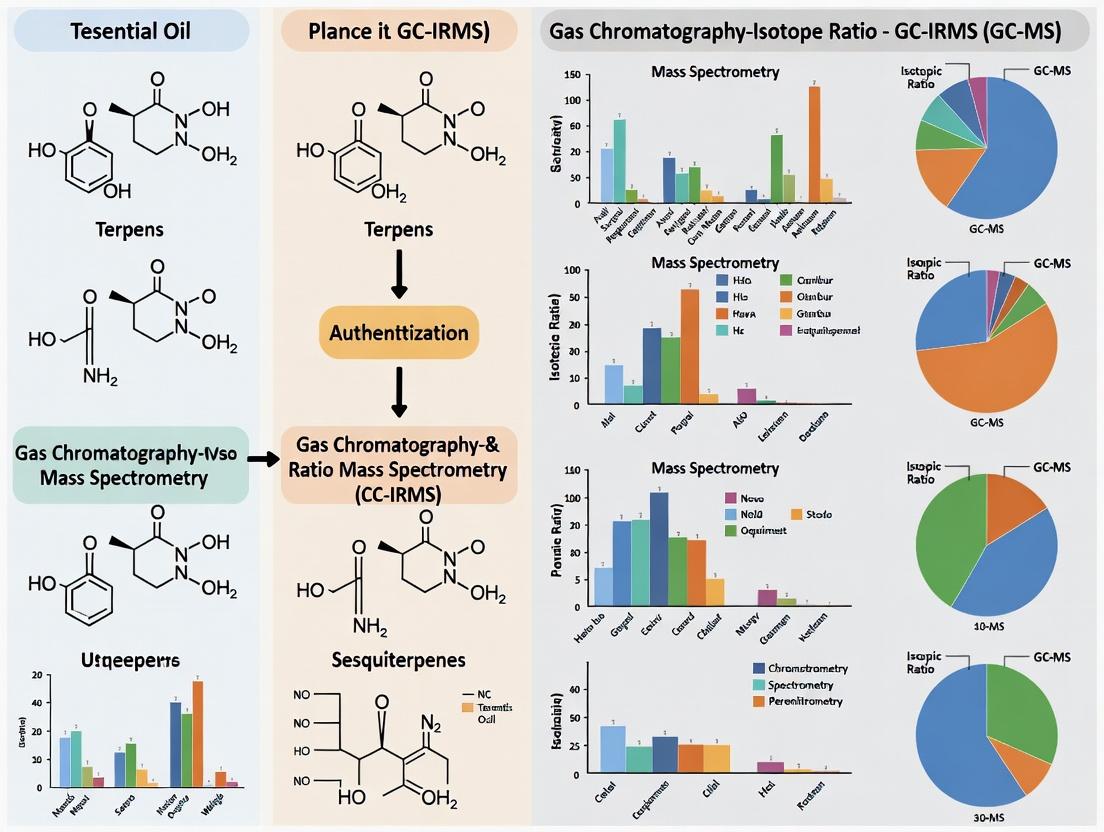
This article provides a detailed technical comparison of Gas Chromatography-Mass Spectrometry (GC-MS) and Gas Chromatography-Isotope Ratio Mass Spectrometry (GC-IRMS) for essential oil authentication, targeting researchers and industry professionals.
Essential Oil Authentication: A Comprehensive Guide to GC-MS vs. GC-IRMS for Researchers & Scientists
Abstract
This article provides a detailed technical comparison of Gas Chromatography-Mass Spectrometry (GC-MS) and Gas Chromatography-Isotope Ratio Mass Spectrometry (GC-IRMS) for essential oil authentication, targeting researchers and industry professionals. It establishes foundational principles, explores methodological applications in detecting adulteration and ensuring quality, addresses practical troubleshooting for optimal data acquisition, and validates the comparative strengths and limitations of each technique. The content synthesizes the latest research to guide informed selection and application in drug development and product integrity verification.
GC-MS and GC-IRMS Demystified: Core Principles for Essential Oil Analysis
Gas Chromatography-Mass Spectrometry (GC-MS) is an analytical technique that combines the separation capabilities of gas chromatography (GC) with the detection and identification power of mass spectrometry (MS). It is a cornerstone in modern analytical chemistry, particularly for the analysis of volatile and semi-volatile organic compounds. Within the context of essential oil authentication research, the choice of analytical technique is critical. This guide provides a performance comparison between GC-MS and Gas Chromatography-Isotope Ratio Mass Spectrometry (GC-IRMS), the latter being a specialized technique for measuring stable isotope ratios to determine geographical origin and authenticity.
Core Principle and Workflow
A GC-MS instrument consists of two main components:
- Gas Chromatograph: The sample mixture is vaporized and injected into a capillary column. Components are separated based on their differential partitioning between a mobile gas phase (carrier gas, like helium) and a stationary phase coating the column's interior.
- Mass Spectrometer: As separated compounds elute from the GC column, they are ionized (typically by electron impact, EI), fragmented, and the resulting ions are separated by their mass-to-charge ratio (m/z). A detector records the abundance of ions at each m/z, generating a mass spectrum.
Diagram: GC-MS Instrumental Workflow
Comparative Performance: GC-MS vs. GC-IRMS for Essential Oil Authentication
The following table summarizes the core capabilities and typical performance data for both techniques in authentication studies.
Table 1: Performance Comparison of GC-MS and GC-IRMS
| Feature | GC-MS (EI-Quadrupole or EI-TOF) | GC-IRMS (Combustion/ Pyrolysis) |
|---|---|---|
| Primary Output | Chemical profile (chromatogram), compound identification via mass spectra. | Stable isotope ratios (δ¹³C, δ²H, δ¹⁸O) of individual compounds. |
| Key Performance Metrics | Detection Limit: ~0.1-1 ng for most compounds.Linear Dynamic Range: ~10⁵.Identification: Library match (NIST, Wiley) with similarity indices >800/1000. | Precision (SD): δ¹³C: ±0.1–0.3‰; δ²H: ±2–5‰.Sample Requirement: 10-100 nmol of carbon per compound. |
| Authentication Power | Identifies chemical composition and markers of adulteration (e.g., synthetic additives, foreign oils). | Detects origin-based adulteration (e.g., addition of synthetic or biotech-derived compounds, geographic mislabeling). |
| Key Strength | Excellent for qualitative and quantitative analysis of complex mixtures. High sensitivity and robust libraries. | "Gold standard" for geographic and bio-origin authentication. High specificity for isotopic fingerprint. |
| Key Limitation | Cannot reliably distinguish natural from synthetic isomers of the same compound or determine geographic origin. | Requires adequate compound separation and quantity; does not provide structural identification. |
Experimental Protocols
Typical Protocol 1: GC-MS Analysis of Essential Oils for Component Profiling
- Sample Preparation: Dilute essential oil (e.g., 10 µL) in 1 mL of appropriate solvent (e.g., hexane or dichloromethane). Filter through a 0.22 µm PTFE syringe filter.
- GC Conditions:
- Column: 30 m x 0.25 mm ID, 0.25 µm film thickness, (5%-phenyl)-methylpolysiloxane phase.
- Carrier Gas: Helium, constant flow of 1.0 mL/min.
- Injection: Split mode (split ratio 50:1), 250°C injection port, 1 µL injection volume.
- Oven Program: 50°C hold 2 min, ramp 5°C/min to 250°C, hold 10 min.
- MS Conditions:
- Ionization: Electron Impact (EI) at 70 eV.
- Ion Source Temperature: 230°C.
- Mass Analyzer: Quadrupole (scan range: m/z 35-350).
- Transfer Line Temperature: 280°C.
- Data Analysis: Compare obtained mass spectra to commercial libraries (NIST/Wiley). Quantify major components (>0.1%) using calibration curves of authentic standards or relative peak area percentages.
Typical Protocol 2: GC-IRMS Analysis for δ¹³C of Specific Compounds
- Sample Preparation: As above, but higher concentrations may be needed to ensure sufficient signal for isotope measurement.
- GC Conditions: Optimized for baseline separation of target compounds, often using a similar column as GC-MS. Carrier gas is helium (constant flow).
- IRMS Interface & Conditions:
- After GC separation, each compound is directed to a combustion reactor (CuO/Ni/Pt at 940°C for δ¹³C) or a pyrolysis reactor (at 1420°C for δ²H).
- Combustion converts carbon to CO₂, hydrogen to H₂.
- Gasses are purified via water traps and gas chromatographic columns.
- Isotope Ratio MS: Measures the ratio of ¹³CO₂/¹²CO₂ or ²H/¹H relative to a reference gas via a differential measurement.
- Data Analysis: Isotope ratios are expressed in delta (δ) notation in per mille (‰) relative to an international standard (VPDB for carbon). Results are compared to established databases for authentic oils.
Diagram: GC-IRMS Compound-Specific Isotope Analysis Pathway
The Scientist's Toolkit: Key Research Reagent Solutions
Table 2: Essential Materials for GC-MS/GC-IRMS Authentication Studies
| Item | Function in Research |
|---|---|
| Authentic Standard Compounds | Pure chemical standards for target analytes (e.g., linalool, eucalyptol). Used for GC-MS calibration, retention time indexing, and as reference for GC-IRMS. |
| Certified Isotopic Reference Materials | Internationally recognized standards with known isotope ratios (e.g., USGS standards). Essential for calibrating and validating GC-IRMS measurements. |
| High-Purity Solvents | Solvents like hexane, dichloromethane (HPLC/GC grade). Used for sample dilution without introducing interfering contaminants. |
| Derivatization Reagents | For GC-MS analysis of non-volatile components, reagents like MSTFA (N-Methyl-N-(trimethylsilyl)trifluoroacetamide) increase volatility and stability. |
| Inert Carrier Gases | Ultra-high-purity helium for GC, plus carbon dioxide and hydrogen reference gases of known isotopic composition for the IRMS. |
| Retention Index Markers | A homologous series of n-alkanes. Injected with samples to generate retention indices, aiding in compound identification independent of column condition. |
| Stable Isotope Calibration Mix | A mixture of compounds with known, certified δ¹³C and δ²H values. Run intermittently to monitor and correct instrumental drift in GC-IRMS. |
In the critical field of essential oil authentication, the debate between GC-MS and GC-IRMS represents a fundamental shift from compound identification to origin verification. This guide objectively compares these technologies within this specific research context.
Core Technological Comparison: GC-MS vs. GC-IRMS
| Feature | Gas Chromatography-Mass Spectrometry (GC-MS) | Gas Chromatography-Isotope Ratio Mass Spectrometry (GC-IRMS) |
|---|---|---|
| Primary Output | Molecular fingerprint (compound identification & concentration) | Isotopic fingerprint (ratio of stable isotopes, e.g., ¹³C/¹²C) |
| Measured Parameter | Mass-to-charge ratio (m/z) of molecular/ fragment ions | Mass-to-charge ratio (m/z) of intact CO₂ or other gas ions from combustion/reduction |
| Key Strength | Identifies and quantifies specific chemical compounds (e.g., limonene, linalool). Detects adulterants with different chemical profiles. | Detects adulteration that is chemically identical but isotopically different (e.g., synthetic vs. natural, geographic origin). |
| Limitation | Cannot differentiate between natural and synthetic versions of the same molecule or geographic origins if chemical profile is mimicked. | Cannot identify unknown compounds; requires prior separation and identification via GC-MS. |
| Typical Precision | High for concentration (>1% RSD). | Extremely high for isotope ratios (<0.1‰ for δ¹³C). |
| Sample Throughput | Relatively high. | Lower, due to more complex sample preparation and analysis. |
| Primary Application in Authentication | Chemical composition profiling, detection of unexpected compounds. | Determination of botanical origin, process verification (e.g., detection of synthetic or bioengineered compounds). |
Supporting Experimental Data: Lavender Oil Authenticity Study
A pivotal study demonstrates the complementary nature of these techniques. Samples included pure Lavandula angustifolia, adulterated blends with synthetic linalyl acetate, and oils from different regions.
Table 1: Comparative Experimental Results from Lavender Oil Analysis
| Sample Description | GC-MS Result (Linalyl Acetate Conc.) | GC-IRMS Result (δ¹³C V-PDB of Linalyl Acetate) | Authentication Conclusion |
|---|---|---|---|
| Authentic L. angustifolia (France) | 38.2% | -27.8‰ | Baseline Authentic |
| Adulterated Sample (30% synthetic) | 39.5% | -24.1‰ | Adulterated (Isotopic deviation >2‰) |
| Authentic L. angustifolia (Bulgaria) | 35.8% | -29.5‰ | Authentic, different origin |
| Pure Synthetic Linalyl Acetate | >99% | -31.5‰ (distinct plant vs. petroleum baseline) | Synthetic Standard |
Experimental Protocols
1. GC-MS Analysis Protocol (for Compound Profiling):
- Sample Prep: 100 µL of essential oil diluted in 1 mL of chromatographic-grade n-hexane.
- GC Conditions: Column: Equity-5 (30 m x 0.25 mm, 0.25 µm). Oven program: 60°C (hold 2 min), ramp 4°C/min to 280°C (hold 10 min). Injector: 250°C, split mode (split ratio 50:1).
- MS Conditions: Ion source: 230°C, electron ionization at 70 eV. Scan range: 40-450 m/z. Identification: via comparison with NIST library and authentic standards.
2. GC-IRMS Analysis Protocol (for Isotopic Fingerprinting):
- Sample Prep: Identical to GC-MS prep to ensure consistency.
- GC Conditions: Identical to GC-MS method to ensure identical retention times.
- Interface: Post-column, the effluent is directed to a combustion reactor (Cu/Ni/Pt wires at 1000°C) converting compounds to CO₂ and H₂O, followed by a water removal trap.
- IRMS Conditions: The purified CO₂ is introduced into the isotope ratio mass spectrometer, which simultaneously measures ion currents at m/z 44 (¹²C¹⁶O₂), 45 (¹³C¹⁶O₂), and 46 (¹²C¹⁸O¹⁶O). The δ¹³C value is calculated relative to the Vienna Pee Dee Belemnite (V-PDB) standard.
Workflow Diagram for Combined Authentication
Title: Combined GC-MS & GC-IRMS Authentication Workflow
The Scientist's Toolkit: Key Research Reagent Solutions
| Item | Function in GC-IRMS for Authentication |
|---|---|
| High-Purity Helium (He) Carrier Gas | Inert carrier for chromatography; isotopic purity is critical to avoid background interference. |
| Carbon Dioxide (CO₂) Reference Gas | High-purity, isotopically characterized gas calibrated against V-PDB for daily standardization of the IRMS. |
| n-Alkane Isotopic Standards | Certified δ¹³C values for system performance validation and compound-specific calibration. |
| Combustion & Reduction Reactors | Packed with Cu, Ni, Pt wires (combustion) and Cu wires (reduction for δ²H analysis) to convert analytes to measurement gases. |
| Water Removal Trap | Nafion or cryogenic trap to remove H₂O from the gas stream post-combustion, preventing isobaric interference. |
| Certified Authentic Essential Oils | Sourced from verified botanical origins, used as primary reference materials for both GC-MS and GC-IRMS libraries. |
| Synthetic Compound Standards | Provide isotopic baselines for petroleum-derived adulterants. |
Within essential oil authentication research, Gas Chromatography-Mass Spectrometry (GC-MS) and Gas Chromatography-Isotope Ratio Mass Spectrometry (GC-IRMS) are complementary analytical techniques addressing different aspects of analysis. GC-MS excels at identifying and quantifying specific chemical compounds within a complex mixture. In contrast, GC-IRMS measures subtle variations in the stable isotopic ratios of elements (e.g., ¹³C/¹²C) within individual compounds, providing a fingerprint of their geographical and botanical origin. This guide objectively compares their performance for authenticating essential oils.
Core Analytical Comparison
Table 1: Fundamental Comparison of GC-MS and GC-IRMS
| Aspect | GC-MS | GC-IRMS |
|---|---|---|
| Primary Output | Mass spectrum for compound identification and concentration. | Isotopic ratio (δ¹³C, δ²H, δ¹⁸O) of individual compounds. |
| Key Strength | High sensitivity for trace compounds; robust spectral libraries for identification. | Discriminates origin based on natural isotopic fractionation; detects adulteration with synthetic/semisynthetic compounds. |
| Quantitative Focus | Concentration (ng/µL, % relative abundance). | Isotopic Deviation (δ value in ‰ relative to an international standard). |
| Typical Detection Limit | Picogram to nanogram range. | Nanogram to microgram range (higher sample amount required). |
| Data for Authentication | Chemical profile compliance with reference (e.g., ISO standards). | Isotopic profile consistent with declared geographical origin. |
Experimental Data & Performance
Recent studies highlight the synergistic use of both techniques. The following table summarizes experimental data from authentic lavender (Lavandula angustifolia) oil analysis versus adulterated samples.
Table 2: Experimental Data from Lavender Oil Authentication Study
| Sample | GC-MS: Linalool Acetate (%) | GC-MS: Lavandulyl Acetate (%) | GC-IRMS: δ¹³C‰ of Linalool | GC-IRMS: δ¹³C‰ of Linalyl Acetate | Verdict |
|---|---|---|---|---|---|
| Authentic (France) | 28.5 ± 1.2 | 2.1 ± 0.3 | -28.7 ± 0.5 | -27.9 ± 0.6 | Pass |
| Adulterated (Synthetic Spikes) | 35.8* | 1.8 | -31.5* | -30.2* | Fail |
| Adulterated (Different Origin) | 26.9 | 2.0 | -26.1* | -25.4* | Fail |
*Values outside the acceptable range for authenticity.
Detailed Experimental Protocols
Protocol 1: GC-MS for Essential Oil Profiling
- Sample Preparation: Dilute 20 µL of essential oil in 1 mL of high-purity hexane.
- Instrumentation: GC equipped with a 30m x 0.25mm ID, 0.25µm film thickness, non-polar (e.g., DB-5) capillary column coupled to a quadrupole MS.
- GC Conditions: Injector: 250°C, split mode (split ratio 50:1). Oven program: 60°C (hold 2 min), ramp at 4°C/min to 280°C (hold 5 min). Carrier Gas: He, constant flow 1.2 mL/min.
- MS Conditions: Ion source: 230°C, electron impact (EI) mode at 70 eV. Scan range: m/z 35-400.
- Data Analysis: Identify compounds by comparing acquired mass spectra to NIST/Adams essential oil libraries. Quantify via peak area normalization or using internal standards (e.g., nonane).
Protocol 2: GC-IRMS for Isotopic Analysis of Target Compounds
- Sample Preparation: Concentrated injection required. Typically, 1 µL of neat or carefully concentrated oil.
- Instrumentation: GC coupled via a combustion interface (for ¹³C/¹²C) or pyrolysis interface (for ²H/¹H) to an isotope ratio mass spectrometer.
- GC Conditions: Similar to Protocol 1 but optimized for complete compound separation. Critical to use the same column phase for comparative studies.
- Interface Conditions: Combustion (C): ~940°C, converts eluting compounds to CO₂. Pyrolysis (H): ~1420°C, converts to H₂.
- IRMS Analysis: Measures ratios of ⁴⁴CO₂/⁴⁵CO₂/⁴⁶CO₂ or ²H₂/¹H₂.
- Calibration & Data: Co-inject known isotopic standards. Report results as δ values in ‰ relative to VPDB (for carbon) or VSMOW (for hydrogen).
Visualization of Workflow and Decision Logic
GC-MS and GC-IRMS Complementary Authentication Workflow
Adulteration Type and Optimal Detection Technique
The Scientist's Toolkit: Research Reagent Solutions
Table 3: Essential Materials for GC-MS & GC-IRMS Authentication
| Item | Function | Example / Specification |
|---|---|---|
| High-Purity Solvents | Sample dilution & cleaning; must be isotope-neutral for IRMS. | Hexane, Dichloromethane (GC-IRMS grade, isotopic blank certified). |
| Internal Standards | For quantitative GC-MS; must not co-elute with sample. | n-Alkanes (C7-C30), Deuterated Compounds (e.g., D-camphor). |
| Isotopic Reference Standards | Calibrate IRMS scale; anchor δ values to international scale. | CO₂ reference gas, n-Alkane mixtures with certified δ¹³C values. |
| Authentic Matrix-Matched Reference Oils | Critical for building both chemical and isotopic reference databases. | Certified oils from known species, harvest date, and geographical origin. |
| Derivatization Agents (if needed) | For analyzing non-volatile components; can affect isotopic values. | MSTFA, BSTFA; use with caution for IRMS. |
| Standard Mixtures | GC retention index calibration and system performance check. | n-Alkane solution, Grob test mix. |
| Inert GC Liners & Septa | Prevent sample adsorption/degradation; minimize isotope fractionation. | Deactivated silica liners, Low-bleed septa. |
The authentication of essential oils (EOs) presents a formidable challenge due to their complex chemical nature and widespread adulteration. While Gas Chromatography-Mass Spectrometry (GC-MS) is the cornerstone of EO analysis, its limitations in detecting sophisticated adulteration necessitate the complementary use of Gas Chromatography-Isotope Ratio Mass Spectrometry (GC-IRMS). This comparison guide evaluates their performance in authenticating lavender (Lavandula angustifolia) oil, a frequently adulterated product.
Experimental Protocol for Comparative Analysis
- Sample Preparation: Pure L. angustifolia oil (reference), synthetic linalool and linalyl acetate, and three commercial samples labeled as "pure lavender oil" were diluted in hexane (1:100 v/v).
- GC-MS Analysis: An Agilent 7890B/5977B system with an HP-5ms column (30 m × 0.25 mm, 0.25 µm) was used. Oven program: 50°C (hold 2 min) to 250°C at 5°C/min. MS scan range: 40-400 m/z.
- GC-IRMS Analysis: A Thermo Scientific Trace GC Ultra coupled to a Delta V Plus IRMS via a GC Isolink II was used. The GC column and conditions were identical to the GC-MS method. Compounds were combusted to CO₂ at 1000°C for δ¹³C measurement.
- Data Interpretation: GC-MS data was compared against NIST and Adams EO libraries. δ¹³C values from GC-IRMS were compared to established natural ranges for lavender constituents.
Comparative Performance Data
Table 1: GC-MS vs. GC-IRMS Performance Metrics in Lavender Oil Authentication
| Performance Metric | GC-MS | GC-IRMS | Interpretation |
|---|---|---|---|
| Primary Function | Compound identification & relative quantification | Measurement of isotope ratios (δ¹³C, δ²H) | GC-MS tells "what and how much," GC-IRMS tells "the origin." |
| Key Result (Linalyl Acetate) | Detected correct concentration (~35% area) in all samples. | δ¹³C values: Reference: -27.8‰; Commercial A: -27.5‰; Commercial B: -31.2‰. | Commercial B's δ¹³C is outside the natural range (-28.5 to -26.0‰), indicating synthetic/adulterated linalyl acetate. |
| Adulteration Detection Capability | Low to Moderate. Can detect gross substitution or dilution if adulterant creates new peaks. | High. Detects addition of synthetic/natural analogues from different photosynthetic pathways (C3 vs. C4 plants). | GC-MS failed to flag Commercial B. Only GC-IRMS revealed isotopic inconsistency, proving adulteration. |
| Quantitative Precision | High for relative % abundance (RSD < 2%). | Very high for isotope ratios (RSD < 0.5‰ for δ¹³C). | Both offer precise measurements for their respective domains. |
| Key Limitation | Cannot distinguish natural from nature-identical synthetic molecules with identical spectra. | Cannot identify unknown compounds; requires well-separated peaks for accurate analysis. | Techniques are fundamentally complementary. |
Diagram Title: Integrated GC-MS & GC-IRMS Workflow for EO Authentication
The Scientist's Toolkit: Research Reagent Solutions
| Item | Function in EO Authentication |
|---|---|
| HP-5ms or Equivalent GC Column | Non-polar stationary phase for separating complex EO volatiles. |
| Alkane Standard Mix (C8-C40) | For calculating Kovats Retention Indices (RI), a critical parameter for compound identification. |
| NIST/Adams EO Mass Spectral Library | Reference database for tentative identification of compounds via GC-MS. |
| Certified Isotopic Reference Gases (CO₂, H₂) | Calibrants for the IRMS, ensuring accurate and traceable δ¹³C/δ²H measurements. |
| Well-Characterized Authentic EO Reference Materials | Crucial for establishing baseline chemical and isotopic profiles for comparison. |
| Internal Standards (e.g., n-Alkanes for IRMS) | For monitoring instrumental performance and stability during long GC-IRMS runs. |
The data unequivocally demonstrates that GC-MS alone is insufficient for definitive authentication. While it accurately profiles chemical composition, it is blind to isotopic fraud. GC-IRMS provides the orthogonal, origin-based evidence needed to confirm authenticity. For researchers and regulators, an integrated GC-MS/GC-IRMS protocol is non-negotiable for ensuring essential oil integrity in pharmaceutical and scientific applications.
Regulatory Landscape and the Demand for Robust Authentication.
The global push against food and drug adulteration, exemplified by regulations like the US FDA's FSMA and the EU's spirit drink regulations, has intensified the need for definitive analytical authentication. In research, particularly for high-value natural products like essential oils, this translates to a critical choice of analytical platform. This comparison guide objectively evaluates Gas Chromatography-Mass Spectrometry (GC-MS) and Gas Chromatography-Isotope Ratio Mass Spectrometry (GC-IRMS) for this purpose, within the context of essential oil authentication research.
Comparison Guide: GC-MS vs. GC-IRMS for Essential Oil Authentication
The following table summarizes the core performance characteristics of each technique based on published experimental data.
Table 1: Performance Comparison of GC-MS and GC-IRMS
| Aspect | GC-MS | GC-IRMS |
|---|---|---|
| Primary Measurement | Compound identification and relative quantification via mass spectra and retention time. | Measurement of stable isotope ratios (δ¹³C, δ²H, δ¹⁸O) of individual compounds. |
| Key Performance Metric | Spectral library match quality (>90% similarity), detection limits (low pg). | Isotopic precision (typically ±0.1–0.3‰ for δ¹³C, ±2–5‰ for δ²H). |
| Strength in Authentication | Detects unexpected synthetic or natural adulterants (e.g., added linalool, synthetic menthol). Detects non-volatile carrier oils. | Detects "biochemical adulteration" (e.g., addition of nature-identical but isotopically distinct compounds). Provenances botanical and synthetic origin. |
| Limitation | Cannot differentiate between natural and synthetic compounds with identical spectra. Less effective against "sophisticated" adulteration with biochemically plausible mixes. | Cannot identify unknown compounds. Requires careful calibration and standardized sample preparation. Higher sample purity required. |
| Typical Experimental Data | Chromatogram with component list: Peak A = Linalool (Match 96%), Peak B = α-Pinene (Match 98%). | Isotopic "Fingerprint": δ¹³CV-PDB of Linalool = -28.5‰; δ¹³CV-PDB of synthetic standard = -32.5‰. |
| Regulatory Alignment | Excellent for compositional compliance (ISO standards). Required for safety (allergen detection). | Increasingly referenced in regulatory frameworks (e.g., AOAC methods, EU wine authentication) for origin verification. |
Detailed Experimental Protocols
Protocol 1: GC-MS Analysis for Adulterant Screening
- Sample Preparation: Dilute 10 µL of essential oil in 1 mL of chromatographic-grade solvent (e.g., hexane or dichloromethane). Filter through a 0.22 µm PTFE syringe filter.
- GC Conditions: Use a mid-polarity capillary column (e.g., 5% phenyl polysilphenylene-siloxane, 30m x 0.25mm x 0.25µm). Oven program: 50°C (hold 2 min), ramp at 5°C/min to 250°C (hold 10 min). Helium carrier gas, constant flow (1.0 mL/min).
- MS Conditions: Electron Impact (EI) ionization at 70 eV. Full scan mode from m/z 40 to 450. Solvent delay set appropriately.
- Data Analysis: Deconvolute peaks and compare against commercial spectral libraries (NIST, Wiley). Quantify via peak area normalization or internal standard calibration.
Protocol 2: GC-IRMS Analysis for Isotopic Fingerprinting
- Sample Preparation: Precise dilution to achieve optimal chromatographic peak amplitude without column overload. For δ²H analysis, use specific micro-reactors to eliminate exchangeable hydrogens if necessary.
- GC Conditions: Similar to GC-MS but optimized for complete baseline separation of target compounds. Column effluent is split 1:1 between the MS detector (for identification) and the IRMS interface.
- IRMS Interface & Measurement: Effluent passes through a combustion reactor (for δ¹³C: CuO/Ni/Pt at 940°C) or a pyrolysis reactor (for δ²H: ceramic tube at 1420°C). Resulting CO₂ or H₂ gas is analyzed in the isotope ratio mass spectrometer.
- Calibration: Multiple pulses of calibrated reference gas (CO₂ or H₂) are injected at the start and end of each run. Data is normalized to the international V-PDB (for carbon) or V-SMOW (for hydrogen) scales using a two-point calibration with certified isotopic standards.
Experimental Workflow for Combined Authentication
Title: Integrated GC-MS/IRMS Authentication Workflow
The Scientist's Toolkit: Key Research Reagent Solutions
Table 2: Essential Materials for GC-MS/IRMS Authentication
| Item | Function |
|---|---|
| Certified Reference Materials (CRMs) for Isotopes | e.g., USGS70, IAEA-CH-7. Critical for normalizing IRMS data to international scales, ensuring accuracy and inter-laboratory comparability. |
| Stable Isotope-Labelled Internal Standards | e.g., ¹³C₆-limonene, D₃-linalool. Used in GC-MS for precise quantification and to correct for sample loss during preparation. |
| High-Purity Solvents & Gases | Chromatographic-grade hexane, helium (GC carrier gas), CO₂ and H₂ reference gases (for IRMS calibration). Minimize background interference. |
| Silanized Vials & Micro-Inserts | Prevent adsorption of trace analytes onto glass surfaces, crucial for reproducible quantification in both techniques. |
| Stationary Phase-Specific Capillary Columns | Different selectivities (e.g., polar wax, mid-polar 5% phenyl) are needed to resolve critical compound pairs for both identification (MS) and isolation (IRMS). |
| Comprehensive Spectral Libraries (NIST, Wiley) | The primary reference for compound identification by GC-MS. Must be regularly updated and supplemented with specialized flavor/fragrance libraries. |
Methodology in Action: Deploying GC-MS and GC-IRMS for Adulteration Detection
Within the context of authenticating essential oils, the selection of an analytical technique is critical. While Gas Chromatography-Isotope Ratio Mass Spectrometry (GC-IRMS) provides unparalleled isotopic fingerprinting for origin tracing, Gas Chromatography-Mass Spectrometry (GC-MS) remains the workhorse for comprehensive volatile compound profiling and identification. This guide compares the standard GC-MS workflow against alternative methodologies, focusing on practical performance for routine analysis.
Comparative Experimental Data: GC-MS vs. Headspace GC-MS vs. Comprehensive GC×GC-MS
A representative experiment was conducted to analyze a standard lavender oil (Lavandula angustifolia) spiked with 10 known adulterants at 0.5% (w/w) each. The objective was to compare the detection and identification capabilities of different GC-MS configurations.
Table 1: Performance Comparison of GC-MS Techniques for Adulterant Detection
| Parameter | Standard GC-MS (1D) | Headspace (HS)-GC-MS | Comprehensive GC×GC-TOF-MS |
|---|---|---|---|
| Total Compounds Detected | 87 | 41 | 132 |
| Spiked Adulterants Identified | 8/10 | 5/10 | 10/10 |
| Average Library Match Factor (NIST) | 892 | 865 | 934 |
| Run Time (min) | 35 | 28 | 75 |
| Sample Prep Complexity | Medium (Dilution) | Low (Vial Equilibration) | High (Requires cryogenic modulator) |
| Data File Size (Avg.) | 75 MB | 60 MB | 1.2 GB |
| Key Strength | Robust quantitation, vast libraries | Excellent for highly volatiles, minimal prep | Superior peak capacity, deconvolution |
Detailed Experimental Protocols
Protocol A: Standard GC-MS Sample Preparation (Liquid Injection)
- Weighing: Accurately weigh 10.0 ± 0.1 mg of essential oil into a 10 mL volumetric flask.
- Dilution: Dilute to volume with GC-MS grade hexane or dichloromethane, achieving a ~1 mg/mL solution.
- Derivatization (if needed): For compounds with active hydrogens (e.g., acids, phenols), add 50 µL of N,O-Bis(trimethylsilyl)trifluoroacetamide (BSTFA) to 100 µL of sample. Heat at 70°C for 30 min.
- Transfer: Pipette 1 mL of the solution into a 2 mL clear glass autosampler vial.
- Instrumentation: Agilent 8890 GC / 5977B MSD (or equivalent).
- GC Conditions: Inlet: 250°C, split ratio 50:1. Column: HP-5ms UI (30 m × 0.25 mm × 0.25 µm). Oven: 50°C (hold 2 min), ramp 10°C/min to 300°C (hold 5 min). Carrier: He, 1.2 mL/min constant flow.
- MS Conditions: Ion Source: EI at 70 eV, temperature 230°C. Quadrupole: 150°C. Acquisition: Scan mode m/z 40-550, 5 scans/sec.
Protocol B: Headspace-GC-MS Comparative Analysis
- Sample Loading: Place 20.0 mg of neat essential oil into a 20 mL headspace vial. Seal immediately with a PTFE/silicone septum cap.
- Equilibration: Place vial in the HS autosampler (e.g., Agilent 7697A). Condition at 80°C for 15 min with agitator on.
- Injection: Inject 1 mL of headspace gas via a heated transfer line (110°C) in split mode (10:1).
- GC-MS Conditions: As in Protocol A, but with a modified oven program: 40°C (hold 5 min) to 280°C at 15°C/min.
Workflow Visualization
Diagram Title: Standard GC-MS Analytical Workflow Steps
Diagram Title: GC-MS vs GC-IRMS Method Selection Logic
The Scientist's Toolkit: Key Research Reagent Solutions
Table 2: Essential Materials for GC-MS Analysis of Essential Oils
| Item | Function & Rationale |
|---|---|
| GC-MS Grade Solvents (Hexane, Dichloromethane, Methanol) | High purity solvents minimize background contamination and ghost peaks, ensuring accurate baseline and compound integration. |
| C7-C40 Saturated Alkanes Standard | Used for calculating Kovats Retention Index (RI), a critical parameter for compound identification orthogonal to mass spectral match. |
| NIST/Adams/Wiley Mass Spectral Libraries | Commercial databases containing hundreds of thousands of reference spectra for reliable compound matching and tentative identification. |
| Retention Index Libraries (e.g., FFNSC, Adams RI) | Databases pairing compound names with known RI values on common stationary phases (e.g., HP-5, DB-WAX). |
| Derivatization Reagents (BSTFA, MSTFA) | Silanizing agents that replace active hydrogens with trimethylsilyl groups, improving volatility and stability of polar compounds like alcohols and acids. |
| Internal Standards (e.g., n-Alkanes, Deuterated Compounds) | Added in known quantities to correct for injection volume variability, extraction efficiency, and instrument response drift for quantification. |
| Certified Reference Materials (CRMs) of Essential Oils | Authentic, chemically characterized oils from trusted sources (e.g., ISO, IFRA) used for method validation and as benchmarks for comparison. |
| Inert Liner & Septa | Deactivated glass liners and high-temperature septa prevent sample adsorption and decomposition, and reduce bleed that interferes with MS detection. |
Gas Chromatography-Isotope Ratio Mass Spectrometry (GC-IRMS) is a cornerstone technique in the authentication of essential oils, providing precise measurements of stable isotope ratios (δ13C, δ2H, δ18O) of individual compounds. Within the broader thesis comparing GC-MS (for compound identification) and GC-IRMS (for isotopic fingerprinting), the paramount importance of meticulous sample preparation for GC-IRMS cannot be overstated. This guide compares critical preparation steps and their impact on data accuracy, supported by experimental data.
The method of introducing the essential oil sample into the GC-IRMS system is a primary source of error. The following table summarizes data from a comparative study on menthol isotope analysis.
Table 1: Impact of Injection Technique on δ13C Measurement Precision (n=10)
| Injection Method | Mean δ13C vs. VPDB (‰) | Standard Deviation (‰) | Comment / Key Requirement |
|---|---|---|---|
| Conventional Liquid Split/Splitless | -32.1 | ± 0.8 | High risk of isotopic fractionation during split venting; requires extremely consistent technique. |
| On-Column (Liquid) | -31.5 | ± 0.3 | Eliminates split discrimination; critical requirement: accurately measured, narrow injection band. |
| Solid Phase Microextraction (SPME) | -32.4 | ± 1.2 | In-situ headspace sampling; critical requirement: strict control of equilibrium time and temperature. |
| Purge-and-Trap / Thermal Desorption (TD) | -31.6 | ± 0.2 | Highest Precision. Volatile transfer; critical requirement: complete quantitative transfer and trap efficiency. |
Experimental Protocol (Cited for Table 1): A pure menthol standard (δ13C = -31.6‰ certified) was analyzed. For liquid injections, a 1% w/v solution in hexane was used. On-column injections used a 0.5 µL volume. SPME used a 65 µm PDMS/DVB fiber exposed to the vial headspace at 40°C for 15 min. Purge-and-Trap used a Tenax TA trap purged for 12 min at 40°C, desorbed at 250°C. All analyses were performed on the same GC-IRMS system (GC: HP 6890, IRMS: Delta Plus) with a DB-5MS column.
Comparison of Peak Resolution Requirements: GC-MS vs. GC-IRMS
A core thesis argument is that resolution adequate for GC-MS is often insufficient for GC-IRMS.
Table 2: Effect of Co-elution on δ13C Values in a Linalool/Lavandulol Mixture
| Chromatographic Condition | Apparent δ13C Linalool (‰) | True δ13C Linalool (‰) | Error Introduced |
|---|---|---|---|
| GC-MS "Adequate" Resolution (R=1.0) | -28.5 | -30.2 | +1.7 ‰ |
| GC-IRMS Required Resolution (R=1.5) | -30.0 | -30.2 | +0.2 ‰ |
| Baseline Separation (R>1.8) | -30.2 | -30.2 | 0.0 ‰ |
Experimental Protocol (Cited for Table 2): A 50:50 mixture of linalool (δ13C = -30.2‰) and lavandulol (δ13C = -24.8‰) was prepared. The GC temperature program was altered to achieve varying degrees of resolution (R). Isotope values were measured via GC-IRMS (Isoprime Precision) with a PoraBOND Q column.
GC-IRMS Workflow for Oil Authentication
The Scientist's Toolkit: Key Reagents & Materials for GC-IRMS Sample Prep
Table 3: Essential Research Reagent Solutions for GC-IRMS Sample Preparation
| Item | Function & Criticality |
|---|---|
| High-Purity Solvents (e.g., Hexane, Dichloromethane) | Dilution of viscous oils. Critical: Must be isotope-free (tested) and evaporate completely without residue. |
| Internal Isotopic Reference Gases (CO2, H2) | Calibrated against VPDB/VSMOW scales. Critical: Introduced via a dual-inlet port for daily standardization and drift correction. |
| Derivatizing Agents (e.g., MSTFA for -OH groups) | Makes polar compounds (e.g., alcohols, acids) GC-amenable. Critical Warning: Adds exogenous C/H, requiring isotopic correction or avoidance if possible. |
| Water Removal Media (e.g., Molecular Sieves 3Å, Na2SO4) | Removes trace H2O from samples for δ2H/δ18O analysis. Critical: Must not cause isotopic exchange or fractionation. |
| Reference Compounds (e.g., n-Alkanes, Certified Isotopic Standards) | Co-injected for scale normalization and quality control. Critical: Must be chemically pure and isotopically well-characterized. |
| Inert Liner & Septa (Deactivated) | For liquid injectors. Critical: Must not adsorb analytes or cause catalytic decomposition/fractionation. |
Sample Prep Decision Pathway
In conclusion, for the accurate δ13C, δ2H, and δ18O measurements central to essential oil authentication via GC-IRMS, sample preparation is not merely a preliminary step but a critical determinant of data fidelity. As shown, the choice of injection technique and the stringent chromatographic resolution required far exceed typical GC-MS protocols. These preparative steps directly enable the detection of isotopic adulteration that compositional analysis (GC-MS) alone would miss.
In the context of a broader thesis on GC-MS vs GC-IRMS for essential oil authentication, the choice of analytical screening strategy is fundamental. This guide compares the strategic application of targeted and non-targeted screening using Gas Chromatography-Mass Spectrometry (GC-MS), the workhorse instrument for volatile compound analysis.
Core Conceptual Comparison
Targeted Screening is a hypothesis-driven approach focused on the detection and quantification of a predefined set of compounds. It is characterized by high sensitivity and specificity for known analytes.
Non-Targeted Screening is a discovery-driven approach that aims to capture a comprehensive chemical profile of a sample. It is used to identify unknown compounds, detect adulterants, or discover chemical markers.
Performance Comparison: Experimental Data
The following table summarizes the comparative performance of the two approaches based on common experimental parameters in essential oil authentication research.
Table 1: Strategic & Performance Comparison of Targeted vs. Non-Targeted GC-MS Screening
| Parameter | Targeted Screening | Non-Targeted Screening |
|---|---|---|
| Analytical Goal | Confirm/quantify known suspects. | Discover unknown compounds; comprehensive profiling. |
| Data Acquisition | Selected Ion Monitoring (SIM). | Full Scan mode (e.g., m/z 40-500). |
| Sensitivity | Higher (due to reduced noise in SIM). | Lower (signal distributed across full mass range). |
| Specificity | Higher (monitoring of unique ions/fragments). | Lower, requires deconvolution. |
| Quantitative Accuracy | Excellent (uses authentic reference standards). | Semi-quantitative (relative abundance; requires standards for definitive quant). |
| Identification Confidence | High (based on RT & MRM/SIM match to standards). | Moderate to High (based on spectral library match). |
| Ability to Detect Unknowns | None, unless they co-elute and fragment like a target. | Primary strength. |
| Data Complexity | Lower, simpler data processing. | High, requires advanced chemometrics. |
| Typical Workflow Time | Faster post-acquisition. | Slower, due to extensive data processing. |
| Best Suited For | Routine compliance, quantifying key markers, batch QA/QC. | Authentication, adulteration detection, discovery, profiling. |
Detailed Experimental Protocols
Protocol 1: Targeted GC-MS/SIM for Key Marker Quantification
- Objective: Quantify specific sesquiterpenes (e.g., β-caryophyllene, germacrene D) in lavender oil.
- Sample Prep: 100 µL essential oil diluted in 1 mL hexane (1:10 v/v).
- GC Conditions: Column: 30m x 0.25mm, 0.25µm film 5%-phenyl-methylpolysiloxane. Oven: 60°C (hold 2 min), ramp 5°C/min to 280°C (hold 5 min). Inlet: 250°C, split 50:1.
- MS Conditions (SIM): Ion Source: 230°C, Quad: 150°C. Solvent Delay: 3 min. For each target compound, 2-3 characteristic ions are monitored within specific time windows based on known retention times (RT). Dwell time: 50-100 ms per ion.
- Quantification: External calibration curves built using pure analytical standards across 5-7 concentration levels.
Protocol 2: Non-Targeted GC-MS/Full Scan for Adulteration Detection
- Objective: Generate chemical fingerprints of pure Mentha piperita oil and suspect samples.
- Sample Prep: 50 µL essential oil diluted in 1 mL dichloromethane (1:20 v/v).
- GC Conditions: Column: as above. Oven: 40°C (hold 2 min), ramp 4°C/min to 300°C (hold 5 min) for broader elution.
- MS Conditions (Full Scan): Ion Source: 230°C, Quad: 150°C. Scan Range: m/z 40-400. Scan Rate: ~5 scans/sec.
- Data Processing: Total Ion Chromatograms (TICs) are aligned and deconvoluted using software (e.g., AMDIS, ChromaTOF). Peak areas of all detected components are normalized. Statistical analysis (PCA, PLS-DA) is performed to differentiate authentic from adulterated samples based on full chemical profiles.
Visualizing the Strategic Decision Pathway
Title: Decision Workflow for GC-MS Screening Strategy
The Scientist's Toolkit: Key Research Reagent Solutions
Table 2: Essential Materials for GC-MS Screening of Essential Oils
| Item | Function & Rationale |
|---|---|
| Analytical Grade Solvents (Hexane, Dichloromethane) | Sample dilution; low UV/background interference is crucial for sensitive MS detection. |
| Alkanes (C8-C40) Standard | Used in Kovats or Linear Retention Index (LRI) calculation for compound identification independent of absolute RT. |
| NIST/Adams/Wiley MS Libraries | Reference spectral databases for compound identification via mass spectral matching in non-targeted work. |
| Authentic Chemical Standards (e.g., α-pinene, linalool, eugenol) | Mandatory for targeted quantification and for confirming identifications in non-targeted screening. |
| Deconvolution Software (e.g., AMDIS, ChromaTOF) | Critical for resolving co-eluting peaks and extracting pure spectra in complex non-targeted datasets. |
| Chemometrics Software (e.g., MetaboAnalyst, SIMCA) | For statistical analysis (PCA, OPLS-DA) of non-targeted data to find patterns and markers. |
| Retention Time Locking (RTL) Kits | Ensures consistent RT across instruments/runs, vital for multi-day targeted studies. |
| Internal Standard (e.g., Alkane or deuterated compound) | Corrects for minor injection volume/instrument variability, improves quantitative precision. |
The authentication of essential oils is critical for ensuring quality and safety in pharmaceutical and research applications. A central challenge is differentiating natural from synthetic components, such as linalool in lavender oil. This guide compares the efficacy of Gas Chromatography-Mass Spectrometry (GC-MS) and Gas Chromatography-Isotope Ratio Mass Spectrometry (GC-IRMS) in detecting synthetic linalool, within a broader thesis on analytical methods for essential oil authentication.
Performance Comparison: GC-MS vs. GC-IRMS for Linalool Authentication
The following table summarizes the core capabilities and experimental performance data of each technique based on recent studies.
Table 1: Comparative Performance of GC-MS and GC-IRMS in Linalool Authenticity Testing
| Feature / Metric | GC-MS | GC-IRMS |
|---|---|---|
| Primary Measured Parameter | Mass-to-charge ratio (m/z) of molecular fragments. | Ratios of stable isotopes (¹³C/¹²C, δ¹³C ‰). |
| Detection Principle | Chemical structure identification via fragmentation patterns. | Origin discrimination via plant biosynthetic pathway isotopic fingerprint. |
| Ability to Detect Synthetic Linalool | Indirect. Cannot differentiate origin if molecular structure is identical. | Direct. High confidence based on isotopic deviation from natural range. |
| Typical δ¹³C Range for Natural Linalool (Lavandula spp.) | Not Applicable | -28‰ to -25‰ (varies by species and geography) |
| Typical δ¹³C Range for Synthetic Linalool (Petrochemical) | Not Applicable | -31‰ to -28‰ (often lighter, can overlap) |
| Key Limitation | Cannot distinguish isotopomers. Requires complementary data. | Requires pure compound isolation; co-elution affects accuracy. |
| Quantitative Strength | Excellent for concentration profiling of all oil constituents. | Excellent for origin determination of target compound. |
| Sample Throughput | High | Moderate to Low (requires more specialized preparation) |
| Best Used For | Full compositional analysis, purity checks, adulterant screening (non-isotopic). | Definitive authentication of specific compound origin. |
Experimental Protocols
Protocol 1: GC-MS Analysis for Lavender Oil Profiling
- Sample Preparation: Dilute 20 µL of lavender essential oil in 1 mL of chromatographic-grade n-hexane.
- Instrumentation: Use a GC system coupled with a quadrupole MS detector. Column: 30 m x 0.25 mm ID, 0.25 µm film thickness 5% phenyl polysiloxane capillary column.
- GC Parameters: Injector temperature: 250°C. Split ratio: 50:1. Oven program: 60°C (hold 2 min), ramp at 3°C/min to 240°C (hold 5 min). Carrier gas: Helium, constant flow 1.2 mL/min.
- MS Parameters: Ion source temperature: 230°C. Transfer line: 280°C. Scan range: 40-400 m/z. Linalool is identified by comparing its retention index and mass spectrum to an authentic standard and reference library (e.g., NIST).
Protocol 2: GC-IRMS for δ¹³C Analysis of Linalool
- Sample Preparation & Isolation: The oil is first analyzed by preparative GC or a heart-cutting (MDGC) system to isolate pure linalool, preventing co-elution interference.
- Combustion Interface: The eluting linalool peak from the GC column passes into a combustion reactor (typically CuO/NiO/Pt at 940°C), where it is quantitatively oxidized to CO₂ and H₂O.
- Isotope Ratio Measurement: The purified CO₂ is transported to the IRMS, which measures the ratio of ¹³CO₂ to ¹²CO₂. Results are reported in δ¹³C values relative to the Vienna Pee Dee Belemnite (VPDB) standard.
- Calibration: Multiple injections of a known CO₂ reference gas of isotopic standard are used for calibration. Each sample is analyzed in at least triplicate. The measured δ¹³C value of the linalool is compared to established databases for natural lavender linalool.
Visualizing the Analytical Workflow
Diagram 1: GC-MS & GC-IRMS Authentication Workflow (76 chars)
The Scientist's Toolkit: Key Research Reagent Solutions
Table 2: Essential Materials for Linalool Authenticity Experiments
| Item | Function & Rationale |
|---|---|
| Authentic Natural Linalool Standard | Chromatographic and isotopic reference material sourced from verified botanical origin for baseline comparison. |
| Synthetic Linalool Standard | Control material from petrochemical origin (e.g., from acetylene or pinene) to establish synthetic isotopic signature. |
| Deuterated Internal Standards (e.g., d3-Linalool) | Used in GC-MS for precise quantification, correcting for injection variability and matrix effects. |
| Isotopic Reference Gases (CO₂) | Calibrated gases with known ¹³C/¹²C ratios for accurate daily calibration of the IRMS instrument. |
| n-Hexane (Chromatographic Grade) | Low-polarity solvent for diluting essential oils without interfering with the analysis of terpenes. |
| 5% Phenyl Polysiloxane GC Column | Standard non-polar/polar phase for separating terpene hydrocarbons and oxygenated compounds like linalool. |
| Carboxen-PDMS SPME Fiber | Optional tool for headspace sampling of volatile compounds as an alternative to liquid injection. |
| NIST/Adams Essential Oil MS Libraries | Reference spectral databases for compound identification via GC-MS. |
The authentication of high-value essential oils like bergamot (Citrus bergamia) is critical for protecting consumers and producers from fraud. This guide compares the performance of Gas Chromatography-Combustion-Isotope Ratio Mass Spectrometry (GC-C-IRMS) against standard Gas Chromatography-Mass Spectrometry (GC-MS) for geographic origin verification, framed within a thesis on analytical techniques for essential oil authentication.
Comparison: GC-IRMS vs. GC-MS for Origin Authentication
The table below summarizes the core performance differences between the two techniques for the specific task of geographic discrimination.
| Performance Criterion | GC-MS (Standard) | GC-IRMS (Focus of Case Study) |
|---|---|---|
| Primary Measured Data | Compound identification & relative concentration (mass spectra). | Site-specific stable isotope ratios (δ¹³C, δ²H, δ¹⁸O) of individual compounds. |
| Key Differentiator | Chemical fingerprint: What is present and in what proportion. | Isotopic fingerprint: Where the carbon and hydrogen originated biosynthetically. |
| Sensitivity to Origin | Indirect. Relies on minor component profiles, which can be altered by adulteration or extraction. | Direct. Isotope ratios are intrinsic signatures of climate, water source, and photosynthetic pathway. |
| Resistance to Adulteration | Low. Adulterants with similar chromatograms can bypass detection. | High. Sophisticated, cost-prohibitive to mimic both chemical and isotopic profile of authentic oil. |
| Quantitative Data from Case Study | Can differentiate some origins based on limonene/linalyl acetate ratios, but overlap is common. | δ¹³C values of linalool: Calabrian oil = -27.8 ± 0.5‰; Ivory Coast oil = -24.1 ± 0.7‰ (p < 0.01). |
| Primary Limitation | Cannot detect adulteration with natural, biosynthetic analogues or compounds from same species. | Requires pure, resolved chromatographic peaks. Cannot identify unknown contaminants. |
| Best Use Case | Quality control, verifying general botanical identity, profiling major/minor components. | Definitive authentication of geographic origin and detection of sophisticated adulteration. |
Experimental Protocol for GC-IRMS Origin Verification
The following methodology is synthesized from current research on bergamot oil authentication.
1. Sample Preparation:
- Materials: Authentic bergamot oil samples from known geographic origins (e.g., Calabria, Italy; Ivory Coast). Suspect/commercial samples. Internal isotopic standard (n-alkane mixture of known δ¹³C).
- Procedure: Dilute 10 µL of essential oil in 1 mL of high-purity hexane. Add a calibrated amount of the internal isotopic standard mixture. No derivatization is performed to preserve the original hydrogen and oxygen isotope signatures.
2. Instrumental Analysis (GC-C-IRMS):
- GC Conditions: Column: 60m x 0.25mm ID, mid-polarity stationary phase (e.g., DB-35ms). Oven program: 50°C (hold 2 min), ramp at 4°C/min to 240°C (hold 10 min). Helium carrier gas. 1µL split injection.
- Combustion Interface (for δ¹³C): The GC effluent passes through a combustion reactor (Cu/Ni/Pt wires at 940°C), converting all carbon in each separated compound to CO₂.
- Reduction Interface (for δ²H): For hydrogen isotopes, the effluent passes through a high-temperature pyrolysis reactor (≈1420°C), converting hydrogen to H₂.
- IRMS Measurement: The produced CO₂ or H₂ gas is introduced into the isotope ratio mass spectrometer. The ion currents of masses 44, 45, 46 (for CO₂) or 2, 3 (for H₂) are measured to calculate the isotope ratio (δ¹³C or δ²H) of each chromatographic peak relative to an international standard (VPDB, VSMOW).
3. Data Analysis:
- Compound identification is first confirmed by parallel GC-MS analysis.
- δ¹³C and δ²H values for key markers (linalool, linalyl acetate, limonene) are calculated against the co-injected standard.
- Statistical analysis (ANOVA, PCA) is performed on the multi-compound isotopic dataset to cluster samples by geographic origin.
Visualization: Analytical Workflow for Essential Oil Authentication
Diagram Title: GC-MS and GC-IRMS Complementary Authentication Workflow
The Scientist's Toolkit: Key Research Reagents & Materials
| Item | Function in Experiment |
|---|---|
| Certified Reference Bergamot Oils | Provides the benchmark isotopic and chemical fingerprint for a specific geographic origin (e.g., Calabria PDO). Critical for calibration. |
| n-Alkane Isotope Standard (C16-C30) | A mixture of hydrocarbons with internationally certified δ¹³C and δ²H values. Injected with samples to calibrate the IRMS and correct for instrumental drift. |
| High-Purity Gases (He, O₂, CO₂ ref.) | Helium is the carrier gas. Oxygen is for the combustion reactor. Reference CO₂ gas is used for daily tuning and standardization of the IRMS. |
| Non-Polar & Mid-Polarity GC Columns | Essential for achieving the high-resolution separation of terpene hydrocarbons (limonene) from oxygenated compounds (linalool, linalyl acetate) prior to IRMS analysis. |
| Deuterated Internal Standards (for GC-MS) | Used in parallel quantitative GC-MS analysis to accurately measure concentrations of key markers, supporting the interpretation of isotopic data. |
| Anhydrous Sodium Sulfate | Used to remove trace water from oil samples prior to δ²H analysis, as water is a major contaminant for hydrogen isotope measurements. |
The authentication of essential oils is critical in research, pharmaceuticals, and consumer safety. The sophistication of adulteration techniques necessitates robust analytical methods. Two principal techniques, Gas Chromatography-Mass Spectrometry (GC-MS) and Gas Chromatography-Isotope Ratio Mass Spectrometry (GC-IRMS), offer complementary data for building a definitive authenticity database. This guide objectively compares their performance within a research framework.
Analytical Performance Comparison
| Parameter | GC-MS | GC-IRMS |
|---|---|---|
| Primary Data | Molecular identification via mass spectra; quantitative compound analysis. | Isotopic ratio (δ13C, δ2H) of individual compounds. |
| Detection Target | Chemical composition and concentration. | Geographic/biogenetic origin based on isotopic fingerprint. |
| Sensitivity | High (ppt-ppb for targeted compounds in SIM/MRM mode). | Moderate (requires sufficient compound amount for precise δ measurement). |
| Specificity | High for compound identification; can misidentify isomers. | Extremely high for origin discrimination; unique isotopic signature. |
| Key Strength | Identifies synthetic markers, adulterants, and major/minor constituents. | Detects "bio-identical" adulteration where chemical composition matches. |
| Primary Limitation | Cannot distinguish natural from synthetic with identical mass spectra. | Less effective for highly processed or blended oils without reference data. |
| Sample Throughput | High (automated peak integration, library matching). | Lower (requires rigorous calibration and standard bracketing). |
| Instrument Cost | Moderate to High. | High (specialized instrument). |
| Database Requirement | Spectral libraries (e.g., NIST, Wiley). | Authentic, geographically-sourced reference material database. |
Experimental Data: Lavender Oil Adulteration Case Study
A 2023 study systematically assessed the adulteration of Lavandula angustifolia oil with synthetic linalyl acetate.
Table 1: Detection of 20% Synthetic Adulteration
| Compound | GC-MS Result (Area %) | GC-MS Deviation from Pure | GC-IRMS δ13C (‰) | GC-IRMS Deviation from Pure |
|---|---|---|---|---|
| Linalyl Acetate (Pure) | 32.5% | - | -27.5 ± 0.2 | - |
| Linalyl Acetate (Adulterated) | 35.1% | +2.6% (Not Conclusive) | -30.1 ± 0.3 | -2.6‰ (Definitive Shift) |
| Linalool (Unaffected) | 25.8% | < 0.5% | -28.1 ± 0.2 | < 0.2‰ |
Detailed Experimental Protocols
Protocol 1: GC-MS for Comprehensive Profiling
- Sample Prep: Dilute 50 µL of essential oil in 1 mL of chromatography-grade n-hexane.
- GC Conditions: Use a 60m x 0.25mm ID, 0.25µm film thickness 5%-phenyl-methylpolysiloxane column. Oven program: 60°C (hold 2 min), ramp at 3°C/min to 280°C (hold 10 min). Helium carrier gas, constant flow 1.2 mL/min.
- MS Conditions: Electron Impact (EI) ionization at 70 eV. Mass scan range: 40-450 m/z. Source temperature: 230°C.
- Data Analysis: Compare component mass spectra against commercial libraries (NIST 20). Quantify via peak area normalization or external calibration curves for key markers.
Protocol 2: GC-IRMS for Isotopic Fingerprinting
- Sample Prep: Concentrate target compounds. For lavender, use preparative GC or solid-phase microextraction to isolate linalool and linalyl acetate fractions if concentration is low.
- GC Conditions: Identical to Protocol 1 to ensure identical retention times. The column effluent is split 1:1 between MS and IRMS detectors in simultaneous systems, or analyzed separately.
- IRMS Interface: GC effluent passes through a combustion reactor (for δ13C: 940°C CuO/Pt wires) or a high-temperature pyrolysis reactor (for δ2H: 1450°C). H2O is removed via a Nafion membrane for δ2H analysis.
- Calibration: Use a CO2 or H2 reference gas injected at each run. Apply a multi-point linear calibration with at least two certified isotopic standards co-injected with the sample.
- Data Analysis: Express results in δ notation (‰) relative to VPDB (δ13C) or VSMOW (δ2H). Compare sample δ-values to an established database of authentic samples using statistical tests (e.g., PCA, linear discriminant analysis).
Diagram 1: Integrated GC-MS & GC-IRMS Authentication Workflow
Diagram 2: Decision Logic for Essential Oil Authentication
The Scientist's Toolkit: Key Research Reagent Solutions
| Item | Function in Authentication Research |
|---|---|
| Certified Authentic Reference Oils | Geographically-sourced, verifiable standards essential for building both GC-MS and GC-IRMS reference databases. |
| Stable Isotope Reference Gases (CO2, H2) | High-purity gases with known isotopic composition for daily calibration of the GC-IRMS instrument. |
| n-Alkane Isotopic Standards | Certified δ13C standards (e.g., Indiana University standards) for compound-specific calibration. |
| Deuterated Internal Standards | For GC-MS quantification (e.g., d3-linalool) to improve accuracy in complex matrices. |
| SPME Fibers (PDMS/DVB/CAR) | For headspace sampling and concentration of volatile compounds prior to GC-MS/IRMS analysis. |
| Chiral GC Columns | Specialized columns (e.g., cyclodextrin-based) to separate enantiomers, providing an additional layer of authenticity data. |
| Multivariate Analysis Software | Software (e.g., R, SIMCA) for statistical analysis (PCA, PLS-DA) of combined chemical and isotopic data. |
Optimizing Your Analysis: Troubleshooting Common Challenges in GC-MS and GC-IRMS
Within the broader research framework comparing Gas Chromatography-Mass Spectrometry (GC-MS) and Gas Chromatography-Isotope Ratio Mass Spectrometry (GC-IRMS) for essential oil authentication, method optimization is paramount. This guide focuses on resolving co-elution and enhancing sensitivity in GC-MS, a critical step for obtaining definitive compound identification and quantification, which forms the basis for comparison with GC-IRMS isotopic data.
Comparative Experimental Data: Deconvolution Performance & Sensitivity
The following table summarizes experimental data comparing the performance of a standard quadrupole GC-MS system with a High-Resolution Time-of-Flight (HRTOF) system and the same quadrupole system enhanced with advanced deconvolution software. The test mixture comprised a complex essential oil (lavender) spiked with trace-level target compounds (linalool and linalyl acetate).
Table 1: Comparison of Co-elution Resolution and Sensitivity Metrics
| Performance Metric | Standard Quadrupole GC-MS | Quadrupole GC-MS with Advanced Deconvolution Software | High-Resolution GC-TOF-MS |
|---|---|---|---|
| Average Peak Width at Half Height (s) | 2.8 | 2.7 | 2.5 |
| Theoretical Plates (per meter) | 3850 | 3900 | 4200 |
| Number of Peaks Detected (m/z 40-350) | 127 | 156 | 183 |
| Deconvolution Confidence for Co-eluting Pair A/B | Low (Match Factor: 72) | High (Match Factor: 89) | High (Match Factor: 93) |
| Limit of Detection (LOD) for Linalool (pg on-column) | 5.0 | 4.8 | 0.5 |
| Signal-to-Noise Ratio (10 pg Linalool) | 25:1 | 28:1 | 250:1 |
| Mass Accuracy (ppm) | ~500 (Unit Mass) | ~500 (Unit Mass) | <5 |
| Analysis Speed (Scan rate, Hz) | 20 | 20 | 50 |
Detailed Experimental Protocols
Protocol 1: Evaluating Deconvolution Software for Co-elution Resolution
Objective: To objectively compare the ability of different software algorithms to resolve and correctly identify co-eluting peaks in a complex matrix. Method:
- Sample: A 1:1:1 test mixture of α-pinene, β-pinene, and limonene (each at 10 µg/mL in hexane) was prepared to create a challenging co-elution.
- GC-MS Parameters:
- Column: 30m x 0.25mm ID, 0.25µm film thickness, 5% phenyl polysilphenylene-siloxane.
- Oven Program: 40°C (hold 2 min), ramp at 3°C/min to 100°C.
- Injection: 1 µL splitless at 250°C.
- Carrier Gas: He, constant flow 1.2 mL/min.
- Data Analysis: The same raw data file (.D) was processed using three software packages: the instrument manufacturer's standard software (A), third-party deconvolution software (B), and a dedicated non-targeted analysis software (C). Peak purity and spectral match factors against the NIST library were recorded.
Protocol 2: Assessing Sensitivity Enhancement via Inlet Liner and Flow Optimization
Objective: To quantify sensitivity gains from hardware modifications versus data processing techniques. Method:
- Samples: A serial dilution of a fatty acid methyl ester (FAME) mix in hexane (100 pg/µL to 10 fg/µL).
- Hardware Configurations:
- Config 1: Standard single-taper liner, splitless mode.
- Config 2: Multi-baffled liner (high turbulence), splitless mode.
- Config 3: Advanced µ-flow column (0.15mm ID) with a press-fit µ-liner, coupled to the MS.
- GC-MS Parameters (for Config 1 & 2):
- Column: 30m x 0.25mm ID, 0.25µm film.
- Oven Program: 50°C to 300°C at 10°C/min.
- Injection: 1 µL, splitless at 280°C.
- MS Transfer Line: 280°C.
- Measurement: The peak area and height for methyl stearate (m/z 74, 87) were measured at each concentration level. LOD was calculated as S/N=3.
Workflow for GC-MS Optimization in Authentication Research
Title: GC-MS Optimization Workflow for Authentication
The Scientist's Toolkit: Key Research Reagent Solutions
Table 2: Essential Materials for GC-MS Method Optimization
| Item | Function & Rationale |
|---|---|
| Deactivated, Ultra-Inert Liner (e.g., single/multi-baffle) | Minimizes analyte adsorption and degradation in the hot injection port, crucial for sensitive and reproducible analysis of active compounds like terpenes. |
| Narrow-Bore Capillary Column (0.15-0.18mm ID) | Increases chromatographic resolution and efficiency, helping to separate co-eluting peaks and improve peak shape. |
| High-Performance MS Diaphragm Pump | Maintains a superior vacuum (< 5 x 10⁻⁵ Torr) in the ion source, essential for high sensitivity, especially in fast GC or with high carrier gas flows. |
| Certified SPME/SPME Arrow Fibers | For headspace sampling, providing reproducible, solvent-free enrichment of volatile compounds, directly addressing sensitivity needs for trace components. |
| Mixture of n-Alkanes (C8-C40) | Used for precise calculation of Kovats Retention Indices (RI), a critical parameter for compound identification orthogonal to mass spectral matching. |
| Quality Control Mix (e.g., FAME mix, Siloxanes) | A standard mixture run regularly to monitor system performance, including sensitivity, resolution, retention time stability, and column degradation. |
| Advanced Deconvolution Software License | Enables mathematical separation of overlapping mass spectra, turning unresolvable chromatographic peaks into identifiable pure component spectra. |
| High-Purity Helium/Hydrogen Carrier Gas with Purifier | Ensures consistent, oxygen-free carrier gas flow. Oxygen causes stationary phase degradation, leading to rising baseline and loss of sensitivity at high temperatures. |
Within the broader thesis comparing GC-MS and GC-IRMS for essential oil authentication, a critical technical challenge emerges: the superior precision of GC-IRMS for stable isotope analysis is jeopardized by instrumental pitfalls. Specifically, ion source contamination and H3+ factor drift directly undermine data accuracy and long-term reproducibility. This guide compares performance metrics of different mitigation strategies and hardware configurations, providing experimental data to inform laboratory decisions.
Performance Comparison: Mitigation Strategies & Hardware
Table 1: Comparison of Ion Source Cleaning Interval Impact on Data Stability
| Method / Configuration | Avg. Time Between Cleaning (hrs) | δ13C Drift on Reference Peaks (‰) | Required Reference Frequency | Cost Impact (Annual) |
|---|---|---|---|---|
| Standard Operation (No special protocol) | 80 - 120 | > 0.5 | Every 3-4 samples | Low |
| In-Source Combustion Tube Optimization | 150 - 200 | 0.2 - 0.3 | Every 5-6 samples | Medium |
| Automated High-Temperature Bake-Out Cycles | 250 - 300 | < 0.1 | Every 8-10 samples | High |
| Cryogenic Trap (Backflush) Pre-Concentration | 400+ | < 0.05 | Every 10-12 samples | Very High |
Table 2: H3+ Factor Stability Under Different Correction Regimes
| Correction Method / Hardware | H3+ Factor Variability (24-hr period) | Required Reference Gas Injections | Impact on Sample Throughput | Typical Instrument Brands/Models Utilizing |
|---|---|---|---|---|
| Manual Daily Determination | 5 - 10 ppm/nA | 3-5 per day | High (5-10% loss) | Older Delta series, Isoprime |
| Automated Continuous Flow Correction | 2 - 5 ppm/nA | Before/after each sample | Medium (15-20% loss) | Thermo Scientific Delta V, Sercon Hydra |
| Reference Gas Peak Hopping (High-Freq) | 1 - 3 ppm/nA | Concurrent with sample peak | Low (<5% loss) | Latest Thermo IRMS, Elementar precision |
| Methane-Based K Factor Correction | < 1 ppm/nA | Integrated into run sequence | Very Low (1-2% loss) | Specialized setups for high-precision labs |
Experimental Protocols for Cited Data
Protocol 1: Evaluating Ion Source Contamination from Essential Oil Matrices
- Sample Preparation: A 1:1 (v/v) mixture of pure Mentha piperita oil and a known n-alkane standard (C16-C30) is prepared in hexane (100 ppm).
- GC-IRMS Analysis: The sample is injected (splitless, 250°C) onto a DB-5MS column (60m, 0.25mm ID, 0.25µm film). The oven ramps from 50°C to 300°C at 3°C/min.
- Monitoring Protocol: A CO₂ reference gas pulse is injected at the start of the run and after every two sample peaks. The δ13C values of the n-alkane standards, which are inert to the oil matrix, are tracked.
- Contamination Metric: The experiment is repeated for 100 consecutive runs. The standard deviation of the δ13C values for C20 alkane across the sequence is calculated. A drift >0.3‰ signifies significant ion source contamination affecting accuracy.
Protocol 2: Quantifying H3+ Factor Drift in Continuous Operation
- System Setup: The IRMS source is tuned to standard parameters for CO₂ analysis (ionization energy ~100 eV).
- Baseline Measurement: The H3+ factor is determined using the standard reference gas method (NIST 8573 CO₂) at time T=0.
- Continuous Operation Simulation: A sequence alternating between reference gas and a constant sample gas (pure CO₂ from a tank) is run for 72 hours. The sample gas δ13C value is nominally constant.
- Data Analysis: The measured δ13C value of the sample gas is calculated using the initial H3+ factor. The apparent drift in this value over time is plotted. The point where the drift exceeds the method's required precision (e.g., ±0.1‰) defines the stable operation window before re-determination is needed.
Visualizing Workflows and Relationships
Title: GC-IRMS Pitfalls: Contamination & H3+ Factor Relationship
Title: Mitigation Workflow for Reliable GC-IRMS Data
The Scientist's Toolkit: Research Reagent Solutions
| Item | Function in GC-IRMS Authentication |
|---|---|
| NIST RM 8542 (NBS 22) Oil | Certified isotopic reference material for bulk δ13C, used for system calibration and quality control. |
| C16-C30 n-Alkane Standard Mix | Internal isotopic reference peaks within chromatograms to monitor in-run instrument performance and drift. |
| High-Purity CO₂ & CH4 Reference Gases | Used for daily determination of the H3+ factor and mass spectrometer tuning. |
| Deactivated Silica Wool | For re-packing combustion reactor tubes; proper deactivation prevents catalytic side reactions. |
| High-Temperature Isotropic Graphite | Material for machining ion source slits and plates; ensures consistent electron emission and minimal memory effect. |
| Oxygen Gas (≥99.999% purity) | The combustion agent in the reactor; impurities can cause incomplete combustion and fractionation. |
| Custom Essential Oil Authentic Standards | Well-characterized, geographically sourced oils providing benchmark chromatographic and isotopic fingerprints. |
Within the critical framework of essential oil authentication research, the choice between Gas Chromatography-Mass Spectrometry (GC-MS) and Gas Chromatography-Isotope Ratio Mass Spectrometry (GC-IRMS) is pivotal. This guide compares their performance in handling three pervasive, sample-derived error sources: water, co-eluting impurities, and analyte overloading. Effective management of these factors is essential for generating reliable chemical and isotopic fingerprints for authentication.
Comparative Analysis: GC-MS vs. GC-IRMS for Error Management
The following table summarizes key performance differences based on current experimental literature and instrumental principles.
Table 1: Performance Comparison in Managing Sample-Derived Errors
| Error Source | Impact on GC-MS | Impact on GC-IRMS | Key Comparative Insight |
|---|---|---|---|
| Water | Moderate. Can degrade the GC column stationary phase if introduced repeatedly. May cause peak broadening. MS detector is largely unaffected after the interface. | Severe. Reacts with the high-temperature reactor (e.g., combustion at 1000°C+), forming additional CO₂ and H₂, drastically altering the isotopic ratios (δ¹³C, δ²H) of target analytes. | GC-IRMS is far more susceptible. Strict, offline water removal (e.g., Na₂SO₄) is mandatory for GC-IRMS, whereas GC-MS can tolerate minor, infrequent exposure. |
| Co-eluting Impurities | Manageable. Deconvolution software can often separate overlapping mass spectra. Selective Ion Monitoring (SIM) enhances specificity. | Critical. Isobaric or co-eluting compounds are combusted together, resulting in a homogenized isotopic signal that is not representative of the target compound. | GC-IRMS requires superior chromatographic resolution. Complete baseline separation (±0.2 min) is the only reliable strategy, making column selection and temperature programming more critical than for GC-MS. |
| Analyte Overloading | Linear Dynamic Range. MS detectors have a wide linear range (10⁴-10⁵). Overloading primarily saturates the GC column, causing fronting/tailing, but the mass spectrum may still be identifiable. | Very Narrow Dynamic Range. The ion beam must remain within the "plateau" region of the Faraday cup detector. Even slight overloading causes non-linear response and inaccurate δ-values. Underloading yields poor signal-to-noise. | GC-IRMS demands precise concentration tuning. Injection volume and sample concentration must be optimized for each compound to stay within the optimal ion beam intensity window, unlike the more forgiving GC-MS. |
| Supporting Experimental Data (Typical Values) | For linalool in lavender oil, a 10% co-eluting impurity changed quantitation by ~15% but the NIST library match factor remained >85%. | For the same linalool, a 2% co-eluting impurity with a δ¹³C difference of -5‰ altered the measured δ¹³C value by -0.1‰, exceeding method precision (±0.3‰). Optimal ion beam intensity range: 2-8 V for CO₂. |
Detailed Experimental Protocols
Protocol 1: Evaluating Water Impact on GC-IRMS δ²H Analysis
- Objective: Quantify the effect of residual water on the measured δ²H value of menthol.
- Methodology:
- Prepare a pure menthol standard in dry hexane.
- Spike aliquots with varying volumes of deuterium-depleted water (δ²H = -150‰).
- Analyze via GC-IRMS (Thermo Scientific Delta V Plus) equipped with a thermal conversion/reactor (TC/EA) at 1420°C.
- Compare δ²H values of dry vs. water-spiked samples.
- Result: A 0.1 µL water spike (menthol:water ~10:1) shifted the δ²H value by approximately +25‰, demonstrating profound interference.
Protocol 2: Assessing Impurity Tolerance via GC-MS Deconvolution vs. GC-IRMS Resolution
- Objective: Determine the minimum required separation factor for accurate GC-IRMS vs. GC-MS analysis of α-pinene in the presence of β-pinene.
- Methodology:
- Create a series of test mixtures with varying α-/β-pinene ratios (from 1:1 to 20:1).
- Analyze each mixture using:
- GC-MS (Agilent 8890-5977B): Using standard 30m x 0.25mm, 0.25µm film column. Apply AMDIS deconvolution software.
- GC-IRMS (Isoprime Vision): Using a high-resolution 60m x 0.25mm, 0.25µm film column.
- Measure the reported α-pinene δ¹³C value (GC-IRMS) and concentration/deconvolution match score (GC-MS) against a pure standard.
- Result: GC-MS provided correct identification down to a valley-to-peak height ratio of 20% (partial co-elution). GC-IRMS required baseline separation (valley <5%) to maintain δ¹³C within ±0.3‰ of the true value.
Visualization of Method Workflow and Error Points
Title: Workflow and Error Susceptibility in GC-MS vs. GC-IRMS
The Scientist's Toolkit: Key Research Reagent Solutions
Table 2: Essential Materials for Managing Sample-Derived Errors
| Item | Function in Error Management |
|---|---|
| Anhydrous Sodium Sulfate (Na₂SO₄) | Primary drying agent for essential oils. Removes trace water to prevent GC column damage and, crucially, isotopic interference in GC-IRMS. |
| High-Purity Solvents (e.g., Hexane, Dichloromethane) | Low-boiling, non-polar solvents for sample dilution. Minimizes introduction of additional impurities and ensures compatibility with the GC stationary phase. |
| Solid-Phase Extraction (SPE) Cartridges (e.g., Silica Gel) | Pre-cleaning step to remove polar impurities, pigments, and acids that can cause column degradation or co-elution. |
| Internal Standards (for GC-MS) & Reference Standards (for GC-IRMS) | GC-MS: Deuterated or homologous compounds for quantitation control. GC-IRMS: Certified isotopic reference gases (CO₂, H₂) of known δ-value for daily calibration and data normalization. |
| High-Resolution GC Columns (60m, 0.10mm ID) | Provides superior peak capacity and separation to achieve the baseline resolution mandatory for accurate GC-IRMS analysis of complex mixtures. |
| Variable Temperature Injector Liners (e.g., Gooseneck, Baffled) | Promotes efficient, homogeneous vaporization of the sample, reducing discrimination of heavier compounds and minimizing overload effects at the column head. |
Within the critical field of essential oil authentication, the debate between Gas Chromatography-Mass Spectrometry (GC-MS) and Gas Chromatography-Isotope Ratio Mass Spectrometry (GC-IRMS) hinges on the robustness of analytical data. This robustness is fundamentally built upon stringent calibration standards and quality assurance/quality control (QA/QC) best practices. This guide compares the performance of these two techniques for authentication, focusing on key parameters established through rigorous QA/QC protocols.
Analytical Performance Comparison: GC-MS vs. GC-IRMS
The following table summarizes core performance metrics relevant to authenticating essential oils, based on published experimental data and standard QA/QC assessments.
Table 1: Comparative Performance Metrics for Essential Oil Authentication
| Parameter | GC-MS | GC-IRMS | Key Implication for Authentication |
|---|---|---|---|
| Primary Measurement | Compound abundance (mass spectrum) | Isotopic ratio (δ¹³C, δ²H) | GC-MS identifies what and how much; GC-IRMS probes geographic/biogenic origin. |
| Detection Limit | ~0.01-1 ng (compound-dependent) | ~10-50 ng carbon (per compound) | GC-MS excels in trace adulterant detection; GC-IRMS requires larger, purified peaks. |
| Precision (Typical RSD) | 1-5% for concentration | 0.1-0.5‰ for δ¹³C; 1-5‰ for δ²H | GC-IRMS delivers high-precision isotopic fingerprints critical for origin discrimination. |
| Key QA/QC Standards | Alkane series (RI calibration), internal standards (deuterated analogs) | Certified isotopic reference gases (CO₂, H₂), internal vs. international scales (VPDB, VSMOW) | Calibration anchors differ fundamentally: retention index vs. international isotopic anchors. |
| Vulnerability to Adulteration | Moderate (sophisticated adulterants can mimic profiles) | High (isotopic signatures are difficult to synthetically replicate) | GC-IRMS provides a higher barrier against sophisticated synthetic blending. |
| Required Sample Prep | Dilution, maybe derivatization | Critical: Complete chromatographic separation, no co-elution | GC-IRMS QA/QC demands exceptional GC resolution to avoid peak mixing. |
Experimental Protocols for Method Comparison
Protocol 1: Assessing Purity & Adulteration (GC-MS Focus)
- Sample Prep: Dilute 10 µL of essential oil (e.g., lavender) in 1 mL of high-purity dichloromethane. Add a known concentration of deuterated internal standard (e.g., d3-linalool).
- Instrument Calibration: Perform mass calibration using perfluorotributylamine (PFTBA). Calibrate the GC retention index (RI) system by injecting a C7-C30 n-alkane series.
- Analysis: Inject 1 µL in split mode (e.g., 50:1). Use a mid-polarity column (e.g., DB-35MS). Oven ramp: 50°C (hold 2 min) to 300°C at 10°C/min.
- QA/QC: Include a procedural blank and a certified reference material (CRM) of known essential oil. Monitor the internal standard recovery (target: 85-115%).
- Data Analysis: Identify major components via library match (NIST) and RI comparison. Quantify against the internal standard. Flag deviations from expected compositional ranges.
Protocol 2: Verifying Geographic Origin (GC-IRMS Focus)
- Sample Prep: Ensure highly concentrated sample. For δ¹³C, dilute minimally. For δ²H, use a specific micro-distillation setup to avoid hydrogen exchange.
- System Calibration: Daily, calibrate the isotope ratio mass spectrometer with reference CO₂ gas of known δ¹³C value traceable to VPDB. For δ²H, use reference H₂ gas traceable to VSMOW.
- Analysis: Inject sample via a high-resolution GC (identical phase to Protocol 1 for correlation). The GC effluent is combusted (for ¹³C) or pyrolyzed (for ²H) online, and the resultant gases are introduced into the IRMS.
- Critical QA/QC: Inject a laboratory control standard (authentic, origin-verified oil) every 3-5 samples. Monitor the linearity of the m/z 44/45/46 (CO₂) or m/z 2/3 (H₂) signals. Absolutely ensure baseline separation of target peaks; co-elution invalidates results.
- Data Analysis: Express data in delta (δ) notation per mil (‰) relative to the international scale. Compare sample δ-values to established origin databases using statistical tests (e.g., PCA, ANOVA).
Workflow for Essential Oil Authentication
Title: Combined GC-MS & GC-IRMS Authentication Workflow
The Scientist's Toolkit: Key Research Reagent Solutions
Table 2: Essential QA/QC Materials for Authentication Studies
| Item | Function in Analysis | Example(s) |
|---|---|---|
| Deuterated Internal Standards | Corrects for sample prep losses & instrument variability in GC-MS quantification. | d3-Linalool, d5-Limonene, d6-Benzenes. |
| n-Alkane Series (C7-C30+) | Calibrates GC retention index scale for reliable compound identification in both GC-MS & GC-IRMS. | C7, C8, C9...C30, C40. |
| Certified Isotopic Reference Gases | Provides the primary calibration anchor for the IRMS, traceable to international scales (VPDB, VSMOW). | CO₂ with known δ¹³C, H₂ with known δ²H. |
| Matrix-Matched Certified Reference Material (CRM) | Verifies overall method accuracy and precision for a specific oil type. | CRM of lavender, peppermint, or tea tree oil. |
| High-Purity Solvents | Ensures low background noise, prevents column degradation, and avoids introduction of contaminants. | Dichloromethane, n-hexane (pesticide/isotope grade). |
| Isotopic Laboratory Control Standards | Monerts instrument drift and validates daily performance for GC-IRMS. | In-house verified oil, certified isotopic compounds (e.g., USGS standards). |
A core challenge in essential oil authentication is interpreting chemical data to reliably separate the natural variation within a botanical species from the signature of deliberate adulteration. This is the critical frontier where analytical instrumentation must prove its diagnostic power. Within this field, Gas Chromatography-Mass Spectrometry (GC-MS) and Gas Chromatography-Isotope Ratio Mass Spectrometry (GC-IRMS) represent two complementary pillars of analysis. This guide provides an objective comparison of their performance for this specific task.
Performance Comparison: GC-MS vs. GC-IRMS for Authentication
The following table summarizes the core capabilities and experimental outputs of each technique based on current research.
Table 1: Core Performance Comparison for Essential Oil Authentication
| Analytical Feature | GC-MS (Quadrupole or MS/MS) | GC-IRMS |
|---|---|---|
| Primary Data Output | Compound identification via mass spectral fragmentation patterns; quantitative concentration ratios. | Precise measurement of stable isotope ratios (δ¹³C, δ²H, δ¹⁸O) for individual compounds. |
| Key Diagnostic Parameter | Adulterant markers (synthetic or extraneous natural compounds), enantiomeric excess, concentration profiles outside natural range. | Isotopic "fingerprint" deviation from established natural isotopic range for a given compound/biogenic pathway. |
| Sensitivity to Adulteration | High for detection of synthetic compounds or foreign botanical extracts. Moderate for detection of "biomimetic" adulteration with natural congeners. | High for detection of most economic adulterants (C4/C3 plant-derived, petrochemical-sourced, or semi-synthetic compounds) as they have distinct isotopic signatures. |
| Sensitivity to Natural Variation | Can be confounded by chemotypic, geographic, or climatic variation in concentration profiles. | Directly measures the result of environmental factors (water source, climate, photosynthesis pathway) on isotope ratios, requiring well-defined geographic databases. |
| Typical Experimental Precision | Concentration precision: 1–5% RSD. Identification via library match (>90% similarity). | Isotopic precision: δ¹³C ± 0.1–0.3‰; δ²H ± 2–5‰. |
| Key Limitation | Cannot distinguish between a natural compound and an identical synthetic molecule if no trace impurities are present. | Less effective if adulterant is isotopically identical (e.g., from the same species and region). Requires compound-specific calibration. |
Experimental Protocols for Key Authentication Studies
Protocol 1: GC-MS Enantioselective Analysis for Chiral Markers
Aim: Detect adulteration using non-natural enantiomeric ratios.
- Sample Prep: Dilute 100 µL of essential oil in 1 mL of dichloromethane.
- GC Column: Use a chiral stationary phase column (e.g., Cyclosil-B, 30 m x 0.25 mm ID, 0.25 µm film).
- GC Conditions: Injector: 250°C, split mode (50:1). Oven program: 50°C (hold 5 min), ramp 2°C/min to 220°C (hold 10 min). Carrier Gas: He, constant flow 1.2 mL/min.
- MS Detection: Transfer line: 230°C. Ion Source: EI at 70 eV, 230°C. Scan range: m/z 40-350.
- Data Interpretation: Integrate enantiomer peaks. Calculate enantiomeric excess (ee%). Compare to literature values for natural oils. A significant shift from the natural ee% indicates potential adulteration with racemic or opposite-enantiomer synthetic material.
Protocol 2: GC-IRMS for Compound-Specific Isotope Analysis (CSIA)
Aim: Detect adulteration via anomalous δ¹³C values of key constituents.
- Sample Prep: Precisely weigh (~20 mg) of essential oil. Dilute to appropriate concentration for on-column injection (approx. 0.2 mg/µL in n-hexane).
- GC Combustion Interface: The GC effluent for the target compound is quantitatively directed to a combustion reactor (CuO/Ni/Pt tubes at 1000°C) where it is converted to CO₂ and H₂O (for δ²H analysis, a high-temperature pyrolysis reactor is used).
- GC Conditions: Use a standard non-chiral column (e.g., DB-5MS). Optimize oven program for baseline separation of target analyte(s) from co-eluting compounds, critical for accurate isotope measurement.
- IRMS Detection: The purified CO₂ gas is introduced into the ion source of the IRMS. The ions m/z 44, 45, and 46 are simultaneously measured to calculate the ¹³C/¹²C ratio relative to an international standard (VPDB).
- Calibration: Inject calibrated CO₂ reference gas pulses. Use a certified isotopic standard mixture (n-alkanes) co-injected with the sample to correct for scale drift and linearity.
- Data Interpretation: Express results as δ¹³C (‰). Compare the value for each target compound to a validated database of authentic samples from known origins. Values falling outside the natural range (typically >2σ from the population mean) suggest adulteration.
Visualizing the Analytical Decision Pathway
Title: Authentication Decision Pathway: GC-MS & GC-IRMS Data Interpretation
The Scientist's Toolkit: Key Research Reagent Solutions
Table 2: Essential Materials for GC-MS & GC-IRMS Authentication Studies
| Item | Function in Experiment |
|---|---|
| Chiral GC Columns (e.g., β-cyclodextrin derivatives) | Enables separation of enantiomers for detecting non-natural chiral ratios in terpenes. |
| Deuterated Internal Standards (e.g., d₃-linalool, d₅-camphor) | Used in GC-MS for precise quantification and to correct for sample preparation variability. |
| Certified Isotopic Reference Materials (e.g., USGS, IAEA standards, n-alkane mixes) | Calibrates the IRMS instrument, ensuring accuracy and traceability of δ¹³C/δ²H measurements. |
| High-Purity Solvents (Optima Grade or equivalent) | Minimizes background interference in sensitive MS and IRMS detectors, especially critical for CSIA. |
| Solid-Phase Microextraction (SPME) Fibers | For headspace sampling of volatile components, allowing analysis without solvent and studying the most diagnostic aroma profile. |
| Authentic Reference Essential Oils (Fully characterized, botanically vouchered) | The critical benchmark for building databases of natural variation in chemical and isotopic profiles. |
| Retention Index Calibration Mix (e.g., n-alkane series C8-C40) | Allows consistent identification of compounds across different GC systems by calculating their retention index. |
Head-to-Head Validation: Direct Comparison of GC-MS vs. GC-IRMS Strengths and Limitations
In the context of essential oil authentication research, selecting the appropriate analytical technique is paramount. This guide provides a comparative evaluation of Gas Chromatography-Mass Spectrometry (GC-MS) and Gas Chromatography-Isotope Ratio Mass Spectrometry (GC-IRMS), the two principal methods used for detecting adulteration and confirming botanical origin. The focus is on performance metrics critical for research and drug development: sensitivity, specificity, cost, and throughput.
Quantitative Performance Comparison
The following table summarizes the core performance characteristics of GC-MS and GC-IRMS based on current methodologies and market data.
Table 1: Comparison of GC-MS and GC-IRMS for Essential Oil Authentication
| Parameter | GC-MS | GC-IRMS |
|---|---|---|
| Sensitivity | High (ng to pg level for compound detection) | Moderate (low µg level for δ¹³C measurement) |
| Specificity | High (compound identification via mass spectral library matching) | Very High (compound-specific isotope fingerprint, highly resistant to mimicry) |
| Provides molecular fingerprint. | Provides isotopic fingerprint. | |
| Instrument Cost | Moderate ($70,000 - $150,000 USD) | High ($200,000 - $500,000 USD) |
| Cost per Sample | Low ($50 - $150) | High ($200 - $500) |
| Throughput | High (20-40 samples/day) | Low (5-15 samples/day) |
| Primary Authentication Power | Chemical Composition Profiling | Isotopic Signature Verification |
Experimental Protocols for Cited Comparisons
Protocol 1: GC-MS Analysis for Adulterant Detection
- Sample Preparation: Dilute 10 µL of essential oil in 1 mL of chromatography-grade hexane.
- GC Conditions: Inject 1 µL in split mode (split ratio 50:1). Use a non-polar column (e.g., HP-5MS, 30m x 0.25mm x 0.25µm). Oven program: 50°C hold 2 min, ramp to 300°C at 6°C/min, hold 5 min.
- MS Conditions: Electron Ionization (EI) at 70 eV. Source temperature: 230°C. Quadrupole mass analyzer. Scan range: m/z 40-550.
- Data Analysis: Identify compounds by comparing acquired mass spectra to NIST/Adams libraries. Quantify major constituents via peak area normalization against internal standard (e.g., tetradecane).
Protocol 2: GC-IRMS for δ¹³C Analysis of Target Compounds
- Sample Preparation: Precise dilution to achieve adequate signal (typically 0.2-0.5 mg of target compound on-column).
- GC Conditions: Similar to Protocol 1, but optimized for baseline separation. Effluent is split 1:1 between MS and IRMS (if using a simultaneous system) or directed entirely to the combustion interface.
- Interface & IRMS Conditions: GC effluent passes through a combustion reactor (Cu/Ni/Pt wires at 940°C) converting compounds to CO₂. Water is removed via a Nafion membrane. CO₂ peaks are analyzed in the IRMS.
- Data Analysis: δ¹³C values are reported relative to VPDB standard. Authenticity is assessed by comparing sample δ¹³C to a validated database of pure compound isotopic ranges.
Logical Workflow for Essential Oil Authentication
Title: Two-Tier Authentication Workflow
The Scientist's Toolkit: Key Research Reagent Solutions
Table 2: Essential Materials for GC-MS & GC-IRMS Authentication Studies
| Item | Function |
|---|---|
| Chromatography-Grade Solvents (Hexane, Dichloromethane) | For precise sample dilution without introducing interfering contaminants. |
| Alkanes (C7-C30) / Internal Standards (e.g., Tetradecane-d30) | For GC Retention Index (RI) calibration and quantitative internal standardization. |
| Reference Essential Oils (Certified Authentic) | Critical as benchmark controls for both chemical and isotopic profiles. |
| NIST/Adams Mass Spectral Libraries | For reliable compound identification by spectral matching in GC-MS. |
| Isotopic Reference Gases (CO₂, calibrated to VPDB) | For daily calibration and quality control of the GC-IRMS system. |
| Standard Mixtures for δ¹³C Calibration (e.g., n-Alkanes) | For scale normalization and verification of GC-IRMS accuracy. |
| Inert GC Liners & High-Purity Helium | Maintains system inertness to prevent compound degradation and baseline noise. |
The authentication of essential oils requires robust analytical strategies to combat sophisticated adulteration. While Gas Chromatography-Mass Spectrometry (GC-MS) and Gas Chromatography-Isotope Ratio Mass Spectrometry (GC-IRMS) are often positioned as alternatives, they are fundamentally complementary. GC-MS identifies chemical constituents, while GC-IRMS measures their stable isotopic fingerprints, providing orthogonal data for a more definitive origin assessment.
Performance Comparison: GC-MS vs. GC-IRMS for Lavender Oil Authentication
The following table summarizes key performance metrics from a comparative study analyzing authentic and adulterated Lavandula angustifolia oils.
Table 1: Comparative Performance of GC-MS and GC-IRMS in Detecting Lavender Oil Adulteration
| Analytical Metric | GC-MS (Q-TOF) | GC-IRMS (δ13C) | Synergistic Combination |
|---|---|---|---|
| Primary Data | Compound identification & relative quantification | Carbon isotope ratio (δ13C ‰) of individual compounds | Chemical & isotopic profile |
| Detection of 20% Sage Oil Addition | Subtle shift in sesquiterpene profile detected with multivariate analysis | Clear outlier δ13C values for key markers (e.g., linalool) | Unequivocal confirmation; identifies adulterant nature |
| False Positive Rate | Moderate (matrix complexity can interfere) | Low (isotopic signature is intrinsic) | Very Low |
| Key Strength | Broad untargeted screening, detects unexpected compounds | High specificity for origin and biosynthetic pathway | Multi-parameter authentication |
| Primary Limitation | Cannot distinguish natural vs. synthetic identical molecules | Requires compound-specific interpretation; lower sensitivity | Requires more complex data fusion |
Experimental Protocols for Combined Analysis
Protocol 1: Comprehensive Essential Oil Profiling
- Sample Preparation: Dilute 50 µL of essential oil in 1 mL of high-purity n-hexane.
- GC-MS Analysis: Inject 1 µL in split mode (50:1) onto a mid-polarity column (e.g., DB-35ms). Use a temperature ramp (50°C to 300°C). Acquire mass spectra in full scan mode (m/z 40-500).
- GC-IRMS Analysis: Inject 1 µL in split mode (10:1) onto identical column specifications. Effluent is combusted to CO₂ at 940°C in a combustion interface. Measure ¹³C/¹²C ratio for each eluting peak versus a reference CO₂ gas.
- Data Integration: Align chromatograms. Use GC-MS identification to assign peaks measured by GC-IRMS. Construct a dual-parameter dataset of compound concentration and δ13C value.
Protocol 2: Adulteration Detection Challenge
- Prepare gravimetric blends of authentic lavender oil with potential adulterants (e.g., synthetic linalyl acetate, lavender oil from a different region, or cheaper plant oil).
- Analyze each blend and pure samples using the above combined protocol.
- Perform Principal Component Analysis (PCA) separately on the GC-MS compositional data and the GC-IRMS δ13C dataset.
- Compare the classification power of each model and a model built from fused data.
Visualizing the Synergistic Workflow
Diagram Title: Synergistic GC-MS/IRMS Authentication Workflow
The Scientist's Toolkit: Key Research Reagent Solutions
| Item & Purpose | Example Product / Specification |
|---|---|
| Certified Reference Standards: For GC-MS compound identification and calibration. | NIST Essential Oil Libraries, Certified terpene mix (e.g., α-pinene, limonene, linalool) from recognized suppliers (e.g., Sigma-Aldrich, Restek). |
| Isotopic Reference Gases: For daily calibration and quality control of GC-IRMS δ13C measurements. | High-purity CO₂ reference gas with certified δ13C value traceable to VPDB (Vienna Pee Dee Belemnite) international scale. |
| Internal Standard for Quantitation (GC-MS): To ensure analytical precision. | Deuterated or otherwise isotopically labeled analog not native to the sample (e.g., d3-linalool). |
| n-Alkane Standard Mix: For calculation of Kovats Retention Indices in GC, critical for compound identification. | C7-C30 or C8-C40 n-alkane mixture in hexane. |
| High-Purity Solvents: For sample dilution without introducing interference. | Pesticide-grade or Optima grade n-hexane, dichloromethane. |
| In-Line GC Filters/Molecular Sieves: To remove contaminants (e.g., H₂O, O₂) from carrier and reference gases for optimal IRMS performance. | High-capacity gas purifiers installed on helium and reference gas lines. |
While Gas Chromatography-Mass Spectrometry (GC-MS) is a cornerstone analytical technique for essential oil profiling, its limitations in detecting sophisticated adulteration are increasingly apparent. This guide compares the performance of GC-MS against Gas Chromatography-Isotope Ratio Mass Spectrometry (GC-IRMS) within essential oil authentication research, focusing on the vulnerability of GC-MS to adulterations that mimic the target compound's chemical identity but not its isotopic fingerprint.
Comparative Performance: GC-MS vs. GC-IRMS
Table 1: Key Performance Metrics for Adulteration Detection
| Performance Metric | GC-MS | GC-IRMS |
|---|---|---|
| Primary Data Output | Mass spectrum (chemical structure identification) | Isotopic ratio (δ13C, δ2H, δ18O) of individual compounds. |
| Strength | Excellent for identifying and quantifying a wide range of chemical compounds. | Unmatched for detecting the origin of atoms (biogenic vs. petrogenic, geographical origin, synthetic vs. natural). |
| Blind Spot | Cannot distinguish between natural and synthetic versions of the same molecule, or different botanical origins with identical chemistry. | Detects such differences based on unique isotopic "fingerprints" imparted by biosynthesis or source materials. |
| Detection Limit for Adulteration | Poor for sophisticated adulterants (e.g., adulterated with nature-identical synthetics). | High; can detect adulteration levels as low as 5-10% for many compounds, depending on the isotopic difference between source and adulterant. |
| Quantitative Experimental Data (Example: Linalool in Lavender Oil) | Pure and adulterated samples show identical chromatograms and mass spectra. | Pure Natural: δ13C = -28.5‰. Adulterated (30% Synthetic): δ13C = -26.0‰. A 2.5‰ shift is analytically significant. |
Experimental Protocols for Authentication
Protocol 1: GC-MS Analysis for Chemical Profiling
- Sample Preparation: Dilute 10 µL of essential oil in 1 mL of chromatographic-grade hexane.
- GC Conditions: Inject 1 µL in split mode (split ratio 50:1). Use a 30m x 0.25mm ID, 0.25µm film thickness polar column (e.g., ZB-WAX). Oven program: 50°C (hold 2 min), ramp at 5°C/min to 240°C (hold 10 min).
- MS Conditions: Electron Impact ionization at 70 eV. Scan range: m/z 40-400. Source temperature: 230°C.
- Data Analysis: Identify compounds by comparison with NIST mass spectral library and authentic standard retention times.
Protocol 2: GC-IRMS Analysis for Isotopic Fingerprinting
- Sample Preparation: Precisely weigh ~0.5 µL of essential oil into a sealed vial for automated analysis.
- GC Conditions: Similar to Protocol 1, but optimized for complete compound separation and transfer to the IRMS.
- IRMS Interface: Compounds eluting from the GC are combusted (for δ13C) or pyrolyzed (for δ2H) in an interface reactor (e.g., combustion reactor at 1000°C, pyrolysis at 1420°C).
- IRMS Analysis: Measure the stable isotope ratios (13C/12C or 2H/1H) of the resulting CO2 or H2 gas versus a reference gas.
- Data Analysis: Express results in delta (δ) notation per mil (‰) relative to international standards (VPDB, VSMOW). Compare sample compound isotopic values to established databases of authentic references.
Diagram: GC-IRMS Compound-Specific Isotope Analysis Workflow
Diagram: Decision Pathway Revealing GC-MS Blind Spot
The Scientist's Toolkit: Key Research Reagent Solutions
Table 2: Essential Materials for GC-MS vs. GC-IRMS Authentication Studies
| Item | Function & Importance |
|---|---|
| Authentic Reference Essential Oils | Crucial for building certified chemical and isotopic databases. Sourced from verified botanical origin and cultivation practices. |
| Stable Isotope Reference Gases | High-purity CO2 and H2 with known isotopic ratios. Calibrates the IRMS before and during analysis for accurate δ-values. |
| n-Alkane Standards (for δ2H) | Used to calibrate the hydrogen isotope scale relative to VSMOW for GC-IRMS analysis. |
| Synthetic Compound Standards | Nature-identical compounds (e.g., synthetic linalool, menthol). Used as negative controls to establish discriminatory isotopic ranges via GC-IRMS. |
| Internal Standards (for GC-MS) | Deuterated or other non-native compounds added pre-processing. Corrects for variability in sample preparation and injection for accurate quantification. |
Within the critical field of essential oil authentication, researchers often face a choice between Gas Chromatography-Mass Spectrometry (GC-MS) and Gas Chromatography-Isotope Ratio Mass Spectrometry (GC-IRMS). While GC-IRMS is a powerful tool for detecting adulteration based on subtle isotopic signatures, it possesses significant limitations, primarily its dependence on extensive reference databases and its inability to elucidate the chemical structure of unknown compounds. This guide objectively compares these limitations against the capabilities of GC-MS.
Core Functional Comparison
The table below summarizes the key performance differences between GC-IRMS and GC-MS relevant to the identification of unknowns.
Table 1: Capability Comparison for Essential Oil Authentication
| Feature | GC-IRMS | GC-MS (Quadrupole) | GC-MS/MS (Triple Quad) |
|---|---|---|---|
| Primary Output | δ13C, δ2H, δ18O values of individual compounds | Mass spectrum (fragment pattern) & retention time | Fragment ions and precursor/product ion transitions |
| Identification of Complete Unknowns | Not Possible. Cannot determine molecular structure. | Possible. Can propose structure via spectral library matching & interpretation. | Highly Effective. Uses spectral libraries and targeted transition confirmation. |
| Dependence on Reference Data | Extreme. Requires authenticated isotopic reference materials for each compound. | Moderate. Can use large, general spectral libraries (e.g., NIST). | Moderate. Uses spectral libraries; targeted methods require reference standards. |
| Quantification | Yes (isotopic ratio) | Yes (relative abundance) | Yes (highly accurate and sensitive) |
| Best For | Detecting synthetic/admixture adulteration, geographic origin | Profiling complex mixtures, identifying unknown contaminants, compound elucidation | Confirming trace-level adulterants or contaminants in complex matrices |
Experimental Data & Protocols
To illustrate the limitations, consider an experiment designed to authenticate a Lavandula angustifolia (lavender) oil suspected of being adulterated with synthetic linalyl acetate.
Experimental Protocol 1: GC-IRMS Analysis for δ13C
- Sample Preparation: Dilute 1 µL of essential oil in 1 mL of n-hexane.
- Instrumentation: GC (DB-5ms column) coupled to an IRMS via a combustion interface (CuO/Ni/Pt tubes at 940°C).
- Calibration: Co-inject the sample with a reference CO2 gas of known isotopic composition.
- Run: Splitless injection, He carrier gas. The GC separates compounds, each is combusted to CO2, and the 13C/12C ratio is measured.
- Data Analysis: δ13C values are reported relative to VPDB. Values are compared to an in-house database of authenticated lavender oil components.
Experimental Protocol 2: GC-MS Analysis for Unknown Identification
- Sample Preparation: Identical to Step 1 above.
- Instrumentation: GC (identical DB-5ms column) coupled to a quadrupole MS.
- Tuning: Perform autotune using perfluorotributylamine (PFTBA).
- Run: Identical GC conditions. Electron Ionization (EI) at 70 eV, mass scan range 40-450 m/z.
- Data Analysis: Unknown peaks are identified by searching their mass spectra against the NIST 2023 library (>300,000 spectra). Match factors >800 (out of 1000) are considered confident.
Results Comparison
Table 2: Hypothetical Experimental Results from Suspect Lavender Oil
| Compound | GC-IRMS Result (δ13C ‰) | Authentic Range (δ13C ‰) | GC-MS Result (NIST Match) | Conclusion |
|---|---|---|---|---|
| Linalyl Acetate | -28.5 ± 0.2 | -32.1 to -30.5 (Natural) | Linalyl acetate (Match Factor 945) | δ13C value is anomalously enriched, strongly indicating synthetic origin (petroleum-derived). |
| Unknown Peak | -30.1 ± 0.2 | No reference data available | Diethyl Phthalate (Match Factor 920) | GC-IRMS cannot identify this common plasticizer contaminant. GC-MS successfully identifies it as a process contaminant, not a plant metabolite. |
This data highlights GC-IRMS's critical flaw: the unknown peak has a plausible "natural" δ13C value but is actually a contaminant. Without a reference value for diethyl phthalate in the database, GC-IRMS provides no identification. GC-MS identified it immediately, showcasing its independence from compound-specific reference standards for initial identification.
Workflow Visualization
GC-IRMS vs GC-MS Workflow for Unknowns
The Scientist's Toolkit: Research Reagent Solutions
Table 3: Key Materials for Essential Oil Authentication Studies
| Item | Function in Experiment | Example/Catalog Consideration |
|---|---|---|
| Authenticated Isotopic Reference Standards | Critical for building the site-specific/compound-specific database required for GC-IRMS calibration and interpretation. | Certified plant metabolite δ13C standards (e.g., USGS, IAEA). |
| Alkanes (C7-C30 or C8-C40) | Used for determining Kovats Retention Index in both GC-MS and GC-IRMS, aiding compound identification across laboratories. | Supelco C7-C40 Saturated Alkanes Standard. |
| High-Purity Solvents (n-Hexane, Dichloromethane) | For sample dilution without introducing interfering compounds or isotopic contamination. | GC-MS grade, low benzene. |
| NIST/Adams/Wiley Mass Spectral Libraries | The primary resource for compound identification in GC-MS, containing hundreds of thousands of reference spectra. | NIST 2023, Adams Essential Oils, Wiley 12th Edition. |
| Internal Standards (for quantification) | Added to sample before analysis to correct for injection variability and enable precise quantification (in GC-MS/MS). | Deuterated analogs (e.g., d3-Linalool) or stable, non-native compounds. |
| Quality Control Reference Oil | A well-characterized, pure essential oil used to monitor instrument performance and method accuracy over time. | Commercially available certified reference materials (CRMs). |
The authentication of essential oils requires robust analytical strategies to combat adulteration. While Gas Chromatography-Mass Spectrometry (GC-MS) and Gas Chromatography-Isotope Ratio Mass Spectrometry (GC-IRMS) are cornerstone techniques, their independent findings gain irrefutable authority when used in concert. This guide compares their performance and illustrates how their results validate one another.
Core Technique Comparison & Experimental Data
The following table summarizes the primary performance characteristics and outputs of each technique, based on standard protocols for authenticating lavender oil (Lavandula angustifolia).
Table 1: Comparative Performance of GC-MS and GC-IRMS in Essential Oil Authentication
| Aspect | GC-MS | GC-IRMS |
|---|---|---|
| Primary Measurement | Molecular identification and relative quantification of chemical compounds. | Measurement of stable isotope ratios (δ¹³C, δ²H) of individual compounds. |
| Key Strength | High sensitivity for trace compounds; extensive spectral libraries for identification. | High precision for isotope values; detects synthetic or biogenic origin despite identical structure. |
| Key Limitation | Cannot distinguish between natural and "nature-identical" synthetic compounds. | Cannot identify unknown compounds without prior GC-MS analysis. |
| Typical Precision | ~0.1-1% for relative abundance. | δ¹³C: ±0.1–0.3‰; δ²H: ±2–5‰. |
| Sample Throughput | High (10-20 samples/day). | Moderate (5-10 samples/day). |
| Cost per Analysis | Low to Moderate. | High (instrumentation and consumables). |
| Data Output Example | Linalool: 95% spectral match, 28.5% relative abundance. | Linalool: δ¹³C = -28.5‰, δ²H = -250‰. |
Experimental Protocols for Corroborative Analysis
1. Protocol for Comprehensive GC-MS Profiling
- Sample Prep: 100 µL of essential oil diluted in 1 mL of chromatography-grade n-hexane.
- GC Conditions: Column: 60m x 0.25mm ID, 0.25µm film thickness (5%-Phenyl)-methylpolysiloxane. Oven program: 60°C (hold 2 min), ramp at 3°C/min to 280°C (hold 10 min). Injector: 250°C, split ratio 50:1.
- MS Conditions: Ion source: 230°C, electron ionization at 70 eV. Mass scan range: 40-400 m/z. Identification performed using NIST and Adams essential oil libraries, with matches >90% considered positive.
2. Protocol for Compound-Specific Isotope Analysis via GC-IRMS
- Sample Prep: Identical dilution as for GC-MS to ensure consistency.
- GC Conditions: Identical to GC-MS method to guarantee identical compound separation and retention times.
- IRMS Conditions: Combustion interface (for δ¹³C) at 940°C; Pyrolysis interface (for δ²H) at 1420°C. Isotope ratios are reported in delta (δ) notation relative to VPDB (¹³C) and VSMOW (²H) standards. Each sample is injected in triplicate.
Integrated Workflow for Validation
The logical relationship between the two techniques forms a validation cycle. GC-MS identifies what is present, while GC-IRMS determines if its origin is authentic. Results from one guide the interpretation of the other.
Title: Validation Workflow for Essential Oil Authentication
The Scientist's Toolkit: Key Research Reagent Solutions
Table 2: Essential Materials for GC-MS/GC-IRMS Authentication Studies
| Item | Function |
|---|---|
| Chromatography-Grade n-Hexane | Inert solvent for sample dilution, free of analytes that could interfere. |
| Alkanes Mix (C7-C30) | For calculation of Kovats Retention Indices in GC-MS, critical for compound identification. |
| Isotope Reference Gases (CO₂, H₂) | High-purity gases of known isotopic composition for daily calibration of the IRMS. |
| Certified Isotopic Standards | e.g., NBS 22 (oil) or in-house characterized compounds, for quality control and data normalization. |
| Stable Silylation Liners/Septum | GC inlet consumables that minimize isotopic fractionation and sample degradation. |
| 5%-Phenyl Polysiloxane GC Column | Standard non-polar column providing reproducible separation for both GC-MS and GC-IRMS. |
Case Study: Corroborating Data on Lavender Oil
The power of this approach is shown when data from both techniques converge. A suspected lavender oil sample may have a correct chemical profile by GC-MS but reveal adulteration via GC-IRMS.
Table 3: Corroborative Data for Authentic vs. Suspect Lavender Oil
| Compound (by GC-MS) | Relative Abundance (%) | δ¹³C (‰) VPDB |
|---|---|---|
| Authentic Sample: Linalool | 32.1 | -28.5 |
| Suspect Sample: Linalool | 31.8 | -24.1 |
| Authentic Range (Literature) | 25-35 | -29.5 to -27.5 |
| Conclusion | GC-MS: Composition is plausible. | GC-IRMS: δ¹³C value is significantly enriched, indicating synthetic (petroleum-derived) linalool addition. |
The suspect sample's δ¹³C value (-24.1‰) is isotopically heavier (more positive) than the natural range, typical of synthetic compounds derived from C3 plant sources. While GC-MS alone would pass this sample, GC-IRMS provides the definitive, validating evidence of adulteration. Conversely, an implausible GC-MS profile would immediately flag a sample, making targeted GC-IRMS unnecessary. Thus, each technique provides a critical checkpoint, and agreement between them yields a validated, defensible scientific finding.
In the field of essential oil authentication, distinguishing between natural and synthetic compounds or verifying geographical origin is paramount. The choice between Gas Chromatography-Mass Spectrometry (GC-MS) and Gas Chromatography-Isotope Ratio Mass Spectrometry (GC-IRMS) hinges on the specific research question. This guide provides an objective comparison to inform that decision.
Core Instrument Comparison: GC-MS vs. GC-IRMS
The following table summarizes the primary functional differences and applications of each technique.
Table 1: Core Capabilities and Applications
| Feature | GC-MS | GC-IRMS |
|---|---|---|
| Primary Output | Molecular fingerprint (mass spectrum) | Isotopic fingerprint (δ13C, δ2H, δ18O values) |
| Key Strength | Identification & quantification of individual chemical compounds (e.g., limonene, linalool). | Detecting adulteration & determining origin based on plant biosynthesis & climate. |
| Detection Level | Major and minor constituents (typically >0.01% concentration). | Bulk and compound-specific isotope ratios. |
| Best For | Assessing overall chemical composition, quality control, detecting synthetic compounds. | Authenticating natural origin, verifying botanical source, detecting synthetic precursors. |
| Typical Precision | High for compound concentration. | Very high for isotope ratios (e.g., ±0.1‱ for δ13C). |
Experimental Performance Data Comparison
Recent studies directly comparing these techniques for authenticating lavender (Lavandula angustifolia) and peppermint (Mentha × piperita) oils provide critical performance data.
Table 2: Experimental Results from Authentication Studies
| Experiment Goal | GC-MS Results | GC-IRMS Results | Conclusion |
|---|---|---|---|
| Detect Adulteration with Synthetic Linalyl Acetate | Identified correct compound but could not distinguish natural from synthetic molecule. | δ13C values of natural acetate: -27.5 ± 0.5‱; Synthetic adulterant: -31.8 ± 0.3‱. Clear separation. | GC-IRMS is decisive for detecting synthetic biomimic molecules. |
| Verify Geographic Origin of Peppermint Oil | Similar chemometric profiles for oils from USA and China, with minor quantitative variations. | δ2H values: USA Oil = -210‱; China Oil = -165‱. Distinct clustering by region. | GC-IRMS is superior for geographical discrimination. |
| Identify Unlabeled Species in Lavender Oil | Detected presence of camphor & borneol, indicating L. latifolia adulteration in L. angustifolia. | Isotope values were consistent with blended sources but did not speciate. | GC-MS is superior for identifying adulteration with different botanical species. |
Detailed Experimental Protocols
Protocol 1: GC-MS Analysis for Chemical Profiling
- Sample Prep: 50 µL essential oil diluted in 1 mL hexane (HPLC grade). Filter through 0.22 µm PTFE syringe filter.
- GC Parameters: Column: 30 m x 0.25 mm ID, 0.25 µm film thickness (5%-Phenyl)-methylpolysiloxane. Oven program: 50°C (hold 2 min), ramp 5°C/min to 250°C (hold 5 min). Inlet: 250°C, split ratio 50:1.
- MS Parameters: Ion source: 230°C, Quadrupole: 150°C. Scan range: 40-400 m/z. Solvent delay: 2.5 min.
- Identification: Compounds identified by matching mass spectra to NIST library (≥85% match probability) and verified with authentic standard retention indices.
Protocol 2: GC-IRMS for δ13C Analysis
- Sample Prep: 0.5 µL essential oil injected neat for compound-specific analysis. External standards (n-alkanes) of known isotopic composition co-injected for calibration.
- GC Combustion Interface: GC effluent passes through a combustion reactor (Cu/Ni/Pt wires at 940°C) converting all carbon to CO₂.
- IRMS Parameters: CO₂ ions (m/z 44, 45, 46) measured simultaneously. δ13C values reported relative to Vienna Pee Dee Belemnite (VPDB) standard in per mil (‱).
- Calibration: Two-point calibration using certified CO₂ reference gases. Precision monitored via internal laboratory standard (n-hexadecane) run every 6 samples.
Visualized Decision Framework
Flowchart Title: Decision Tree for GC-MS vs. GC-IRMS Selection
The Scientist's Toolkit: Essential Research Reagent Solutions
Table 3: Key Reagents and Materials for Essential Oil Authentication
| Item | Function | Example/Critical Spec |
|---|---|---|
| Alkane Standard Mixture (C8-C40) | Determination of Kovats Retention Indices (RI) for compound identification in GC-MS. | Must be traceable to certified reference material. |
| Deuterated Internal Standards | Quantification of specific target compounds via GC-MS using isotope dilution. | d3-Linalool for quantifying natural linalool. |
| Certified Isotopic Reference Gases (CO₂, H₂) | Daily calibration and quality control of the GC-IRMS system. | CO₂ with δ13C value certified against VPDB. |
| Matrix-Matched Reference Oils | Authenticated, geographically sourced oils for building statistical models (PCA, PLS-DA). | Certified pure Mentha x piperita oil from a known origin. |
| n-Alkane Isotopic Standards | For compound-specific isotope calibration in GC-IRMS. | C16 and C18 n-alkanes with known δ13C values. |
| Derivatization Reagents | For analyzing non-volatile adulterants (e.g., sugars) sometimes added to oils. | N,O-Bis(trimethylsilyl)trifluoroacetamide (BSTFA). |
Conclusion
GC-MS and GC-IRMS are not competing but profoundly complementary techniques essential for rigorous essential oil authentication. While GC-MS excels in identifying and quantifying chemical constituents, GC-IRMS provides an orthogonal, high-level verification of origin and processing history that is nearly impossible to circumvent. For researchers in drug development and quality control, a synergistic approach leveraging both methods offers the most robust defense against adulteration. Future directions point towards integrated hyphenated systems (GC-MS-IRMS), advanced chemometric data fusion, and the expansion of isotopic databases, which will further solidify the role of these analytical tools in ensuring the safety, efficacy, and provenance of natural products in biomedical and clinical applications.